
题目列表(包括答案和解析)
About the year 1900, a small, dark-haired boy named Charlie Chaplin was often seen waiting outside the back entrances of London theatres(剧院). He looked thin and hungry. He was hoping to get work in show business. He could sing and dance, and above all, he knew how to make people laugh. But he couldn' t get work and therefore (所以) wandered (流浪) about the city streets. Sometimes he was sent away to a home for children who had no parents.
But twenty years later this same Chaplin became the greatest, best known, and best loved comedian (喜剧演员) in the world . Any regular (经常的) visitor to the cinema must have seen some of Charlie Chaplin's films. People everywhere have sat and laughed at them until the tears ran down their faces. Even people who don' t understand English can enjoy Chaplin's films because they are mostly silent(无声的) . It isn' t what he says that makes us laugh. His comedy doesn' t depend upon words or language. It depends upon little actions which mean the same thing to people all over the world. Acting out without words of common(普通的) human situations(状况) plays an important part in the dances and plays of many countries. It's a kind of world language.
Chaplin lived most of his life in America and died in Switzerland on Christmas Day 1977, at the age of eighty-eight. There was sadness all over the world at the news of his death.
1.Chaplin was born in ________.
[ ]
2.Little does Chaplin's comedy depend on ________.
[ ]
3.One of the reasons that people all over the world can enjoy Chaplin's films is that ________.
[ ]
A.most of them have been translated into different languages
B.they can enjoy films silently
C.they are most comedies
D.most of them are not sound films
4. ________is a kind of world language according to the passage.
[ ]
5.Chaplin is regarded as king of comedy mainly because
________.
[ ]
A.he acted out the common human situations best in his comedy
B.his films are mostly silent
C.he knew how to make people laugh
D.any regular visitor has seen some of his films
听力测试
Ⅰ.听句子,选择与句子情景相关的图。句子读一遍。(每小题1分,共5分)
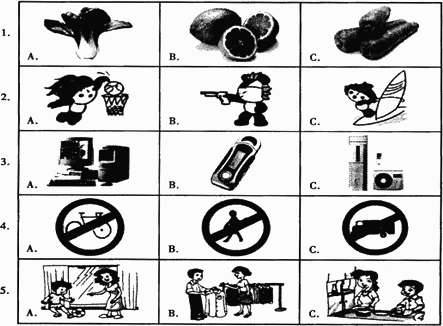
Ⅱ.听句子,选择恰当的答语。句子读一遍。(每小题1分,共5分)
6.A.It’s nine o’clock.
B.It’s Thursday.
C.It’s June 11th.
7.A.It’s hard to say.
B.You’re welcome.
C.I’d like to buy a computer.
8.A.Thank you.
B.Never mind.
C.Of course not.
9.A.That’s OK.
B.Good idea.
C.Not at all.
10.A.It’s wonderful.
B.It’s too big.
C.It’s round.
Ⅲ.听对话,选择正确的答案。对话读两遍。(每小题1分,共10分)
听第一段对话,完成第11小题。
11.What does the girl want?
A.A cup of tea.
B.A glass of water.
C.A bottle of milk.
听第二段对话,完成第12小题。
12.How did John go to school this morning?
A.By bus.
B.On foot.
C.By bike.
听第三段对话,完成第13小题。
13.Where was Betty born?
A.Canada.
B.America.
C.England.
听第四段对话,完成第14-15小题。
14.What was Peter doing at four yesterday afternoon?
A.Sleeping.
B.Watching TV.
C.Answering the phone.
15.What’s the relationship between the two speakers?
A.Mother and son.
B.Husband and wife.
C.Classmates.
听第五段对话,完成第16-17小题。
16.Where did the man go in the summer holidays?
A.To a farm.
B.To his hometown.
C.To the seaside.
17.How long did he stay there?
A.For a month.
B.For two weeks.
C.For a week.
听第六段对话,完成第18-20小题。
18.Which city is the man leaving for?
A.Moscow.
B.London.
C.New York.
19.When did the last train leave?
A.At 9∶50.
B.At 9∶55.
C.At 10∶30.
20.Where can the man buy the ticket?
A.on the train.
B.Near the bus station.
C.At the ticket window.
Ⅳ.听短文,选择最佳答案。短文读两遍。(每小题1分,共5分)
21.The two men walked in the street one evening because they ________.
A.couldn’t fall asleep
B.wanted to steal something
C.wanted to take a walk
22.It was ________ at night.
A.ten
B.eleven
C.twelve
23.Why did the dog run out of the house and bark(狗叫)?
A.It knew the two men.
B.It understood English.
C.It found someone outside.
24.What was the result?
A.The two young men stole nothing.
B.The two young men were caught.
C.The dog followed the two young men to a lonely place.
25.Which if the following is TRUE?
A.The dog was asleep all the night.
B.The two thieves spoke English.
C.The two thieves were too frightened to run.
Ⅴ.听短文,完成下面表格,每空一词。短文读两遍。(每小题1分,共5分)
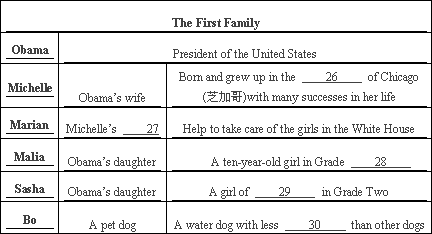
听力
一、听句子,选择与句子情景相关的图。每小题念一遍
0(每小题1分。共5分)1.

2.

3.

4.

5.

二,听句子,选择恰当的答语。每小题念一遍。
(每小题1分,共5分)6.A.Good night. B.Bye-bye. C.Nice to see you, too.
7.A.My pleasure. B.It doesn't matter. C.It's very kind of you.
8.A.I like apples. B.I'm hungry. C.Well done.
9.A.Not at all. B.Thank you. C.That's right.
10.A.I'm Ann. B.I don't agree. C.This is Ann speaking.
三、听对话,选择正确的答案。对话念两遍。(每小题1分,其10分)
听第
l段对话,完成第11小题。11.Whose ruler is this?
A.Betty's. B.Lily's. C.Lucy's.
听第2段对话。完成第12小题。
12.When will Jane go to the party?
A.Next Saturday. B.This Saturday. C.Tomorrow evening.
听第3段对话,完成第13小题。
13.What color is Mary's hair?
A.Red. B.Yellow. C.Black.
听第4段对话,完成第14小题。
14.What does Kate's father do?
A.A driver. B.A teacher. C.An office worker.
听第5段对话,完成第15至17小题。
15.What did Bruce use to do during the summer vacation?
A.Go fishing. B.Go shopping. C.Go camping.
16.Where is Bruce's house?
A.Near the lake. B.Near the sea. C.Near the river.
17.What does the woman think of Bruce?
A.Silly. B.Clever. C.Friendly.
听第6段对话,完成第18至20小题。
18.What is Sam doing?
A.Flying a kite. B.Making a kite. C.Mending a plane.
19.Who is the present for?
A.Sam's mother. B.Sam's sister. C.Sam's friend.
20.What's the relationship between the two speakers?
A.Mother and son. B.Father and daughter. C.Brother and sister.
四、听短文,选择最佳答案。短文念两遍。(每小题1分,共5分)
21.Where is Rose now?
A.In Hainan. B.In Shanghai. C.In Nanjing.
22.Which subject does Rose like best?
A.Math. B.Chinese. C.English.
23.When does Rose go to the English corner?
A.On weekends. B.On Saturday morning. C.On Tuesday afternoon.
24.How often does Rose go to the school library?
A.Every day. B.Once a week. C.Twice a week.
25.How is Rose's school life?
A.Hard. B.Busy. C.Interesting.
五、听对话。完成下面表格。每空一词。对话念两遍(每小题1分。共5分)

听力测试(30分)
Ⅰ.听句子,选择正确的图,每小题念一遍。(每小题1分,共5分)

1.________ 2._______ 3.________ 4.________ 5.________
Ⅱ.听录音,选择正确的应答句,每小题念一遍。(每小题1分,共5分)
6.A.Yes, he does.
B.Yes, he has.
C.No, he didn't.
7.A.He has gone to the library.
B.Yes, he has.
C.He has been there twice.
8.A.A capital of China.
B.In the north of China.
C.About 19,612,368
9.A.Since two years ago.
B.last year.
C.Four years ago.
10.A.We should protect the environment.
B.We should collect and reuse waste water.
C.We shouldn't use both sides of paper.
Ⅲ.听对话,选择正确的答案,对话念两遍。(每小题1分,共10分)
听第1至5段对话,完成11至15题
11.Where are they?
A.In the shop.
B.At the station.
C.In the park.
12.What makes Micheal uncomfortable?
A.Noise pollution.
B.Water pollution.
C.Light pollution.
13.How old is the man now?
A.25 years old.
B.30 years old.
C.35 years old.
14.Has the man's wife ever been to Hongkong?
A.Yes, she has.
B.No, never.
C.Next month.
15.What are they talking about?
A.Sandstorm.
B.Water pollution.
C.sand.
听第6段对话,完成16至18题
16.How many time has Peter been to the beach?
A.Twice.
B.Once.
C.Never.
17.Who is a greener person?
A.Mike.
B.Peter.
C.The woman.
18.What is the woman going to do next Sunday?
Collect the waste things on the beach.
Return dictionary to Mike.
Borrow a dictionary from Mike.
听第7段对话,完成19至20题
19.What are they talking about?
Saving water.
B.Water pollution.
C.Importance of water.
20.Is there enough water for the people in the world?
A, Yes, there is.
B.No, there isn't.
C.Yes.We have enough water.
Ⅳ.听短文,判断下面句子正(T)误(F)。短文读两遍。(每小题1分,共5分)
21.More and more land is becoming desert all the time.
22.Small green plants are not important to dry places.
23.Scientist are trying to make the desert into farmland.
24.Small green plants and grass can't prevent the wind from blowing the earth away.
25.The land can become desert easily if there are no plants.
V.听短文,完成下列表格,短文念两遍。(每小题1分,共5分)

湖北省互联网违法和不良信息举报平台 | 网上有害信息举报专区 | 电信诈骗举报专区 | 涉历史虚无主义有害信息举报专区 | 涉企侵权举报专区
违法和不良信息举报电话:027-86699610 举报邮箱:58377363@163.com