
题目列表(包括答案和解析)
Does a person from Ohio or Virginia have a better chance of living in the White House than anyone else? It seems that way. Eight out of 40 U. S. Presidents came from Ohio. Eight came from Virginia. William Henry Harrison, the ninth U. S. President, had the best chance of all. Why? He was born in Virginia and then lived in Ohio.
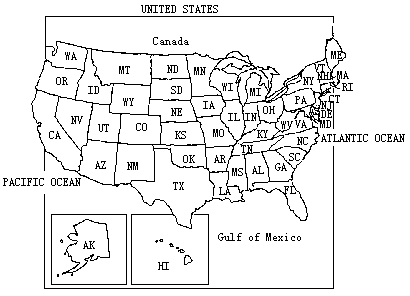
Here is a map of the United States. You will see that Virginia and Ohio are not too far away from each other. New York, Massachusetts, and California are worth noting(注意), too. They each have sent at least three of their native sons to the White House.
Maps are flat (平的) drawings of Earth or parts of it. The map on the above shows the shapes and sizes of the 50 states. Like most U. S. maps, it abbreviates(缩写) the names of the states. Use the map to answer the questions below.
1.President Lyndon Johnson came from the largest state on the Gulf of Mexico. He was from ________ .
[ ]
2.President Jimmy Carter is from Georgia. Which state is below Georgia on the map?
[ ]
3.President Harry Truman was from a state surrounded by Illinois and seven other states. He was from ________ .
[ ]
4.Which area of the United States has more states?
[ ]
5.Which of these states is closest to Canada?
[ ]
阅读理解.
I have a rule for travel: Never carry a map. I prefer to ask for directions.
Foreign visitors are often puzzled in Japan because most streets there don't have names. In Japan, people use landmarks in their directions instead of street names. For example, the Japanese will say to travelers, “Go straight dawn to the corner. Turn left at the big hotel and go past a fruit market. The post office is across from the bus stop.”
In the countryside of the American Midwest, usually there are not many landmarks. There are no mountains, so the land is very flat. In many places there are no towns or buildings within miles. Instead of landmarks, people will tell you directions and distances. In Kansas or Iowa, for example, people will say, “Go north two miles. Turn east, and then go another mile.”
People in Los Angeles, California, have no idea of distance on the map. They measure distance by means of time, not miles. “How far away is the post office?” you ask. “Oh,” they answer, “It's about five minutes from here.” You say, “Yes, but how many miles away is it?” They don't know.
People in Greece sometimes do not even try to give directions because visitors seldom understand the Greek language. Instead of giving you the direction, a Greek will often say, “Follow me.” Then he'll lead you through the streets of the city to the post office.
Sometimes a person doesn't know the answer to our question. What happens in this situation? A New Yorker might say, “Sorry, I have no idea.” But in Yucatan, Mexico, no one answers, “I don't know.” People in Yucatan think “I don't know” is impolite. They usually give an answer, often a wrong one. A visitor can get lost in Yucatan!
One thing will help you everywhere-in Japan, in the United States, in Greece, in Mexico, or in any other place. You might not understand a person's words, but maybe you can understand his body language. He or she will usually turn and then point in the correct direction. Go in that direction, and you may find the post office.
1.The passage mainly tells us that ________.
[ ]
A.there are not many landmarks in the American Midwest
B.never carry a map for travel
C.there are different ways to give directions in different parts of the world
D.New Yorkers often say, “I have no idea,” but people in Yucatan, Mexico never say this
2.The passage says, “In Japan, people use landmarks in their directions.” The word “landmark” mean ________.
[ ]
A.streets names
B.building names
C.hotels, markets and bus stops
D.buildings or places are easily recognized
3.In which place do people tell distance by means of time?
[ ]
A.Japan.
B.American Midwest.
C.Los Angeles, California.
D.Greece.
4.In the passage, ________ countries are mentioned by the writer.
[ ]
5.Which of the following is wrong?
[ ]
A.Travelers can learn about people's customs by asking questions about directions.
B.People in some places give directions in miles, but people in other places give directions by means of time.
C.A person's body language can help you understand directions.
D.People in different places always give directions in the same way:They use street names.
| |||||||||||||||||||||||||||||||||
| |||||||||||||||||||||||||||||||||||||||||||||||||||||||||||||||||||||||||
根据释义和首字母写出单词
a person from another country
f湖北省互联网违法和不良信息举报平台 | 网上有害信息举报专区 | 电信诈骗举报专区 | 涉历史虚无主义有害信息举报专区 | 涉企侵权举报专区
违法和不良信息举报电话:027-86699610 举报邮箱:58377363@163.com