
题目列表(包括答案和解析)
A group of fifteen-year-olds at Sunshine School are holding a charity sale to raise money to help their classmate Lisa. Lisa had cerebral palsy(大脑性瘫痪)when she was a baby. Although Lisa has to use a wheelchair to help her get around, she never gives up. And she is always ready to help others. 、
Lisa has the chance of standing up, but she needs an operation(手术)which will cost lots of money." Lisa's doctor said.
"I never thought that I could stand up one day. Actually the news is surprising for me. However, when I see my parents are worried about the cost of the operation, I am sad. I am used to my life. I don't mind even if I can't stand up," Lisa said, "Now ray classmates and some other kind people are helping me. I am really thankful. If I stood up one day, I would try my best to help more people."
"While helping Lisa, we can also learn a lot. We have learned how to cook cookies and how to sell them," Betty, one of Lisa's classmates said. "Now we know making money is not easy, so we won't waste money anymore."
Alex, a boy in Lisa's class, told a reporter that they could raise about $100 every day. "We have raised about $2,100 so far. We hope we will raise more money for Lisa's operation," said he.
|
Lisa is a fifteen-year-old girl with cerebra palsy. She can't stand up and has to get around in a wheelchair. If she is 1. an operation, she may be able to stand up. Bui her 2. have trouble affording the operation. Some kind people give her a hand and Lisa's 3. decided to raise money to help her by selling home-made cookies. After about three 4. they have raised about $2,100 for Lisa's operation. Lisa is very thankful. And she is very lucky because so many people are helping 5..
|
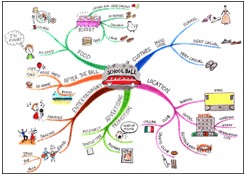
Tony Buzan’s grades were going down at university. Disappointed with his low marks, he went to the library to find a book on how to use his brain. He was directed to the medical section. Confused, he said to the librarian, “I don’t want to take my brain out, I just want to learn how to use it.” Her reply was simple: “There’s no book on that.”
“I thought to myself,” says Buzan, “if I buy a little radio, I get an instruction manual (说明书). If I buy a microwave, I get an instruction manual. But for the most important machine in the world, no instruction manual?”
Fifty years later, Buzan has become the world’s leading speaker on the brain and learning. In the late 1960s, he invented the mind map, a visual representation of thought processes.
This kind of thinking has become a popular tool for planning, organizing, problem solving, and communicating across the world. He has since authored and co-authored over 100 books that have appeared in more than 30 languages.
“I think in most cases, people use less than 1 percent of their brains,” he says.
But how do you expand this 1 percent? How do you become the best student you can be?
According to Buzan, the answer is simple. You take a section of whatever it is that you are trying to learn, he says, and you read it for its essence (精髓、要素). Then you make a mind map of all the important details. For a truly effective mind map, you start with a colored image in the center of your page. Draw the first image that comes to mind on the topic you are mind mapping. Branch off from your central image and create one of your main ideas. From your main branches draw some sub-branches and from those sub-branches you can draw even more branches. He emphasizes that you should use plenty of images and colors as these help with memory recall and encourage creativity.
By using this visual format (形式), according to Buzan, your mind will begin to make associations that will help you remember more information for longer periods of time.
Buzan believes that traditional note-taking methods, such as lists and summaries, do not stimulate the brain’s recall capacity or ability in the same way. Because of this, students will often find themselves locked away in their rooms for hours, trying hard to memorize separate details. Buzan believes that for a more effective and lasting way of studying, you must first understand how your brain works.
“Everyone is born smart,” he says. “You just have to learn how to learn.”
1.What is the main purpose of the first two paragraphs?
A.To show that Tony Buzan was worried about his study.
B.To invite us to think about the importance of manuals.
C.To prove that the mind map is a useful tool for the brain.
D.To show why Tony Buzan studies the brain and learning.
2.What does the word “stimulate” mean in the passage?
A.Excite. B.Improve. C.Encourage. D.Affect.
3.What can we infer from the passage?
A.If we learn the mind map, we will become the best student.
B.The mind map will help your brain connect separate details.
C.The mind map will be more effective if we put more details in it.
D.We will solve the problem if we make connections between ideas.
4.What is the best title for the passage?
A.How to make the mind map?
B.Is the mind map widely used?
C.Can your memory be mapped?
D.Is the mind map helpful in thinking?
根据短文内容及首字母提示, 补全空格内单词, 使短文完整、通顺。
Reading is an activity that people enjoy a lot in their free time.
Some like reading newspapers and o___1___ enjoy novels or comic(喜剧的)books. My f___2___ books are those about the lives of great people. Reading them always gives me a lot of ideas on how to make my o___3___ life better.
Great people are remembered not because they were handsome or beautiful, but because they did not give up w___4___ their lives were difficult. They tried to use e___5___ chance to change their lives and make the world better.
One good example is Orville and Wilbur Wright, the two brothers who invented the airplane. The plane has m___6____ the world a small village. Hard work, not good luck, is the r___7___ why the Wright Brothers could invent this convenient(方便的)machine and become great people. Today we will remember them when we see planes f___8____ in the sky.
Whenever I read s___9___ about great people, I always learn a lot from them and they encourage me to march on.
This is w___10__ I enjoy reading about great people’s lives.
| A.to get a good education | B.to buy some books |
| C.to make friends | D.to meet different teachers |
| A.try to remember more knowledge and formulas |
| B.try to remember what the teacher teach |
| C.try to learn how to read and how to think |
| D.try to read a lot of books |
| A.get knowledge | B.use his head well |
| C.teach everything | D.learn more knowledge from his teacher |
| A.School education is not important for a person |
| B.A student should learn how to study |
| C.A student can learn everything from school |
| D.A good teacher can teach everything. |
Who are the top students in the world, do you know? Last week the Organization for Economic Co-operation Development (经济合作与发展组织) picked the best students in the world. They are Finnish (芬兰的). The OECD gave a test to 280 000 15-year-old students from more than 40 countries and regions (地区) last year. The OECD wanted to know how well students were doing at school.
Finnish students were No. 1 in the reading test and second in maths after Hong Kong students. Those from Japan and Finland were top in science. In the problem solving, Finnish students came second to those from South Korea. The test also showed Finland had more top students than the other countries.
Finns (芬兰人) of your age have done a really good job but don't have a sense of envy. You can learn from them. Most Finnish students make good use of the Internet. Of course not for computer games, but for doing more exercises and finding out more information.
Libraries are also important. Finland spends a lot of money on them. Many students have a free card. They read for at least one or two hours a day.
What do you usually do on the Internet? How often do you go to libraries?
1.Students from which country or region did best in the reading test?
|
A.South Korea. |
B.Hong Kong. |
C.Finland. |
D.Japan. |
2.Which of the following is NOT true?
|
A.Hong Kong students were No. 1 in maths. |
|
B.Finnish students were the first of all the tests. |
|
C.Finnish students did well in the problem solving. |
|
D.Japanese students were top in science. |
3.From this passage we know that_________.
|
A.the test can make the students lose their interest in learning |
|
B.the test is designed to find out good ways to use the Internet |
|
C.it's hard to tell who the best students in the world are |
|
D.Finnish students make better use of the Internet and libraries |
湖北省互联网违法和不良信息举报平台 | 网上有害信息举报专区 | 电信诈骗举报专区 | 涉历史虚无主义有害信息举报专区 | 涉企侵权举报专区
违法和不良信息举报电话:027-86699610 举报邮箱:58377363@163.com