
题目列表(包括答案和解析)
It is common to believe that learning just takes place in school, but much of human learning happens outside the classroom, even from birth and people continue to learn throughout their lives.
Even before they enter school, young children learn to walk, to talk, and to use their hands to use toys, food, and other objects. They use all of their senses to learn about the sights, sounds, tastes, and smells in their environments. They learn how to communicate with their parents, grandparents, siblings, friends, and other people important to their world. When they enter school, children learn subjects like reading, writing, and maths. They also continue to learn a lot outside the classroom. They learn which behaviors are likely to be rewarded and which are likely to be punished. They learn social skills for communicating with other children. After they finish school, people must learn to deal with many changes that affect their lives, such as getting married, raising children, and finding and keeping a job.
Because learning continues throughout our lives and influences almost everything we do, the study of learning is important in many different fields. Teachers need to understand the best ways to educate children. Scientists, social workers and other human service workers need to understand how certain experiences change people’s behaviors.
Learning is closely related (相关的) to memory, which is the storage(储存) of information in the brain (大脑). Scientists who study memory are interested in how the brain stores knowledge, where this storage takes place, and how the brain later offers knowledge when we need it. However, scientists who study learning are more interested in behavior and how behavior changes as a result of a person’s experiences. ?
【小题1】The underlined word “siblings” in Paragraph 2 probably means _________.
| A.teachers | B.classmates | C.doctors | D.brothers or sisters |
| A.After they go into society. | B.Before they enter school. |
| C.When they are at school. | D.Before they are born. |
| A.As a matter of fact, learning begins at a person’s birth and last the whole life. |
| B.Teachers need to understand the best ways to educate their students. |
| C.People need to understand how certain experiences change their behaviors. |
| D.Social workers need to study how experiences affect people’s thoughts. |
根据下列句子及所给单词的首字母,在答题纸上按题号写出各单词的完全形式(每空限填一词)。
1.Don’t be afraid to make m_________ when you speak English.
2.Haven’t you r___________ my e-mail? I e-mailed it two hours ago.
3.Mr Lin is poor in money, but he is r_________ in knowledge. I like talking with him.
4.I don’t like fried food at all. Please bring me rice and vegetables i_______.
5.School year always begins in S___________ after a long summer holiday.
6.He stayed up p_______ games on computer last night, which made him feel sleepy in class.
7.I think it n__________ for the teenagers to do exercise every day.
8.It’s not safe to cross the road when the traffic lights are r________.
9.The E________ China International Cartoon and Animation Industrial Exhibition (动漫节) was held in Hangzhou on April 28th, 2012.
10.A piece of chewing gum stuck to my shoe. It couldn’t be taken away e__________.
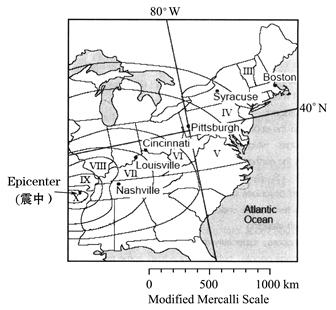
Earthquake Intensity & Observed Effects(强度与现象)
I. Felt by only a few people under very special conditions.
II. Felt by only a few people at rest, especially on the upper floors of buildings.
III. Felt noticeably indoors, especially on upper floors of buildings.
IV. Felt indoors by many people, outdoors by a few; some awaked.
V. Felt by nearly everyone; many awaked; dishes and windows break; plaster (灰泥) cracks (开裂).
VI. Felt by everyone; many frightened and run outdoors; heavy furniture such as tables and shelves moves.
VII. Everyone runs outdoors; small to moderate (中等的) damage(损毁) in usual buildings.
VIII. Considerable (相当大的) damage in usual buildings; monuments(碑) fall.
IX. Considerable damage in all buildings; ground cracks; underground pipes (管道) break.
X. Most buildings damaged; rails bend(弯曲); landslides (山崩) take place; water splashes(溅落) over banks.
XI. Few buildings left standing; bridges damaged; wide cracks in the ground; underground pipes break.
XII. Damage total; waves seen on ground; objects thrown into air.
【小题1】According to the picture, what is the possible position of the earthquake’s epicenter?
| A.36°N, 90°W. | B.36°N, 90°E. | C.90°N, 36°W. | D.90°N, 36°E. |
| A.Everyone runs outdoors. |
| B.Only a few people feel it. |
| C.Many people who stay indoors feel it. |
| D.Felt by people on the upper floors of buildings. |
| A.Cincinnati. | B.Louisville. | C.Pittsburgh. | D.Nashville. |
| A.Felt indoors by few people under very special conditions. |
| B.Few buildings left standing. |
| C.Felt noticeably indoors, especially on upper floors of buildings. |
| D.Felt indoors by many people, outdoors by a few, some awaked. |
| A.Nashville. | B.Louisville. | C.Syracuse. | D.Cincinnati. |
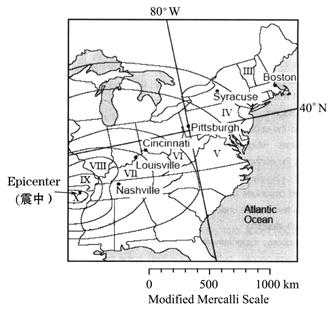
Earthquake Intensity & Observed Effects(强度与现象)
I. Felt by only a few people under very special conditions.
II. Felt by only a few people at rest, especially on the upper floors of buildings.
III. Felt noticeably indoors, especially on upper floors of buildings.
IV. Felt indoors by many people, outdoors by a few; some awaked.
V. Felt by nearly everyone; many awaked; dishes and windows break; plaster (灰泥) cracks (开裂).
VI. Felt by everyone; many frightened and run outdoors; heavy furniture such as tables and shelves moves.
VII. Everyone runs outdoors; small to moderate (中等的) damage(损毁) in usual buildings.
VIII. Considerable (相当大的) damage in usual buildings; monuments(碑) fall.
IX. Considerable damage in all buildings; ground cracks; underground pipes (管道) break.
X. Most buildings damaged; rails bend(弯曲); landslides (山崩) take place; water splashes(溅落) over banks.
XI. Few buildings left standing; bridges damaged; wide cracks in the ground; underground pipes break.
XII. Damage total; waves seen on ground; objects thrown into air.
1.According to the picture, what is the possible position of the earthquake’s epicenter?
A. 36°N, 90°W. B. 36°N, 90°E. C. 90°N, 36°W. D.90°N, 36°E.
2.What is the effects of earthquake intensity IV?
A. Everyone runs outdoors.
B. Only a few people feel it.
C. Many people who stay indoors feel it.
D. Felt by people on the upper floors of buildings.
3.According to the picture, which city would have announced the report: “Nearly everyone felt the earthquake, and many people were awaked. Dishes and windows were broken”?
A. Cincinnati. B. Louisville. C. Pittsburgh. D. Nashville.
4.Which statement best describes the earthquake intensity at Boston?
A. Felt indoors by few people under very special conditions.
B. Few buildings left standing.
C. Felt noticeably indoors, especially on upper floors of buildings.
D. Felt indoors by many people, outdoors by a few, some awaked.
5.For which city was the description of an earthquake “Heavy furniture moved, everyone felt it, and many were frightened and ran outdoors” reported?
A. Nashville. B. Louisville. C. Syracuse. D. Cincinnati.
In Britain, people have different attitudes(态度)to the police. Most people generally 1 them and the job they do, but some people said that the police shouldn’t have special 2 .
What does a policeman actually do? It is not a(n) 3 job to describe. After all,a policeman has a number of jobs to do. A policeman often has to 4 traffic, either on foot in the centre of a town, or in a police car on the roads. Indeed,in Britain, he might be in the Traffic Police and spend a lot of time 5 up and down main roads. A traffic policeman has to help keep the traffic moving,stop speeding cars and help when there is a(n) 6 .
A policeman has to help keep the 7 ,too. If there is a fight, we 8 the police to come immediately. And they often have to deal with situation at great risk of their own 9 .
We want the police to solve crimes,of course,so an ordinary(普通) policeman, 10 he is not a detective,he will often have to help 11 criminals. And 12 do we call when there is an emergency—an air crash,a fire or an earthquake?Of course the police. So a policeman has to 13 to face any terrible emergency that may happen in the modern world.
The police do a 14 job,they do it so well that I support them. But I do not envy policemen. I do not think that I could 15 do the job of a policeman.
1. A.dislike B.protect C.admire D.suspect
2. A.power B.thoughts C.knowledge D.abilities
3. A.funny B.difficult C.attractive D.easy
4. A.control B.stop C.remove D.break
5. A.walking B.driving C.marching D.searching
6. A.murder B.robbery C.accident D.theft
7. A.peace B.balance C.situation D.rule
8. A.order B.encourage C.allow D.expect
9. A.family B.safety C.future D.work
10. A.only if B.as C.since D.even if
11. A.interview B.notice C.arrest D.warn
12. A.how B.where C.what D.who
13. A.hope B.promise C.prepare D.decide
14. A.comfortable B.hopeless C.necessary D.meaningless
15. A.hardly B.ever C.forever D.never
湖北省互联网违法和不良信息举报平台 | 网上有害信息举报专区 | 电信诈骗举报专区 | 涉历史虚无主义有害信息举报专区 | 涉企侵权举报专区
违法和不良信息举报电话:027-86699610 举报邮箱:58377363@163.com