
题目列表(包括答案和解析)
补全对话(共5分)
从方框内选择恰当的句子完成下面的对话。(共5分,每小题1分)
|
A. A table for two? B. What can I do for you? C. My I take your order now? D. Excuse me. Could we have some coffee, please? E. This way, please. F. Anything else? G. What would you like to drink? |
Waiter: Good morning, madam.
Gina: Good morning.
Waiter: 1._____________
Gina: Yes. Can we have table by the window?
Waiter: OK. 2. _____________
( At the table )
Waiter: Here's the menu. 3.__________
Gina: Yes. We'd like chicken with potatoes, beef with onions and some rice.
Waiter: 4.__________
Gina: Orange juice.
Waiter: 5.________
Gina: No, that's all. Thank you.
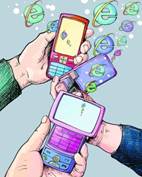
It's the end of class. When the bell rings, students of Luohu Foreign Languages School in Shenzhen quickly take out their cell phones. They want to log on* to their micro blogs to check the interesting things that have happened in the last hour.
Since last year, the trend* of micro blogging has swept the country. Recent surveys shows that most students in middle schools have a micro blog and some even update* their blogs over five times per day.
"We learn many fresh and interesting things on micro blogs and they have become popular topics in class," said Andy Liang, 14. "If you do not know about them, you are out of the loop."
It is also a great place for students to let out stress. "My parents always ask me to study all the time, and encourage me before exams, but it really adds pressure," said Simon Zhang, 15. "When I share these feelings on my micro blog, I get many replies from friends in the same situation, which makes me feel better."
But parents are worried that micro blogging could be a waste of time. Some misleading messages may even cause danger to kids, they said.
Mr. Shen, a professor at the China Education Association, suggests parents not worry too much as long as kids are not crazy about micro blogging. Maybe it can become a window for parents to understand their children. "If parents can read their children's micro blogs, they'll know their thoughts, thus leading to better communication and solutions to problems," he said. He also gives some tips for kids.
---Don't micro blog for more than one hour a day.
---Never micro blog in class.
---Try to talk face to face with people from time to time.
---Be critical*. Don't trust all the messages on a micro blog.
【小题1】The underlined part "out of the loop" in the passage probably means .
| A.not popular | B.not excited | C.unhealthy | D.unlucky |
| A.feel sad | B.let out stress | C.add pressure | D.make friends |
| A.make kids crazy while logging on to it |
| B.bring a lot of misleading messages |
| C.become a window to understand young kids |
| D.lead to worse communication |
| A.It's good for kids to micro blog for more than one hour a day. |
| B.Kids should trust all the messages on a micro blog because they are useful. |
| C.The trend of micro blogging has swept the country since five years ago. |
| D.Kids should try to talk face to face with people, not just micro blogging. |
阅读理解
Ask three people to look out the same window at a busy street corner and tell you what they see. Chances are you will receive three different answers. Each person sees the same scene(场景), but each perceives(察觉)something different about it.
Perceiving goes on in our minds. Of the three people who look out the window, one may say that he sees a policeman giving a motorist a ticket(罚单). Another may say that he sees a rush-hour traffic jam at the intersection. The third may tell you that he sees a woman trying to cross the street with four children in tow(拉着). For perception(感知) is the mind’s interpretation of what the senses—in this case our eyes—tell us.
Many psychologists(心理学家) today are working to try to determine just how a person experiences or perceives the world around him. Using a scientific approach, these psychologists set up experiments in which they can control all of the factors. By measuring and charting the results of many experiments, they are trying to find out what makes different people perceive totally different things about the same scene.
1.Perceiving is an action that takes place _____.
|
A.in our eyes |
|
B.only when we think very hard about something |
|
C.only under the direction of a psychologist |
|
D.in every person’s mind |
2. People perceive different things about the same scene because ____.
|
A.they see different things. |
|
B.they can not agree about things |
|
C.some have better eyesight |
|
D.none of these |
3. Psychologists study perception by _____.
|
A.setting up many experiments. |
|
B.asking each other what they see. |
|
C.looking out of windows. |
|
D.Studying people’s eyes. |
4. The best title for this article is _____.
|
A.How We See |
|
B.Learning About Our Minds Through Science |
|
C.What Psychologists Perceive |
|
D.How To Become An Experimental Psychologist |
Today is Tom’s birthday. After school he walks past the shop on the street corner. He looks at the window. That pair of trainers is still there. He really wants to have them very much.
He was very sad and walks away. He knows his mother can give him anything he likes if she can. But he also knows she has no money and the trainers are too expensive. He doesn’t go home at once because his mother could notice (注意) his worry. So he goes to the park and sits on the grass. Then he sees a boy in a wheel chair (轮椅) . He finds that the boy moves the wheel with his hands. Tom looks at him carefully and is surprised to see that the boy has no feet. He looks at his own feet. “It’s much better to be without shoes than without feet.” he thinks. There is no reason (理由) for him to feel so sorry and sad. He smiles and thinks he is happier.
1.Tom passed the shop__________.
A.on foot B.by bus C.by bike D.in a car
2.Tom wants to buy a pair of trainers and the trainers are___________.
A.too expensive B.quite cheap
C.not there D.not fit him
3.Tom goes into the park because he___________.
A.wants to watch someone fishing there
B.wants to see the boy
C.doesn’t want his mother to notice his worry
D.wants to sit on the grass
4.From the story we can know that Tom______.
A.asks his mother to buy the trains at last
B.doesn’t want to buy the new trainers
C.didn’t want to go to school
D.didn’t want to stay at home
First Frenchman: I once heard someone shout, “Look out,” I put my head out of a window and a basin (盆) of water fell on me. It seems that “Look out” may mean “don’t look out.”
Second Frenchman: Once I was on a ship and heard the captain (船长) shout, “All hands on deck,” I put my hands on the deck and someone walked on them.
Third Frenchman: I once visited an English friend early in the morning and the maid who came to the door and said, “He’s not up yet. Come back in half an hour,” When I went again for him, she said, “He’s not down yet.”
“If he’s not up and he’s not down, where is he?” I asked.
She said, “He’s still in bed. When I say ‘He’s not up ’ I mean ‘he has not yet got up’. When I say‘He’s not down ’I mean ‘he has not yet come downstairs.”
【小题1】“Look out”here means “ _______”.
| A.put your head out of the window and look |
| B.Take care |
| C.I’m going to pour the water |
| D.Help me |
| A.All the sailors gather ( 集合 )on deck |
| B.Give your hands to me |
| C.Put your right hand and left hand on deck |
| D.Shake your hands with me |
| A.was washing his face |
| B.was having his breakfast |
| C.was still in an upstairs room |
| D.was reading a newspaper |
湖北省互联网违法和不良信息举报平台 | 网上有害信息举报专区 | 电信诈骗举报专区 | 涉历史虚无主义有害信息举报专区 | 涉企侵权举报专区
违法和不良信息举报电话:027-86699610 举报邮箱:58377363@163.com