
题目列表(包括答案和解析)
以My ideal school为题,写一篇英语短文,词数在80左右。要点如下:
1. 8点半上课,这样我可以多睡一会。下午3点半放学,我可以有更多的时间做课外活动。
2.教室宽敞明亮,老师和蔼善良,同学友好互助。
3.每天只有半个小时的作业,可以有足够的时间留给我的业余爱好。
4.每周有3节体育课,篮球是我最喜欢的运动。
5.学校一边有个公园,另一边有个大超市,周末可以去公园玩,去超市购物。
6.学校每个月进行一次去大城市的旅行。
_______________________________________________________________________________
_______________________________________________________________________________
_______________________________________________________________________________
_______________________________________________________________________________
_______________________________________________________________________________
_______________________________________________________________________________
_______________________________________________________________________________
_______________________________________________________________________________
_______________________________________________________________________________
| A.knew a lot about it | B.wanted to be a great runner |
| C.practiced running every day | D.never thought running so tired |
| A.had to stop to drink water | B.was worried she wasn’t ready |
| C.run slower than anyone else | D.could find no coach to help her |
| A.brought good results | B.coat a lot | C.saved much time | D.came to fail |
| A.got angry with her friend | B.wasn't pleased with herself |
| C.was a person with a strong mind | D.had no Interest In running |
When visiting Beijing, the Palace Museum is a must-see for many people.
Last year, the museum received 14.2 million visitors, which is twice the number of visitors in 2002. This year it is expected to increase by 10 percent. Compared with other popular museums around the world, the number of visitors at the Palace Museum is very high. Last year the Louvre(罗浮宫) in Paris welcomed 8.8 million visitors and the British Museum in London received 5.8 million.
A large number of visitors can bring a lot of money from ticket sales. But there are also worries that people will do demage(破坏) to relics(文物) and old buildings.
To solve the problem, some people suggested taking cultural objects out of the Palace Museum. In this way, visitors coming for ancient buildings and cultural objects will go to different places. “It is a sign of progress. Letting more people see these treasures is more important than keeping them in their original(原始的) place,” said Song Xiangguang, a professor at Peking University.
However, Shan Jixiang, director of the Palace Museum, doesn’t agree on this idea. He thinks that the most important thing in protecting the Palace Museum is to keep it complete. “The 1.8 million cultural relics and the historical buildings are two key parts of the museum. They can’t be separated.” he said.
Shan said that they are planning to increase the space that is open to the public. This will not only feed visitors’ curiosity(好奇), but also spread them out so they are not putting too much pressure on one area.
Shan also wanted to set up an appointment system. “ If visitors make an appointment before they come, we can make better and different visiting routes(路线) for them.” Shan said.

1.How many visitors did the Palace Museum welcome in 2002?
A.14.2 million B.8.8 million C.5.8 million D.7.1 million
2.Why did some people suggest taking cultural objects out of the Palace Museum?
A.To let more people see the relics. B.To bring less damage to the relics.
C.To make more money from ticket sales. D.To keep the Palace Museum original.
3.The underlined word “separated” means ______ in Chinese.
A.分离 B.破坏 C.偷窃 D.压迫
4.By reading the article, we can know that______________.
A.the Palace Museum has an appointment system now.
B.relics are the only important part of the Palace Museum.
C.the Louvre welcomed the most visitors in the world last year.
D.Shan thought that more areas of the palace should be open to public.
In the summer of 1978 an English man named Steven was driving his tractor through a field of wheat when he discovered something strange. Some of his wheat was lying on the ground. The flattened wheat formed(形成)a circle about six meters across . Around this circle were four smaller circles of flattened wheat.
Three years later a farmer who lived nearby discovered almost the same circles in one of his fields. These circles were larger—nearly 15 meters across . That same year , another English farmer discovered three circles of flattened wheat on his land—one large circle between two small circles. During the following years, farmers in England found circles in their fields more and more often.
The circles are called “crop circles” because they usually appear in fields of wheat or corn. The wheat in the circles lies on the ground but is never broken; it keeps on growing, and the farmers can later harvest it. Farmers always discover the crop circles in the morning, so the circles probably form at night. They appear only in the months from May to September. What causes the crop circles?
At first, people thought that some kids were making them as a joke, or that farmers were making them to attract tourists.(In fact, in 1991, two men said they made the circles themselves, but many scientists don’t believe them.) People tried to copy them: They tried to make circles exactly like the ones the farmers had found. They couldn’t do it. They couldn’t enter a field of wheat without leaving tracks, and they couldn’t flatten the wheat without breaking it.
Several times people reported seeing stranger objects near the fields where crop circles later appeared. Many people believe that these crop circles are the messages sent by living things from outer space(外层空间)or the marks left by their spaceships.
Scientists who have studied the crop circles try to find out what causes them. In the summer of 1990 some scientists spent three weeks in the part of England where many circles have appeared. They had all the latest high-tech equipment(最新高科技设备). The equipment—worth 1.8 million dollars—got nothing. But one night, as the scientists were watching a field, crop circles formed in the field behind them, which were quite different from the others. The scientists had neither seen nor heard anything.
When Steven discovered the crop circles on his land in 1978, he said, “It was just like something that had landed in the field from the air and gone back up again. I don’t know what to make of these things.”
Crop circles have appeared in England, Japan, the United States and Russia. Experts from all over the world have studied them, and they say what Steven said: They don’t know what to make of these things.
【小题1】Which picture is probably the one formed in the field behind the scientists?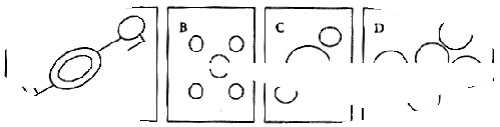
【小题2】“Flattened wheat” means ___________.
| A.broken wheat | B.lying wheat | C.harvested wheat | D.growing wheat |
| A.that is done by living things from outer space |
| B.that cannot be solved but found all around the world |
| C.that cannot be made clear or understood |
| D.that is discovered and copied by the farmers |
When visiting Beijing, the Palace Museum is a must-see for many people.
Last year, the museum received 14.2 million visitors, which is twice the number of visitors in 2002. This year it is expected to increase by 10 percent. Compared with other popular museums around the world, the number of visitors at the Palace Museum is very high. Last year the Louvre(罗浮宫) in Paris welcomed 8.8 million visitors and the British Museum in London received 5.8 million.
A large number of visitors can bring a lot of money from ticket sales. But there are also worries that people will do demage(破坏) to relics(文物) and old buildings.
To solve the problem, some people suggested taking cultural objects out of the Palace Museum. In this way, visitors coming for ancient buildings and cultural objects will go to different places. “It is a sign of progress. Letting more people see these treasures is more important than keeping them in their original(原始的) place,” said Song Xiangguang, a professor at Peking University.
However, Shan Jixiang, director of the Palace Museum, doesn’t agree on this idea. He thinks that the most important thing in protecting the Palace Museum is to keep it complete. “The 1.8 million cultural relics and the historical buildings are two key parts of the museum. They can’t be separated.” he said.
Shan said that they are planning to increase the space that is open to the public. This will not only feed visitors’ curiosity(好奇), but also spread them out so they are not putting too much pressure on one area.
Shan also wanted to set up an appointment system. “ If visitors make an appointment before they come, we can make better and different visiting routes(路线) for them.” Shan said.
【小题1】How many visitors did the Palace Museum welcome in 2002?
| A.14.2 million | B.8.8 million | C.5.8 million | D.7.1 million |
| A.To let more people see the relics. | B.To bring less damage to the relics. |
| C.To make more money from ticket sales. | D.To keep the Palace Museum original. |
| A.分离 | B.破坏 | C.偷窃 | D.压迫 |
| A.the Palace Museum has an appointment system now. |
| B.relics are the only important part of the Palace Museum. |
| C.the Louvre welcomed the most visitors in the world last year. |
| D.Shan thought that more areas of the palace should be open to public. |
湖北省互联网违法和不良信息举报平台 | 网上有害信息举报专区 | 电信诈骗举报专区 | 涉历史虚无主义有害信息举报专区 | 涉企侵权举报专区
违法和不良信息举报电话:027-86699610 举报邮箱:58377363@163.com