
题目列表(包括答案和解析)
Children can spend hours a day looking at computer screens and other digital devices. Some eye doctors say this leads to an increase in “computer vision syndrome(电脑视力综合症).”
Nathan Bonilla-Warford is an optometrist(验光师)in Tampa, Florida. He has seen an increase in problems in children. “A lot more children come into the office either because their parents have noticed that they have headaches or red or watery eyes or discomfort, or because their nearsightedness appears to be increasing and they’re worried,” he says.
Dr. Bonilla-Warford says part of the problem is that children may be more likely to pay no attention to early warning signs than adults. “Even if their eyes start to feel uncomfortable or they start to get a headache, they’re less likely to tell their parents, because they don’t want to have the game or the computer or whatever taken away,” he explains.
He says another part of the problem is that people blink(眨眼)less often when they use digital devices. He says, “A person who uses an electronic device blinks about one third as much as we normally do in everyday life. And so that can result in the front part of the eye drying and not staying protected like normal.”[来源:Z.xx.k.Com]
Eye doctors offer suggestions like following which is known as the 20/20/20 rule. That means every twenty minutes look away twenty feet or more for at least twenty seconds from whatever device you’re using.
Other suggestions include putting more distance between you and the device and using good lighting. Of course, another way is to spend less time looking at screens. Many experts say children should spend no more than two hours a day using digital devices—with no screen time for children under two.
But not all eye doctors have noticed an increase in problems in children. Dr. David Hunter, from Children’s Hospital Boston, has not seen an increase in his practice. “While it is possible to develop fatigue looking at screens for a long period of time, there’s certainly no proof that it actually causes any damage(伤害)to the eyes.” he says.
1.Which of the following is true according to the passage?
|
A.Dr. Bonilla-Warford thinks using computers causes nearsightedness. |
|
B.People keep their eyes protected against drying by blinking normally. |
|
C.Children under two can watch TV for less than two hours a day. |
|
D.Dr. David Hunter says headache causes an increase in eye problems. |
2.What does the underlined word “fatigue” mean?
|
A.Interest |
B.Ability |
C.Tiredness. |
D.Difficulty. |
3.What can be the best title for the passage?
|
A.Looking at Screen: Two Hours or More |
|
B.How Can Children Use Their Eyes Properly |
|
C.Using Digital Devices: Advantages and Disadvantages |
|
D.How Much Screen Time Is Too Much for Children |
| |||||||||||||||||||||||||||||||||||||||||||||
In fall 2006,the National Basketball Association (NBA)started using basketballs made with synthetic ,or man-made ,material instead of leather(皮革).They made the change be- cause they wanted every basketball they use to feel and bounce(弹起)the same.Not all leather balls are exactly alike in weight or how they bounce,but the synthetic balls are.
However,some players complained right away that the new balls bounced differently and were actually harder to control than the leather ones.
Physics helped answer questions about why the new balls felt different.For example,the scientists studied friction(摩擦力),which in this case affects the ability of a player to hold onto a ball."The greater the friction,the better it will stick to his hand,"explains a scientist.
Tests on both wet and dry balls showed that while the synthetic ball was easier to hold onto when dry,it had less friction and became much harder to hold onto when wet.That's because sweat(汗水) stays on the surface of the synthetic balls but gets taken into the leather balls.
The scientists also tested bounce and found that the logo (商标)printed on the new balls made their surface uneven(不平) and caused them to bounce a little strangely com- pared with the leather balls.
In January,the NBA went back to using the leather bails.They aren't perfect,but for now,that's just the way the ball bounces.
1.Why were the synthetic balls expected to be used in NBA according to the text?
A.Because they are easier to control. B.Because they waste less material.
C.Because they look exactly alike. D.Because they feel and bounce alike.
2.The ball is easier to hold on to_________
A.when friction is greater B.when friction is less
C.when it is heavier D.when it bounces strangely
3.The synthetic ball bounces differently from the leather one mainly because _________
A.it is wet B.it is dry
C.there's a logo on it D.its weight remains the same
4.It can be inferred(推断) from the text that _________.
A.a synthetic ball takes in water faster than a leather ball
B.a leather ball is more difficult to make than a synthetic one
C.a synthetic ball is more expensive than a leather ball
D.a leather ball may increase its weight during a game
5.The underlined word" They" in the last paragraph refers to __________.
A.the synthetic balls B.the leather balls
C.the ball players D.the scientists
Since the 1970s, scientists have been searching for ways to link the brain with computers. Braincomputer interface (BCI) technology could help people with disabilities send commands to machines.
Recently, two researchers, Jose Millan and Michele Tavella from the Federal Polytechnic School in Lausanne, Switzerland, demonstrated (展示) a small robotic wheelchair directed by a person’s thoughts.
In the laboratory, Tavella operated the wheelchair just by thinking about moving his left or right hand. He could even talk as he watched the vehicle and guided it with his thoughts.
“Our brain has billions of nerve cells. These send signals through the spinal cord (脊髓) to the muscles to give us the ability to move. But spinal cord injuries or other conditions can prevent these weak electrical signals from reaching the muscles.’ Tavella says. “Our system allows disabled people to communicate with external world and also to control devices.”
The researchers designed a special cap for the user. This head cover picks up the signals from the scalp (头皮) and sends them to a computer. The computer interprets the signals and commands the motorized wheelchair. The wheelchair also has two cameras that identify objects in its path. They help the computer react to commands from the brain.
Prof. Millan, the team leader, says scientists keep improving the computer software that interprets brain signals and turns them into simple commands. “The practical possibilities that BCI technology offers to disabled people can be grouped in two categories: communication, and controlling devices. One example is this wheelchair.”
He says his team has set two goals. One is testing with real patients, so as to prove that this is a technology they can benefit from. And the other is to guarantee that they can use the technology over long periods of time.
41. BCI is a technology that can ________.
A. help to update computer systems B. link the human brain with computers
C. help the disabled to recover D. control a person's thoughts
42. How did Tavella operate the wheelchair in the laboratory?
A. By controlling his muscles. B. By talking to the machine.
C. By moving his hand. D. By using his mind.
43. Which of the following shows the path of the signals described in Paragraph 5?
A. scalp→computer→cap→wheelchair B. computer→cap→scalp→wheelchair
C. scalp→cap→computer→wheelchair D. cap→computer→scalp→wheelchair
44. The team will test with real patients to ________.
A. make profits from them B. prove the technology useful to them
C. make them live longer D. learn about their physical condition
45. Which of the following would be the best title for the text?
A. Switzerland, the BCI Research Center
B. New Findings about How the Human Brain Works
C. BCI Could Mean More Freedom for the Disabled
D. Robotic Vehicles Could Help to Cure Brain Injuries
Eating Chocolate Can Make You Smarter
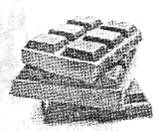
Chocolate lovers know that eating chocolate makes them happy.Now it turns out that eating chocolate may also make them smarter.
Dr.Bryan Raudenbush recently made a study to see how eating chocolate affects people’s brains.The U.S.researcher knew that chocolate contained several stimulants(兴奋剂).But he wasn’t sure how those stimulants actually affected chocolate eaters.
To find out,Raudenbush had a group of volunteers eat 85grams of milk chocolate.He asked another group to eat no chocolate at all.After l 5 minutes,he tested their memory and their ability to solve problems.
The group that ate milk chocolate had higher scores.They were able to remember more words and pictures than the group that did not eat chocolate.Raudenbush concluded(得出结论) that the stimulants in chocolate increased mental(精神的)alertness(灵敏度).
Of course,eating chocolate doesn’t guarantee(保证)you’ll pass every test.You’ll still need to study hard!
1.Many people like eating chocolate because it can make them .
A.annoyed B.unhappy C.pleased D.funny
2.The American researcher knew that .
A.chocolate was a kind of stimulant
B.there were some stimulants in chocolate
C.chocolate contained many objects in it but not stimulants
D.many people loved to eat it because of its stimulants
3.Why did Raudenbush ask a group of volunteers to eat chocolate?
A.Because he thought it was exciting.
B.Because he wasn’t sure how many people eat chocolate.
C.Because his American friend asked him to do so.
D.Because he wanted to know how stimulants affected the eaters of chocolate.
4.The result of the test is that .
A.the stimulants in chocolate increased mental alertness.
B.the group that ate chocolate had higher scores than the group that didn't eat
C.one group ate chocolate but another didn’t eat it.
D.Nothing happened to the groups.
5.If you want to pass every exam, .
A.you will just eat enough chocolate
B.you will ask the expert to have a chocolate test
C.you will still need to study hard
D.you needn’t go to school
湖北省互联网违法和不良信息举报平台 | 网上有害信息举报专区 | 电信诈骗举报专区 | 涉历史虚无主义有害信息举报专区 | 涉企侵权举报专区
违法和不良信息举报电话:027-86699610 举报邮箱:58377363@163.com