Act out their dialogues . SB Page 19 , 1b .Listening 查看更多


题目列表(包括答案和解析)

阅读理解,阅读下列内容,从每小题所给的A、B、C、D四个选项中选出一个最佳答案。

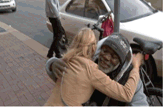
  On February 9th, 2013, Sarah Darling was walking along the street when she met a homeless man named Billy Ray Harris.She reached into her change purse, emptied out all the coins she had and gave them to the homeless man.Neither of them realized that this small generous act would change their lives.

  Sarah didn't realize that she had given Billy not only all her change but also her diamond ring that she had put in her change purse earlier until the following morning.She and her husband, Bill Krejci, rushed to see if they could find Billy.The homeless man was not only in the same place, he also immediately returned the ring.The grateful couple paid him back for his honesty by emptying out their pockets of all the money they had.

  Bill Krejci, a web designer, felt that he needed to do something more for this amazingly honest man.So on February 18th, he set up a special page to raise money for him.In just four days, Billy received over $85, 000 and there seems to be no end yet.

  That is not enough.Billy is living with a person who is generous instead of living in the streets.And that's not all-Thanks to the news report, he got together again with his older brother, Edwin Harris who he had been unable to find for 27 years.

  All the good luck is just because Billy did the right thing-returning something that did not belong to him.

(1)

When did Sarah realize that she had also given Billy her diamond ring?

[  ]

A.

On February 9th, 2013

B.

On February 10th, 2013

C.

On February 18th, 2013

D.

On February 22nd 2013

(2)

Which of the following is NOT mentioned in the passage?

[  ]

A.

Billy is living with a generous person.

B.

Billy has found his brother.

C.

Billy bought a diamond ring.

D.

Billy appeared in the news report

(3)

The underlined word “That” in Paragraph 4 refers to(指代)“ ________ ”.

[  ]

A.

returning the ring

B.

setting up a page

C.

living in the streets

D.

receiving money

(4)

What's the best title of the passage?

[  ]

A.

Generous Woman Changed Her Own Life

B.

Kind Man Set Up Special Page

C.

Homeless Man Returned Diamond Ring

D.

Many People Donated Much Money

查看答案和解析>>

(完形填空)

Young people are often uncomfortable when they are with their parents. They say that their parents don’t understand them. They often think their parents are out of touch with modern ways, that they are too serious and too strict (1)their children, and they seldom give their children a (2)hand.Parents often find (3)difficult to win their children’s trust and they seem to forget how they themselves (4)when they were young.For example, young people like to act the spot (显示地位) (5)much thinking. It is one of their ways to show that they (6) up and they can do with any difficult things. Older people worry (7) . Most of them plan things ahead and don’t like their plans to be upset(被打乱) by anything.

When you want your parents to (8)you do something, you will have better success (9) you ask before you really start doing it. Young people often (10)their parents angry by their choices in clothes, music and something else. But they don’t mean to cause(引起) any trouble. They just feel that in this way they can be cut off from the old people’s world and they want to make a new culture of (11). And if their parents don’t like their music or clothes or their(12)of speech, the young people will feel very happy.Sometimes you even don’t want your parents to (13)“yes” to what you do. You only want to stay at home alone and do what you like. If you plan to control(支配)your life, you’d better (14)your parents over and try to get them to (15)you. If your parents see that you have high sense of responsibility(责任感), they will certainly give you the right to do what you want to do.

(1)

A. at    B. on    C. in    D. with

[  ]

(2)

A. helpful    B. useful    C. free    D. strong

[  ]

(3)

A. it    B. this    C. that    D. them

[  ]

(4)

A. thought    B. wanted    C. needed    D. felt

[  ]

(5)

A. with    B. without    C. about    D. of

[  ]

(6)

A. had grown    B. will grow    C. have grown    D. grow

[  ]

(7)

A. more easy    B. more easily  C. much easier    D. easier

[  ]

(8)

A. believe    B. promise    C. agree    D. let

[  ]

(9)

A. since    B. if    C. because    D. after

[  ]

(10)

A. hope    B. surprise    C. wonder    D. make

[  ]

(11)

A. their own    B. themselves    C. their    D. them

[  ]

(12)

A. reason    B. manner    C. kind    D. type

[  ]

(13)

A. say    B. speak    C. talk    D. tell

[  ]

(14)

A. to win    B. to turn    C. win    D. turn

[  ]

(15)

A. understand    B. love    C. like    D. know

[  ]

查看答案和解析>>

(完形填空)

Young people are often uncomfortable when they are with their parents. They say that their parents don’t understand them. They often think their parents are out of touch with modern ways, that they are too serious and too strict (1)their children, and they seldom give their children a (2)hand. Parents often find (3)difficult to win their children’s trust and they seem to forget how they themselves (4)when they were young. For example, young people like to act the spot (显示地位) (5)much thinking. It is one of their ways to show that they (6) up and they can do with any difficult things. Older people worry (7) . Most of them plan things ahead and don’t like their plans to be upset(被打乱) by anything.

When you want your parents to (8)you do something, you will have better success (9) you ask before you really start doing it. Young people often (10)their parents angry by their choices in clothes, music and something else. But they don’t mean to cause(引起) any trouble. They just feel that in this way they can be cut off from the old people’s world and they want to make a new culture of (11). And if their parents don’t like their music or clothes or their(12)of speech, the young people will feel very happy. Sometimes you even don’t want your parents to (13)“yes” to what you do. You only want to stay at home alone and do what you like. If you plan to control(支配)your life, you’d better (14)your parents over and try to get them to (15)you. If your parents see that you have high sense of responsibility(责任感), they will certainly give you the right to do what you want to do.

(1)

A. at    B. on    C. in    D. with

[  ]

(2)

A. helpful    B. useful    C. free    D. strong

[  ]

(3)

A. it    B. this    C. that    D. them

[  ]

(4)

A. thought    B. wanted    C. needed    D. felt

[  ]

(5)

A. with    B. without    C. about    D. of

[  ]

(6)

A. had grown    B. will grow    C. have grown    D. grow

[  ]

(7)

A. more easy    B. more easily  C. much easier    D. easier

[  ]

(8)

A. believe    B. promise    C. agree    D. let

[  ]

(9)

A. since    B. if    C. because    D. after

[  ]

(10)

A. hope    B. surprise    C. wonder    D. make

[  ]

(11)

A. their own    B. themselves    C. their    D. them

[  ]

(12)

A. reason    B. manner    C. kind    D. type

[  ]

(13)

A. say    B. speak    C. talk    D. tell

[  ]

(14)

A. to win    B. to turn    C. win    D. turn

[  ]

(15)

A. understand    B. love    C. like    D. know

[  ]

查看答案和解析>>

As a volunteer(自愿者) teacher, I traveled a long way to a small village school in Longzhou, Guangxi. On my way there, I thought about the village, the school and the childrenn there. However, my heart sank when I arrived there. It wasn't what I expected. It didn't look like a school at all! The school had only three rooms, one for Grades 1, 2 and 3, and the other for Grades 4, 5 and 6. There was a third one for me.
  The children welcomed me warmly on my first day. They asked me a lot of questions, and I told them stories about myself and my life in Shanghai. The next day, I gave them a test to find out their level(水平). To my surprise, though the test was very easy, over half of the students failed it, yet they all wanted to learn new things. I knew they needed me.
I was busy preparing lessons and reading test papers every night. I enjoyed teaching these lovely and hard-working children, and I could see that they were making progress(进步) with my help. I have also learned a lot from them. I understand their level is becoming higher and higher, and we are good friends now.
I worked in Longzhou for a year. I'm very happy, and the experience(经历) is very useful to me. I love the small village and the children. In fact, I would like to continue working here.
【小题1】How many grades are there in the school?

A.2B.4 C.5D.6
【小题2】The writer came from        .
A.LongzhouB.GuangxiC.ShanghaiD.Beijing
【小题3】What does the writer think of working in the school?      .
A.BoringB.UsefulC.CarefulD.Surprising
【小题4】According to the passage. The writer        .
A.was sorry for the schoolB.worked hard to teach the children
C.don’t want to work in the schoolD.left the school in a short time

查看答案和解析>>

There was a little boy who got angry easily. His father gave him a bag of nails(钉子) and told him that every  16  he got angry, to drive a nail into the back wall. The first day the boy had 17  37 nails into the wall. Then he put fewer and fewer nails. He found it was 18   to be not angry than to drive those  19  into the wall.  Finally the day came when the boy didn't get  20  at all. He told his father about it and the father suggested that the boy now pull out one nail for each day that he was able to be not angry. The days  21  and the young boy was finally able to tell his father that  22  nails were gone. The father took his son by the hand and led him to the  23 . He said, "You have done  24 , my son, but look at the holes in the wall. The wall will  25  be the same. When you say things  26 , they leave a scar(伤疤) just like this one. You  27  put a knife in a man and draw it out. It won't matter  28  you say I'm sorry, the wound(伤口) is still there. A mental hurt is as bad as a physical one. Friends are a very rare jewel, indeed. They make you  29  and encourage you to succeed. They lend an ear, they share a word of praise, and they always 30  to open their hearts to us.

1.A. time        B. day         C. week             D. year

2.A. turned      B. driven     C. pulled          D. threw

3.A. harder      B. tougher    C. easier           D. worse

4.A. sticks     B. knives       C. nails            D. forks

5.A. happy          B. sad          C. excited         D. angry

6.A passed          B. came         C. returned         D. happened

7.A. some           B. many         C. all              D. most

8.A. house          B. nails       C. room             D. wall

9.A. badly       B. well       C. sadly            D. kindly

10.A. never       B. sometimes      C. often         D. always

11.A. politely     B. carefully   C. happily        D. angrily

12.A. must          B. need        C. can           D. should

13.A. how much    B. how long     C. how many times   D. how far

14.A. cry           B. jump         C. lose         D. smile

15.A. refuse      B. want           C. fail          D. learn


查看答案和解析>>


同步练习册答案