
题目列表(包括答案和解析)
书面表达
Ask three of your friends the questions “What do you like?” and “What do you not like?” Write their answers in the form below. Then make a report to you class.
1) Fill in the form
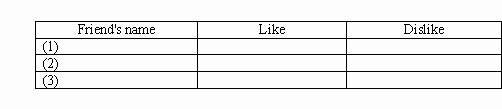
2) Report
(1) ________ likes ________,but he/she doesn't like ________.
(2) ________ likes ________,but he/she doesn't like ________.
(3) ________ likes ________,but he/she doesn't like ________.
学习语言的关键在于应用。请你根据提示词语及句型,踊跃参加以下活动吧!相信你一定是佼佼者!
A.Who is Dr. Know?
Choose a problem from the list below. Ask your classmates for advice. Who gives the best advice is “Dr. Know”.
提示词语及句型:
1)Problems: toothache, stressed out, hungry, backache, cold, sorethroat, tired, headache, thirsty
2)What's the matter?
You should (shouldn't)…
3)lie down, go to bed, see a dentist, listen to music, go out, drink, eat, have a rest, exercise…
B.Who is the healthiest?
Make a survey about what some of your classmates do and how often they do on weekends. Tell it to your classmates. Take a vote:
Who is the healthiest?
提示词语及句型:
1)always, usually, often, sometimes, hardly ever, never, watch TV, read books, exercise, shop, surf the Internet, play football
2)What do you usually do on weekends?
How often do you watch TV?
C.Vacation Dreams
Imagine your dream vacation. On a piece of paper, write what you are doing for vacation, when you are going and how long you are staying there. Put your paper in a bag, then take another paper from the bag. Find the students who has your paper.
提示词语及句型:
1)go camping, go bike riding, go sightseeing, take walks, visit, on Monday, tomorrow, the day after tomorrow, on the 12th, next week, for a week, for three days
2)Where are you doing for vacation?
What are you doing for vacation?
When are you going?
How long are you staying there?
D.Find someone who…
Ask three of your classmates questions. Write their answers in the table below. The first student to fill in all the blanks wins.
提示词语及句型:
1)walk to, ride my bike, take the bus (train, subway), get to school
2)How do you get to school?
How long does it take?
How far is it from…to…?

E.Plan a party
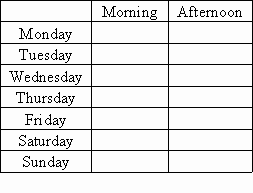
Write everything you have to do next week, and fill in the table below. Choose a day and time to have a party. Then invite classmates to your party.
提示词语及句型:
1)study, have a lesson, visit, help, play football, go to the movies, watch TV
2)Can you come to my party?
I have to…
What are you doing on Tuesday?
F.The same and different
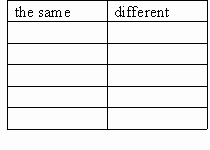
Write your name on a piece of paper and put it in a bag. Take a paper from the bag to find a partner. You have three minutes to make a list of things that are the same and different between you and your partner. The pair with the most items wins.
提示词语及句型:
1)tall, quiet, athletic, serious, intellectual, thin, funny
2)He is taller than me.
We are both girls.
Ask three people to look out the same window at a busy street corner and tell you what they see. Chances are you will receive three different answers. Each person sees the same scene(场景), but each perceives(察觉)something different about it.
Perceiving goes on in our minds. Of the three people who look out the window, one may say that he sees a policeman giving a motorist a ticket(罚单). Another may say that he sees a rush-hour traffic jam at the intersection. The third may tell you that he sees a woman trying to cross the street with four children in tow(拉着). For perception(感知) is the mind’s interpretation of what the senses—in this case our eyes—tell us.
Many psychologists(心理学家) today are working to try to determine just how a person experiences or perceives the world around him. Using a scientific approach, these psychologists set up experiments in which they can control all of the factors. By measuring and charting the results of many experiments, they are trying to find out what makes different people perceive totally different things about the same scene.
1.Perceiving is an action that takes place _____.
|
A.in our eyes |
|
B.only when we think very hard about something |
|
C.only under the direction of a psychologist |
|
D.in every person’s mind |
2.People perceive different things about the same scene because ____.
|
A.they see different things. |
|
B.they can not agree about things |
|
C.some have better eyesight |
|
D.none of these |
3.Psychologists study perception by _____.
|
A.setting up many experiments. |
|
B.asking each other what they see. |
|
C.looking out of windows. |
|
D.Studying people’s eyes. |
4.The best title for this article is _____.
|
A.How We See |
|
B.Learning About Our Minds Through Science |
|
C.What Psychologists Perceive |
|
D.How To Become An Experimental Psychologist |
Grace is nine years old. She has a bad cold and coughs all the time. One day, she went to see a doctor. The doctor gave her some cough medicine.
There are some words on the bottle of the medicine.
|
Shake the bottle well before taking the medicine. |
||
|
Take the medicine 3 times a day after meals. |
||
|
Dose(剂量) for each time: |
||
|
Age |
Over 15 |
2 teaspoons(茶匙) |
|
8-14 |
1 teaspoon |
|
|
4-7 |
1/2 teaspoon |
|
|
*It doesn't work for the children below the age of 3. *Be sure the cap on the bottle is nice and tight(紧的)after taking the medicine. *Keep it away from sunlight. *Use before Dec.2009. |
1.How much medicine should Grace take a day?
A.Half a teaspoon. B.At teaspoon.
C.Two teaspoons. D.Three teaspoons.
2.What should Grace do at first when she wants to the medicine?
A.Wash the bottle. B.Shake the bottle.
C.Keep the bottle cool. D.Keep the bottle hot.
3.After Grace takes the medicine, she should ____.
A.throw the cap away
B.put the bottle in a place with sunlight
C.put a nice cap on the bottle
D.put the cap back on the bottle and tighten it
4.Can a two-year-old child take the medicine?
A.No, he can't.
B.Yes, but only 1/3 teaspoon each time.
C.Yes, but he has to ask the doctor
D.Yes, but only 1/2 teaspoon each time.
5.Which of the following is TRUE?
A.If someone has a stomachache, he can also take the medicine.
B.If Grace's father has a cold, he should take the medicine 2 teaspoons a day.
C.After getting up, Grace should take the medicine at once.
D.Grace can't use the medicine after DEC.2009.
阅读理解
Ask three people to look out the same window at a busy street corner and tell you what they see. Chances are you will receive three different answers. Each person sees the same scene(场景), but each perceives(察觉)something different about it.
Perceiving goes on in our minds. Of the three people who look out the window, one may say that he sees a policeman giving a motorist a ticket(罚单). Another may say that he sees a rush-hour traffic jam at the intersection. The third may tell you that he sees a woman trying to cross the street with four children in tow(拉着). For perception(感知) is the mind’s interpretation of what the senses—in this case our eyes—tell us.
Many psychologists(心理学家) today are working to try to determine just how a person experiences or perceives the world around him. Using a scientific approach, these psychologists set up experiments in which they can control all of the factors. By measuring and charting the results of many experiments, they are trying to find out what makes different people perceive totally different things about the same scene.
1.Perceiving is an action that takes place _____.
|
A.in our eyes |
|
B.only when we think very hard about something |
|
C.only under the direction of a psychologist |
|
D.in every person’s mind |
2. People perceive different things about the same scene because ____.
|
A.they see different things. |
|
B.they can not agree about things |
|
C.some have better eyesight |
|
D.none of these |
3. Psychologists study perception by _____.
|
A.setting up many experiments. |
|
B.asking each other what they see. |
|
C.looking out of windows. |
|
D.Studying people’s eyes. |
4. The best title for this article is _____.
|
A.How We See |
|
B.Learning About Our Minds Through Science |
|
C.What Psychologists Perceive |
|
D.How To Become An Experimental Psychologist |
湖北省互联网违法和不良信息举报平台 | 网上有害信息举报专区 | 电信诈骗举报专区 | 涉历史虚无主义有害信息举报专区 | 涉企侵权举报专区
违法和不良信息举报电话:027-86699610 举报邮箱:58377363@163.com