
题目列表(包括答案和解析)
Have you ever heard the saying "If you want a friend, be one"? If you want to make friends with others, you should be friendly to them first.
Here is how one new
teacher made friends with the students in her class on the first day of school.
As the bell rang, the teacher smiled (微笑) at each
student. Then she said in a quiet voi ce,"Good
morning. How nice it is to have all of you in my class this year. I'd like to
know each of you. I am sure we will enjoy working together." Her voice was
sweet(甜美的) and her look was friendly, so everyone
felt happy.
ce,"Good
morning. How nice it is to have all of you in my class this year. I'd like to
know each of you. I am sure we will enjoy working together." Her voice was
sweet(甜美的) and her look was friendly, so everyone
felt happy.
She told the students
her name and wrote it on the blackboard. Then she told them some of the things
she liked to do and she hoped to do with them during the year. Then she said to
the boys and girls, "Now you know my name and the things I like and I want to know
your names and the things you like."
and girls, "Now you know my name and the things I like and I want to know
your names and the things you like."
Could you make friends by doing the same as this teacher did?
One way of getting to know girls and boys in your class is to find out more about them. People often make friends with those who are the same as them. You play the same games and go on vacations together. It is a good way to make friends.
1.判断正误。The teacher's voice was sweet. 【 】
2.完成句子。She told the students and wrote it on the blackboard.
3.完成句子。One way of getting to know girls and boys in your class is to .
4.找主题句。从文中找出一句能概括本文主旨大意的句子。
5.将文中画线句子翻译成汉语。
In the summer of 1978 an English man named Steven was driving his tractor through a field of wheat when he discovered something strange. Some of his wheat was lying on the ground. The flattened wheat formed(形成)a circle about six meters across . Around this circle were four smaller circles of flattened wheat.
Three years later a farmer who lived nearby discovered almost the same circles in one of his fields. These circles were larger—nearly 15 meters across . That same year , another English farmer discovered three circles of flattened wheat on his land—one large circle between two small circles. During the following years, farmers in England found circles in their fields more and more often.
The circles are called “crop circles” because they usually appear in fields of wheat or corn. The wheat in the circles lies on the ground but is never broken; it keeps on growing, and the farmers can later harvest it. Farmers always discover the crop circles in the morning, so the circles probably form at night. They appear only in the months from May to September. What causes the crop circles?
At first, people thought that some kids were making them as a joke, or that farmers were making them to attract tourists.(In fact, in 1991, two men said they made the circles themselves, but many scientists don’t believe them.) People tried to copy them: They tried to make circles exactly like the ones the farmers had found. They couldn’t do it. They couldn’t enter a field of wheat without leaving tracks, and they couldn’t flatten the wheat without breaking it.
Several times people reported seeing stranger objects near the fields where crop circles later appeared. Many people believe that these crop circles are the messages sent by living things from outer space(外层空间)or the marks left by their spaceships.
Scientists who have studied the crop circles try to find out what causes them. In the summer of 1990 some scientists spent three weeks in the part of England where many circles have appeared. They had all the latest high-tech equipment(最新高科技设备). The equipment—worth 1.8 million dollars—got nothing. But one night, as the scientists were watching a field, crop circles formed in the field behind them, which were quite different from the others. The scientists had neither seen nor heard anything.
When Steven discovered the crop circles on his land in 1978, he said, “It was just like something that had landed in the field from the air and gone back up again. I don’t know what to make of these things.”
Crop circles have appeared in England, Japan, the United States and Russia. Experts from all over the world have studied them, and they say what Steven said: They don’t know what to make of these things.
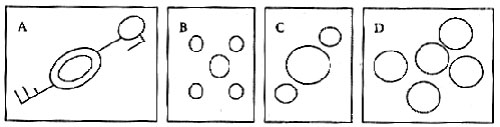
1.Which picture is probably the one formed in the field behind the scientists?
2.“Flattened wheat” means ___________.
A. broken wheat B. lying wheat
C. harvested wheat D. growing wheat
3.The passage is mainly about something ___________ .
A. that is done by living things from outer space
B. that cannot be solved but found all around the world
C. that cannot be made clear or understood
D. that is discovered and copied by the farmers
Never go into a supermarket hungry! This is a good piece of advice. If you go shopping for food before lunchtime, you’ll probably buy more than you plan to. Unfortunately, however, just this advice isn’t enough for shoppers these days. Modern shoppers need an education in how and how not to buy things at the store. First, you check the weekly newspaper ads. Find out the items that are on sale and decide if you really need these things. In other words, don’t buy anything just because it’s cheaper than usual! Second, never let “New and Improved!” or “All Natural” on the front of a package influence you. Instead, read the list of contents on the back. Third,compare prices: that is, you should examine the prices of both different brands(品牌)and different sizes of the same brand.
Another suggestion for shoppers is to buy ordinary items instead of famous brands. Ordinary items in supermarkets come in plain packages. These products are cheaper because producers don’t spend much money on packing or advertising. However, they are still of high quality. In the same way, in buying clothes, you can often find high quality and low prices in brands that are not famous. Shopping in discount clothing stores can help you save a lot of money. Although these stores aren’t very attractive, and they usually do not have individual dressing rooms, not only are the prices low, but you can often find the same famous brands that you find in high-priced department stores.
Wise shoppers read magazine ads and watch TV commercials(商业广告),but they do this with one advantage: knowledge of the psychology behind the ads. In other words, will-informed shoppers watch for information and check for misinformation. They ask themselves questions: Is the advertiser hiding something in small print at the bottom of the page? Is there any real information in the commercial, or is the advertiser simply showing an attractive image? With the answers to these questions, shoppers can make a wise choice.
1. The author gives ________ suggestions to the shoppers in the passage.
A. Three B. Four C. Five D. Six
2.We can learn from the passage that ____________________.
A. ordinary items are not so attractive because of the lower prices .
B. we can’t buy items with words like “New and Improved” or “All Natural”.
C. the advertisers are always showing misinformation in the commercial.
D. the quality of ordinary items can be as good as that of famous brands.
3.The author’s main purpose of writing the passage is to advise shoppers _________________.
A. to buy ordinary items instead of famous brands
B. how to buy ordinary things in supermarkets
C. how to make a proper decision while shopping
D. not to believe advertisements or commercials
It’s me a lot of time to find out what I really want to do in the future.
(A) paying (B) spending (C) taking (D) using
As a volunteer(自愿者) teacher, I traveled a long way to a small village school in Longzhou, Guangxi. On my way there, I thought about the village, the school and the childrenn there. However, my heart sank when I arrived there. It wasn't what I expected. It didn't look like a school at all! The school had only three rooms, one for Grades 1, 2 and 3, and the other for Grades 4, 5 and 6. There was a third one for me.
The children welcomed me warmly on my first day. They asked me a lot of questions, and I told them stories about myself and my life in Shanghai. The next day, I gave them a test to find out their level(水平). To my surprise, though the test was very easy, over half of the students failed it, yet they all wanted to learn new things. I knew they needed me.
I was busy preparing lessons and reading test papers every night. I enjoyed teaching these lovely and hard-working children, and I could see that they were making progress(进步) with my help. I have also learned a lot from them. I understand their level is becoming higher and higher, and we are good friends now.
I worked in Longzhou for a year. I'm very happy, and the experience(经历) is very useful to me. I love the small village and the children. In fact, I would like to continue working here.
【小题1】How many grades are there in the school?
| A.2 | B.4 | C.5 | D.6 |
| A.Longzhou | B.Guangxi | C.Shanghai | D.Beijing |
| A.Boring | B.Useful | C.Careful | D.Surprising |
| A.was sorry for the school | B.worked hard to teach the children |
| C.don’t want to work in the school | D.left the school in a short time |
湖北省互联网违法和不良信息举报平台 | 网上有害信息举报专区 | 电信诈骗举报专区 | 涉历史虚无主义有害信息举报专区 | 涉企侵权举报专区
违法和不良信息举报电话:027-86699610 举报邮箱:58377363@163.com