题目列表(包括答案和解析)

It's the end of class. When the bell rings, students of Luohu Foreign Languages School in Shenzhen quickly take out their cell phones. They want to log on* to their micro blogs to check the interesting things that have happened in the last hour.
Since last year, the trend* of micro blogging has swept the country. Recent surveys shows that most students in middle schools have a micro blog and some even update* their blogs over five times per day.
"We learn many fresh and interesting things on micro blogs and they have become popular topics in class," said Andy Liang, 14. "If you do not know about them, you are out of the loop."
It is also a great place for students to let out stress. "My parents always ask me to study all the time, and encourage me before exams, but it really adds pressure," said Simon Zhang, 15. "When I share these feelings on my micro blog, I get many replies from friends in the same situation, which makes me feel better."
But parents are worried that micro blogging could be a waste of time. Some misleading messages may even cause danger to kids, they said.
Mr. Shen, a professor at the China Education Association, suggests parents not worry too much as long as kids are not crazy about micro blogging. Maybe it can become a window for parents to understand their children. "If parents can read their children's micro blogs, they'll know their thoughts, thus leading to better communication and solutions to problems," he said. He also gives some tips for kids.
---Don't micro blog for more than one hour a day.
---Never micro blog in class.
---Try to talk face to face with people from time to time.
---Be critical*. Don't trust all the messages on a micro blog.
1.The underlined part "out of the loop" in the passage probably means .
A. not popular B. not excited C. unhealthy D. unlucky
2.Micro blog made Simon when he shared his feelings and got replies on his micro biog.
A. feel sad B. let out stress C. add pressure D. make friends
3.We can know from Mr. Shen that micro blogging can .
A. make kids crazy while logging on to it
B. bring a lot of misleading messages
C. become a window to understand young kids
D.lead to worse communication
4.Which statement is TRUE according to the passage?
A. It's good for kids to micro blog for more than one hour a day.
B.Kids should trust all the messages on a micro blog because they are useful.
C.The trend of micro blogging has swept the country since five years ago.
D. Kids should try to talk face to face with people, not just micro blogging.

It's the end of class. When the bell rings, students of Luohu Foreign Languages School in Shenzhen quickly take out their cell phones. They want to log on* to their micro blogs to check the interesting things that have happened in the last hour.
Since last year, the trend* of micro blogging has swept the country. Recent surveys shows that most students in middle schools have a micro blog and some even update* their blogs over five times per day.
"We learn many fresh and interesting things on micro blogs and they have become popular topics in class," said Andy Liang, 14. "If you do not know about them, you are out of the loop."
It is also a great place for students to let out stress. "My parents always ask me to study all the time, and encourage me before exams, but it really adds pressure," said Simon Zhang, 15. "When I share these feelings on my micro blog, I get many replies from friends in the same situation, which makes me feel better."
But parents are worried that micro blogging could be a waste of time. Some misleading messages may even cause danger to kids, they said.
Mr. Shen, a professor at the China Education Association, suggests parents not worry too much as long as kids are not crazy about micro blogging. Maybe it can become a window for parents to understand their children. "If parents can read their children's micro blogs, they'll know their thoughts, thus leading to better communication and solutions to problems," he said. He also gives some tips for kids.
---Don't micro blog for more than one hour a day.
---Never micro blog in class.
---Try to talk face to face with people from time to time.
---Be critical*. Don't trust all the messages on a micro blog.
【小题1】The underlined part "out of the loop" in the passage probably means .
| A.not popular | B.not excited | C.unhealthy | D.unlucky |
| A.feel sad | B.let out stress | C.add pressure | D.make friends |
| A.make kids crazy while logging on to it |
| B.bring a lot of misleading messages |
| C.become a window to understand young kids |
| D.lead to worse communication |
| A.It's good for kids to micro blog for more than one hour a day. |
| B.Kids should trust all the messages on a micro blog because they are useful. |
| C.The trend of micro blogging has swept the country since five years ago. |
| D.Kids should try to talk face to face with people, not just micro blogging. |
| |||||||||||||||||||||||||||||||||||||||||||||||||||||||||||||||||||||||||
根据短文内容,从下列各题所给的四个选项中选择正确的一项。
Our village carpenter(木匠), John Hill, came one day and made a dining table for my wife. He made it just the right size to fill the space between the two windows. When I got home that evening, John was drinking a cup of tea and writing out his bill(帐单)for the job.
My wife said to me, quietly, “That's his ninth cup of tea today.” But she said, in a loud voice, “ It's a beautiful table, dear, isn't it ? ”
“ I'll decide about that when I see the bill, ” I said.
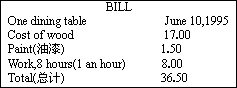
John laughed and gave me his bill for the work. I read:
One dining table 10 November 1989
Cost(成本;费用)of wood £17.00( £是pound的符号)
Paint(油漆)£1.50
Work, 8 hours(£1 an hour)£8.00
Total(合计)£36.50
When I was looking at the bill, John said, “ It's been a fine day, hasn't in? Quite sunny. ”
“ Yes, ” I said. “ I'm glad it's only the 10th November. ”
“Me, too, ” said John. “ You wait it'll be a lot colder by the end of the month. ”
“Yes, Cold and more expensive! Dining tables will be £20 more expensive on November 30th, won't they, John? ”
John looked hard at me for half a minute. Was there a little smile in his two blue eyes? I gave his bill back to him .
“If it isn't too much trouble, John , ” I said . “please add it up again. You can forget the date . ”
I paid him £26.50 and he was happy to get it .
1. Why did John talk about the weather when the writer was looking at the bill?
[ ]
A. Because he didn't want the writer to go through the bill carefully .
B. Because it was really a fine day .
C. Because he wanted the writer to check the bill carefully .
D. Because he wanted to tell the writer what the weather was like .
2. Why did the writer say that dining tables would be £20 more expensive on November 30th ?
[ ]
A. Because it was difficult to make dining tables in cold weather .
B. Because paint would be more expensive .
C. Because the cost of wood would be more expensive .
D. Because he thought John would almost certainly add the date to the cost of the dining table
3. The writer thought John would ask for ______ if he made a dining table on the last day of November .
[ ]
A.£20.00 B.£46.50 C.£56.50 D.£26.50.
4. When the writer gave him the money, John was happy because ______.
[ ]
A. he got what he should get for his work
B. he got much more money for his work
C. he got the money easily
D. he didn; t have to add up the costs again
5. From the story we know that ______ .
[ ]
A. John made a mistake in the bill
B. John tried to fool the writer in order to get more money for his work
C. John had written out the bill before the writer got home
D. John still wanted to get £36.50 for his work in the end
本篇大意是:木匠约翰给主人公的妻子做了一个小饭桌,结账时的账单上把成本费17.00、油漆料钱1.50、工价8.00和日期10一起相加,多计价10元,结果被主人发现了,但他并没有直接批评多要钱的木匠,只是诙谐地说:“月底30日做比月初10日做,还要贵些,是不是?”而且只付了木匠应得到的26.50元钱.很明显,本篇比上篇更难些,因上篇中主人公怀特和厂家双方处理的问题是直接的,直言不讳,而本篇中的主人公却是明人做暗事,肚内藏机关,木匠虽然诡谲,主人却更机灵,一眼看穿了木匠的把戏,但他处理问题颇有技巧,既解决问题,不多花钱,又不搞得很僵,双方不快,体现了现代生意场中的交往策略和洽谈风格.我国正在建设社会主义市场经济,这是法制化、规范化的市场经济,反对不正当的竞争.此文有一定的现实意义,文中的内容联系着当代的社会生活,通过英语试卷,同样可以检验学生:的审视能力.
Our village carpenter(木匠), John Hill, came one day and made a dining table for my wife. He made it just the right size to fill the space between the two windows. When I got home that evening, John was drinking a cup of tea and writing out his bill(账单) for the job.
My wife said to me, quietly, “That's his ninth cup of tea today.” But she said, in a loud voice, “It's a beautiful table, dear, isn't it?”
“I'll decide about that when I see the bill,” I said.
John laughed and gave me his bill for the work. I read:
When I was looking at the bill, John said, “It's been a fine day, hasn't it? Quite sunny.”
“Yes,” I said. “I'm glad it's only the 10th of November.”
“Me, too,” said John. “You wait-it'll be a lot colder by the end of the month.”
“Yes. Colder-and more expensive! Dining tables will be £20 more expensive on November 30th, won't they, John?”
John looked hard at me for half a minute. Was there a little smile in his two blue eyes? I gave his bill back to him.
“If it isn't too much trouble, John,” I said, “please add it up again. You can forget the date.”
I paid him £26.50 and he was happy to get it.
1.Why did John talk about the weather when the writer was looking at the bill?
A Because he didn't want the writer to go through the bill carefully.
B.Because it was really a fine day.
C.Because he wanted the writer to check the bill carefully.
D.Because he wanted to tell the writer what the weather was like.
2.Why did the writer say that dining tables would be £ 20 more expensive on November 30th?
[ ]
A.Because it was difficult to make dining tables in cold weather.
B.Because paint would be more expensive.
C.Because the cost of wood would be more expensive.
D.Because he thought John would almost certainly add the date to the cost of the dining table.
3.The writer thought John would ask for ________ if he made a dining table on the last day of November.
[ ]
4.When the writer gave him the money, John was happy because ________.
[ ]
A.he got what he should get for his work
B.he got much more money for his work
C.he got the money easily
D.he didn't have to add up the costs again
5.From the story we know that ________.
[ ]
A.John made a mistake in the bill
B.John tried to fool the writer in order to get more money for his work
C.John had written out the bill before the writer got home
D.John still wanted to get £36.50 for his work in the end
湖北省互联网违法和不良信息举报平台 | 网上有害信息举报专区 | 电信诈骗举报专区 | 涉历史虚无主义有害信息举报专区 | 涉企侵权举报专区
违法和不良信息举报电话:027-86699610 举报邮箱:58377363@163.com