
题目列表(包括答案和解析)
One day, a middle school teacher comes into the classroom and says to his students, “Today I want you to write about yesterday’s football match. I'm going to take your exercise books home with me. Now please begin.”
The students all take out their pens and exercise
books and begin to write. A boy called Tom thinks hard(努力). But he doesn't write down a word. Five minutes
later, he finishes(完成). He stands up and looks at the teacher.
The teacher asks, “What is the matter, Tom?” “I have finished, sir.” says the
boy. “Well ,
give me your book.” The boy goes to the teacher and hands in (交)his exercise book. The teacher opens it and reads,
“Rain, no match. ”
,
give me your book.” The boy goes to the teacher and hands in (交)his exercise book. The teacher opens it and reads,
“Rain, no match. ”
1.The teacher asks the students to .
A. read the text B. write about a match
C. do their homework D. have a lesson
2.The teacher is going to read the students' exercise books .
A. in class B. at home C. at school D. in classroom
3.Five minutes later, he __________ .
A. writes down many things B. writes down "Rain, no match"
C. writ es
a word D.
doesn't write down a word
es
a word D.
doesn't write down a word
4.Tom is to hand in the exercise book.
A. the third(第三) B. the last(最后)
C. the first(第一)D. the second(第二)
5.Tom writes about the match.
A. nothing B. a lot C. lots of things D. Much
听力部分(25分)
Ⅰ.听句子,选出句子中包含的信息。每个句子读两遍。(共5小题,每题1分)
1.A.biking
B.hiking
C.hanging
2.A.on Saturdays
B.on Sundays
C.on sunny days
3.A.bus station
B.subway station
C.train station
4.A.Kay wants to be a doctor.
B.Kay is ill.
C.Kay is a bad girl.
5.A.My friend and I are old.
B.My friend is younger than me.
C.My friend is older than me.
Ⅱ.听句子,选出正确的答语。每个句子读两遍。(共5小题,每题1分)
6.A.Three or four times a week.
B.This Sunday.
C.He wants to buy some fruit.
7.A.I am going on vacation.
B.To Tibet.
C.By bike.
8.A.For ten minutes.
B.By bike.
C.Ten minutes’ walk.
9.A.All right.Let’s go.
B.That’s all right.
C.How about you?
10.A.Sorry, I am late.
B.Yes, I’d love to.
C.I think I can’t.
Ⅲ.听对话及问题,选择正确的答案。对话及问题读两遍。(共5小题,每题1分)
11.What does Cindy have to do On Sunday afternoon?
A.
B.
C.
12.How is John going to school today?
A.
B.
C.
13.What does Lucy do on weekends?
A.
B.
C.
14.What does the woman want the man to get her?
A.A stamp
B.A cup of coffee
C.A letter
15.When is the man leaving Pairs?
A.May 1st
B.May 3rd
C.May 4th
Ⅳ.听对话,根据对话内容选择正确答案。 对话及问题读两遍。(共5小题,每题1分)
请听第一段对话,回答第16-17小题。
16.What sport does Michael like best?
A.Volleyball
B.Baseball
C.Basketball
17.How often does he play it?
A.Once a week
B.Twice a week
C.Every day
请听第二段对话,回答第18-20小题。
18.Why is David going to England?
A.To study
B.To travel
C.To visit friends
19.Where is David mainly(主要)staying in England?
A.In Liverpool
B.In London
C.In Manchester
20.How long is David staying in England?
A.2 weeks
B.4 weeks
C.6 weeks
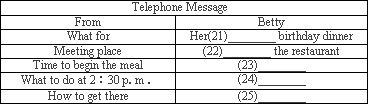
Ⅴ.听电话录音,根据录音内容补全表格。内容读两遍。(共5小题,每题1分)
听力(20分)
第一部分,听对话回答问题(10分)
本部分共有10小题,每小题你将听到一段小对话,每段对话听两遍。在听每段对话前,你将有5秒钟的时间阅读题目。
1.Whom did George go to Canada with?

2.Which sign do they see in the street?

3.What time does Miss Li drive to the office?

4.What does the woman need?

5.How much money will the man have if Alice lends him her money?
A.5 dollars.
B.8 dollars.
C.10 dollars.
6.Where did the man go just now?
A.To the office
B.To the museum
C.To the post office
7.What does the man mean?
A.He is good at climbing high.
B.It is not high at all.
C.He may fall and hurt himself.
8.How long will the woman stay at the hotel?
A.For two days.
B.For three days.
C.For four days.
9.What will Peter do tomorrow?
A.Go to the theatre.
B.Have an exam.
C.Do the homework.
10.How many people will go for the picnic tomorrow?
A.One.
B.Two.
C.Three.
第二部分 听对话和短文回答问题(10分)
你将听到一段对话和两篇短文,各听两遍。听每段对话或短文前,你将有时间阅读相关小题,每小题5秒钟。
听一段对话,回答第11、12题。
11.When will the match start on Sunday?
A.At 1∶30.
B.At 1∶45.
C.At 2∶00.
12.Who are they going to play with?
A.A team of soldiers.
B.Their friends.
C.Their classmates.
听第一篇短文,回答第13至15题。请根据短文内容,选择正确答案,完成信息记录表。

13.A.2∶30.
B.2∶15.
C.2∶45.
14.A.Class 8
B.Class 3
C.Class 7
15.A.Simon
B.Jack
C.Tony
听第二篇短文,回答第16至20题。
16.What sport is very popular in China?
A.Tennis
B.Baseball
C.Ping-pong.
17.Who likes baseball best?
A.Li Bo
B.The speaker
C.We don't know.
18.Where do the American children often play baseball?
A.On streets
B.At school.
C.In fields or parks.
19.How many players are there in each baseball team?
A.Nine
B.Two
C.Eleven.
20.What does the speaker think of doing sports?
A.It can give us strength(力量)
B.It can make us healthy.
C.It can make us popular.
听力(共二节,计25分)
第一节(共9小题;每小题1分,满分9分)
听下面9段对话。每段对话后面有一个小题,从题后所给的A、B、C三个选项中选出最佳选项。听完每段对话后,你都有10秒钟的时间来回答有关小题和阅读下一小题。每段对话仅读一遍。
1.A.He’s gone to class.
B.He’s gone to play football.
C.He’s gone shopping.
2.A.Pollution.
B.Studying.
C.Population.
3.A.Not changed a lot.
B.Very dirty.
C.Very clean.
4.A.2 years.
B.4 years.
C.1 year.
5.A.There are no fish there.
B.There are no flowers there.
C.It has been polluted.
6.A.Rainy.
B.Windy.
C.Snowy.
7.A.Kang Kang.
B.Jane.
C.Jack.
8.A.She is not good at writing.
B.She is weak in reading.
C.She can’t pronounce well.
9.A.Jane’s.
B.Kang Kang’s.
C.Mike’s.
第二节(共16小题;每小题1分,满分16分)
听下面5段对话或独白。每段对话或独白后面有几个小题,从题中所给的A、B、C三个选项中选出最佳选项。听每段对话或独白前,你将有时间阅读各个小题,每小题5秒钟;听完后各题将给出5秒钟的答题时间。每段对话或独白读两遍。
听第10段材料,回答第10-11小题。
10.Where is Jim going next weekend?
A.To America.
B.To Hong Kong.
C.To France.
11.What language will Jim practice there?
A.English.
B.French.
C.Chinese.
听第11段材料,回答12-14小题。
12.Does Kang Kang have difficult understanding “G’day”?
A.Yes, he does.
B.Sorry, we don’t know.
C.No, he doesn’t.
13.How many expressions of American English are mentioned in the dialogue?
A.One.
B.Two.
C.Three.
14.What are they talking about?
A.How widely English is used in the world.
B.How we can learn English well.
C.How differently is English used in different countries.
听第12段材料,回答第15-17小题。
15.Can Mary write French well?
A.Yes, she can.
B.No, she can’t.
C.We don’t know.
16.What does Jack think of Japanese?
A.It’s difficult.
B.It’s easy.
C.It is the same as German.
17.How many languages can Mary speak besides English?
A.One.
B.Two.
C.Three.
听第13段材料,回答第18-21小题。
18.How many foreign languages can Cindy speak?
A.Two.
B.Three.
C.Four.
19.What was she when Cindy lived in China?
A.A teacher.
B.A student.
C.A doctor.
20.Which language was Cindy good at after a year?
A.English.
B.French.
C.Chinese.
21.How many years did Cindy study French at college?
A.One year.
B.Four years.
C.Five years.
听第14段材料,回答第22-25小题。
22.Why did the Chinese girl smile in the classroom?
A.she was asked to answer a question
B.the teacher looked funny
C.she couldn’t answer the question
23.What happened to the Englishman one day?
A.He dropped a plate.
B.He was working in a dinning room.
C.He laughed at the Chinese.
24.How was the Englishman feel when the Chinese laughed at him?
A.Happy.
B.Worried.
C.Angry.
25.What does the passage want to tell us?
A.Smiles and laughter don’t mean the same thing to different people.
B.American people are easy to get angry.
C.Chinese students are impolite.
湖北省互联网违法和不良信息举报平台 | 网上有害信息举报专区 | 电信诈骗举报专区 | 涉历史虚无主义有害信息举报专区 | 涉企侵权举报专区
违法和不良信息举报电话:027-86699610 举报邮箱:58377363@163.com