
Words and phrases 1 giant pandas 2 look like white mice 3 be born 4 bamboo leaves and shoots 5 in danger 6 hunter 7 fur 8 cut down trees and farests 9 take action 10 protect Main ideas of this passage Paragraph1: something about Xi Wang Paragraph2-3: the growth of Xi Wang Paragraph4-6:the problems of giant pandas Paragraph7-8: take actions to protect pandas 查看更多


题目列表(包括答案和解析)

阅读理解

  There are some stories behind English words

  You've spent a lot of time studying how to use English in a proper wayBut have you ever wondered why English speakers say some of the things they say?For example, why do they sayan easy taskisa piece of cake?Why do the two lettersOKmeansall right?

  Many English words and phrases have stories behind themSometimes these stories can help us look back into old western historyLet's take a look at a few of the original * common English words and phrases

  OK

  “OKwas an American who lived in the 19th centuryHis name wasOld Kinderhook”.In one year he was trying to take the place of the leader of his townHis supporters went around the town shoutingOK\OK\The supporters thought their future leader wasall right”.The expression caught on, and now if something isall right, people like to sayOK|

  Boss*

  Is your boss nice to you?If not, just be glad you weren't living in the old timesBack to that time, bosses could do anything bad to their men and could even beat* them!That explains why the wordbosscomes from an old German word meaningto beat”.

  A piece of cake

  A famous American writer named Ogden Nash lived in the 1930sMany readers enjoyed his poems and wrote them down in their notebooksIn one of his poems, Nash wrote,Her picture's in the papers now, and life's a piece of cake.”His readers found these words interesting and quickly wrote them downThey thought that if one picture in a newspaper could make you famous, wouldn't life be easy?

  For nearly 70 years,a piece of cakehas meant any task or activity that is easy

(1)

Some of English words can tell us stories about ________

[  ]

A.

how people learned English

B.

how English speakers create the words

C.

how people spoke English

D.

how people taught others to speak English

(2)

The wordbossin old German means________”.

[  ]

A.

to work

B.

to help

C.

to beat

D.

to kill

(3)

OKcomes from________”.

[  ]

A.

Old King

B.

Old Kindman

C.

Old Kinderhook

D.

Old Mcdonald

(4)

In this passagea piece of cakemeans________”.

[  ]

A.

an easy task or activity

B.

a difficult task or activity

C.

a simple newspaper to read

D.

a famous picture in a newspaper

查看答案和解析>>

阅读理解

  Languages keeps evolving(进化、发展), and English is no exception.It is a language that embraces(欣然接受)new words that may be cool today but gone tomorrow.

  There are, however, some words and phrases that have stood the test of time.OK, which has become the international standard for expressing agreement, is a good example.

  But why is this rather odd(奇怪的)expression so popular and so useful when we could use any number of other words to say the same thing?

  Writing in The Times, Allen Metcalf, author of OK:The Improbable Story of America’s Greatest Word, writes:“What OK provided that the others did not was neutrality(中性), a way to express agreement without having to offer an opinion.”

  For example, if someone asks you “Shall we go for a walk after lunch?” you can simply respond “OK”.There you go-no extra opinions.Just straight, plain old OK.

  So just where did this rather curious expression come from? The origins of OK have been widely disputed(辩论,争论).Some people have guessed that OK was the name of a person or a product.

  Speakers of many different languages have had their say on this question, keen to claim the term as their own.

  Writing an article for London’s Metro newspaper, Metcalf states:‘O and K are present in every language of the world, as expressions that can be abbreviated(缩写)OK.” For example:French-“O qu-oui”, “yes indeed”; German-“Ohne Korrektur”,“ without correction needed”; and in Latin or Greek, “Olla kalla”, “all good”.

  But, does it sound a little too informal with this popular little expression?

  Apparently not.

  In a speech where he stated that his election(当选)would not be a radical(激进的)result to all problems, President Obama said:“…even though I am president…, AI-Qaida is still a threat(威胁)and that we cannot pretend somehow that because Barack Hussein Obama got elected as president, suddenly everything’s going to be OK,” he said.

  So, there you go, straight from the president.It’s OK to say OK, and thanks to the expression’s widespread usage across the world, you can be understood anywhere.

(1)

Using the example of Obama, the author wants to show that _________.

[  ]

A.

there is still a long way to go to defeat Al-Qaida

B.

Obama likes to use OK when he speaks

C.

OK is widely used even on formal occasions

D.

the use of OK is encouraged in formal speech

(2)

According to Allen Metcalf, OK differs from other terms to express agreement, which of the following opinions is true?

[  ]

A.

It is easiest way to say.

B.

It doesn’t need emotion.

C.

It is the most commonly used.

D.

It doesn’t use in the formal speech.

(3)

What is the best title for the passage?

[  ]

A.

Why OK is OK everywhere?

B.

It’s OK to say OK in the world.

C.

Where did OK come from?

D.

Everything is going to be OK.

查看答案和解析>>

写作(Writing)

要求:

1.根据提供的图示或信息,适当拓展想象空间,将提供的内容灵活体现在文章中;

2.条理清楚,意思连贯,语句通顺,标点正确,书写清晰、规范;

3.不得少于规定的词数或句子数。

  Amy is a typist (打字员). She works in an office. She goes to work in the morning. She always talks nicely and she does not act like a stupid woman.
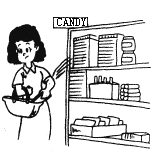
  Yesterday she went to the supermarket to buy a tooth-brush. There were not many people inside. She looked around carefully. Then she took a bar of chocolate from the shelf. She put it in her bag. She did not pay for it. She was dishonest.

  Paul is quite different from Amy. Write about Paul with the help of the passage above. The following words and phrases will also help you. The first sentence is given. (not less than 70 words)

  a cleaning company清洁公司;rudely粗鲁地;clever聪明的;bank银行;furniture家具;honest诚实的

Paul is a worker.

_____________________________________________________

查看答案和解析>>

完形填空

  In China today, (1) are very popular. Many people, men and (2) , old and (3) , want (4) computer.

   (5) many schools there (6) computer classrooms, computers are very 7 .For example, students can (8) their maths work (9) a computer. The computer (10) questions on the screen(屏幕)in front 11 the students and the (12) answer (13) their key boards(键盘).

  Students can also learn a foreign language(外语)with a computer. The computer (14) us sounds in pronunciation(发音), grammar and the right use of words and phrases.

  Students know a lot (15) computer now. For example, they can use Basic to make up useful programmes(节目).They can use WPS to write compositions.

(1)ATV

Bradios

Ccars

Dcomputers

(2)Awoman

Bdoctors

Cwomen

DStudents

(3)Along

Bshort

Cnew

Dyoung

(4)Astudy

Bto learn

Cstudies

Dlearns

(5)AAt

BIn

COn

DWith

(6)Aare

Bis

Chave

Dhas

(7)Ause

Dusing

Cuseful

Dcareful

(8)Ato

Bdo

Cdoes

Ddoing

(9)Aon

Bin

Cat

Dwith

(10)Ato write

Bwrites

Cwriting

Dwrite

(11)Aat

Bwith

Cof

Don

(12)Aboys

Bmen

Cwomen

Dstudents

(13)Aat

Bin

Con

Dwith

(14)Ato give

Bgives

Cgive

Dgiving

(15)Awith

Babout

Cof

Dat

查看答案和解析>>

Although the USA is by far the most powerful of the English-speaking countries, English that is taught in most parts of the world is British English. Besides, British English is the “mother” language upon which all English, written or spoken, is based, including American English. In fact, most Americans like the way the “English” speak. Many Americans, including some who have no British blood in them, regard Britain culturally (文化上) as the Mother Country. Americans read English literature (文学作品) without any difficulty at all, and British readers of early 20th century American literature have no problems either. But for the last fifty years the Americans have been inventing a large number of new words and phrases, many of which have already reached the UK and the whole English-speaking world.

However, there are occasional(偶尔的)misunderstandings(误会). A smart English woman said to a smart American woman on a California beach. English woman: It’s the first time I’ve bathed for years. American woman (amazed): Is that so? I can’t believe it! English woman: It’s true. You see, the water at home’s always so cold. American woman : But…But surely you have hot water in England? English woman (laughs): Of course, but not in the sea! There can be similar misunderstandings over the word “pants”, though most English people know that Americans call trousers “pants”. American girl: I never wear pants. They don’t suit me. English girl: Really? Couldn’t that be a bit embarrassing(难堪的)? American girl: Embarrassing? Why? English girl: Well—that short skirt you’re wearing…American girl: Oh, my! But I wear panties(短衬裤)! In British English, “pants” are undergarments. However, young people in Britain do sometimes say “pants” for “trousers”.

1 All the English is based on__________.

A. British English                  B. American English

C. Canadian English                D. Australian English

2 Which of the following sentences is not true?

A. Americans can read English literature easily.

B. British readers can read all the American literature with no difficulty, either.

C. Some of the English words we are learning now are from the USA.

D. There are some times misunderstandings between Americans and Englishmen.

3 Pants in American English mean _________in British English.

A. panties          B. undergarments

C. underwear        D. trousers

4 From the passage we know that “to bathe” in American English means ________ and means_______ in British English.


查看答案和解析>>


同步练习册答案