
题目列表(包括答案和解析)
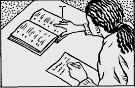
Read how Sofia writes a composition.
 |  |  |  |
| 1.The weekend before she has to give it to the teacher, she sits on her own in the kitchen. First, she looks at the title and thinks a lot. | 2.Then she writes a few ideas onto a piece of paper, in no particular order. She looks up a couple of words in the dictionary and writes those down. | 3.Then she has a sandwich and goes to watch TV. | 4.The next day she looks at what  she wrote. She adds some more ideas. Then she decides how to order her ideas. She starts to write. she wrote. She adds some more ideas. Then she decides how to order her ideas. She starts to write. |
 |  |  |  |
| 5.There are some words she’s not sure about so she looks them up in her dictionary. | 6.When she has finished writing, she reads  carefully through her composition. She crosses some things out and changes one or two sentences. carefully through her composition. She crosses some things out and changes one or two sentences. | 7.Then she looks back at her notes from other written work. She makes sure she hasn’t made any of the same mistakes. | 8.Finally, she writes out her composition onto a clean piece of paper and puts it in her bag. |
| A.She looks at the title and thinks a lot. |
| B.She has a sandwich and goes to watch TV. |
| C.She writes a few ideas onto a piece of paper. |
| D.She looks up a couple of words in the dictionary. |
| A.she writes them down | B.she looks back at her notes |
| C.she crosses some things out | D.she looks them up in the dictionary |
A.drive r r | B.doctor | C.student | D.parent |
 |  |  |  |
| 1.The weekend before she has to give it to the teacher, she sits on her own in the kitchen. First, she looks at the title and thinks a lot. | 2.Then she writes a few ideas onto a piece of paper, in no particular order. She looks up a couple of words in the dictionary and writes those down. | 3.Then she has a sandwich and goes to watch TV. | 4.The next day she looks at what she wrote. She adds some more ideas. Then she decides how to order her ideas. She starts to write. |
 |  |  |  |
| 5.There are some words she’s not sure about so she looks them up in her dictionary. | 6.When she has finished writing, she reads carefully through her composition. She crosses some things out and changes one or two sentences. | 7.Then she looks back at her notes from other written work. She makes sure she hasn’t made any of the same mistakes. | 8.Finally, she writes out her composition onto a clean piece of paper and puts it in her bag. |
| A.She looks at the title and thinks a lot. |
| B.She has a sandwich and goes to watch TV. |
| C.She writes a few ideas onto a piece of paper. |
| D.She looks up a couple of words in the dictionary. |
| A.she writes them down | B.she looks back at her notes |
| C.she crosses some things out | D.she looks them up in the dictionary |
| A.driver | B.doctor | C.student | D.parent |
Read how Sofia writes a composition.
|
|
|
|
|
|
1.The weekend before she has to give it to the teacher, she sits on her own in the kitchen. First, she looks at the title and thinks a lot.
|
2.Then she writes a few ideas onto a piece of paper, in no particular order. She looks up a couple of words in the dictionary and writes those down. |
3.Then she has a sandwich and goes to watch TV.
|
4.The next day she looks at what she wrote. She adds some more ideas. Then she decides how to order her ideas. She starts to write. |
|
|
|
|
|
|
5.There are some words she’s not sure about so she looks them up in her dictionary. |
6.When she has finished writing, she reads carefully through her composition. She crosses some things out and changes one or two sentences. |
7.Then she looks back at her notes from other written work. She makes sure she hasn’t made any of the same mistakes. |
8.Finally, she writes out her composition onto a clean piece of paper and puts it in her bag. |
180words
1.What does Sofia do first before she writes the composition?
A. She looks at the title and thinks a lot.
B. She has a sandwich and goes to watch TV.
C. She writes a few ideas onto a piece of paper.
D. She looks up a couple of words in the dictionary.
2.When she meets some words she’s not sure, .
A. she writes them down B. she looks back at her notes
C. she crosses some things out D. she looks them up in the dictionary
3.From the passage we can know Sofia is a .
A. driver B. doctor C. student D. parent
0ur village carpenter(木匠),John Hill, came one day and made a dining table for my wife. He made it just the right size to fill the space between the two window. When I got home that evening, John was drinking a cup of tea and writing out his bill( 账单) for his job.
My wife said to me quietly, “That’s his ninth cup of tea today. ”But she said in a loud voice, “It’s a beautiful table, dear, isn’t it?” “I’ll decide about that when I see the bill,” I said. John laughed and gave me his bill for the work. I read:
One dining table 10th November, 2011
Cost of wood $ 17:00
Paint $1. 50
Work, 8 hours($1 an hour) $8. 00
Total $36. 50
When I was looking at the bill, John said,” It’s been a fine day, hasn’t it? Quite sunny. ”
“Yes,” I said. “I’m glad it’s only the 10th of November. ”
“Me, too,” said John, “you wait—it will be a lot colder by the end of the month. ”
“Yes, colder—and more expensive! Dining table will be $20 more expensive on November 30th, won’t they, John?”
John looked hard at me for half a minute. Was there a little smile in his two blue eyes? I gave his bill back to him.
“If it’s not too much trouble, John,” I said,“Please add(加) it up again, You can forget the date-------”
I paid him $26. 50 and he was happy to get it.
【小题1】Why did John talk about the weather when the writer was looking at the bill?
| A. Because he didn’t want the writer to check the bill carefully. |
| B. Because he wanted to show that he was really polite. |
| C.Because it’s a good way to communicate with each other. |
| D.Because he wanted to confirm what the weather was like. |
| A.$ 26. 50 | B.$36. 50 | C.$56. 50 | D.$57. 50 |
| A. he felt lucky to get the money for his work |
| B. he got paid a lot more than usual for his work |
| C. he got as much money as he had expected |
| D. he didn’t have to add up the costs any more |
| A. Clever | B. Silly | C. Dishonest | D. Humorous(幽默的) |
| A. He made a mistake carelessly in the bill |
| B. He tried to get more money for his work. |
| C. He had written the bill before the writer got home |
| D. He had talked about the bill with the writer’s wife. |
阅读理解。
Today I got a good report from the school.In our school, each student gets a report at the end of the school year.Teachers of all subjects write their judgment(鉴定)about the subjects.Some of my classmates have got a good treat from their parents for their “good reports”, but I think mine is the best.I gave it to mum when I returned home.Mum was very happy to see it.
On English she wrote:
“Henry has made very good progress with his reading.He reads books of his own choice with absorption(吸收)and pleasure.He reads aloud fluently(流利的), with good expression and understanding.Henry listens very well to stories and poems.He participates(参与)in class discussions expressing himself clearly.”
“Henry’s written work(作文)is very good.He writes with a rounded(圆体子), clear joined handwriting using the basic rules of spelling and punctuation very well.The context of his writing is sound(完好的,合理).He has interesting ideas for stories, and is able to give factual accounts highlighting the important details of an event or visit.”
根据短文内容,完成下列句子。
1.We Chinese students get a r________ at the end of every school year.
2.This is a part of Henry’s report on his E________.
3.From the report, we know Henry is good at r ________, l________ and w ________.
4.Henry’s written works have s________ contests and i________ ideas.
湖北省互联网违法和不良信息举报平台 | 网上有害信息举报专区 | 电信诈骗举报专区 | 涉历史虚无主义有害信息举报专区 | 涉企侵权举报专区
违法和不良信息举报电话:027-86699610 举报邮箱:58377363@163.com


