Teaching aids: tape, tape-recorder, cards. 查看更多


题目列表(包括答案和解析)

完形填空

  In college, I wanted to be a math teacher.After completing four years of math courses, it was time to find a   1  .I wanted to teach in a big city at a nice school.But I quickly discovered there was a lot of   2   for teaching jobs.Finally my father suggested that I interview at a school in a very small town.The position there was for an English teacher! I went to the interview to   3   my dad.To my surprise, the headmaster offered me the job immediately.I accepted it because I needed a job.

  When I arrived at the school in the fall, there was a new headmaster.He didn’t know   4   I was! Then I learned that I had to create a curriculum(课程)for each of my five classes.I didn’t know where to start.I was also asked to coach basketball and be the school drama(戏剧)director.And I had   5   taken a drama class! This was a little school, but it was a   6   job.

  During my first year, I almost lived at school.I worked hard creating lesson plans and holding basketball and play practices.Many students came from single-parent families.A lot of them didn’t   7   about school.Some of them were at our school because they had been kicked out of other schools.I felt very young and inexperienced.

  Even though I didn’t have much experience, I was full of encouragement and ________ love.And that’s what I gave my students.I tried to make my classes fun and interesting.Once my students knew that I   8   teaching them, they behaved better.My students became so dear to me that I couldn’t imagine teaching   9   else.I remember one student couldn’t   10   breakfast.So I always gave him some bread on his way out of my class.He   11   all of his classes but mine.I think it was because I took the time to show him I   12   cared.

  Now when I think of my first teaching job, I have many pleasant stories.And even though the job took a lot out of me, it was really an unforgettable experience in my life.

(1)

[  ]

A.

friend

B.

way

C.

job

D.

house

(2)

[  ]

A.

development

B.

competition

C.

agreement

D.

information

(3)

[  ]

A.

thank

B.

please

C.

welcome

D.

praise

(4)

[  ]

A.

who

B.

where

C.

what

D.

how

(5)

[  ]

A.

just

B.

always

C.

never

D.

already

(6)

[  ]

A.

BIG

B.

LUCKY

C.

MAIN

D.

PROUD

(7)

[  ]

A.

learn

B.

talk

C.

think

D.

care

(8)

[  ]

A.

loved

B.

considered

C.

finished

D.

suggested

(9)

[  ]

A.

anyone

B.

anytime

C.

anything

D.

anywhere

(10)

[  ]

A.

earn

B.

provide

C.

afford

D.

find

(11)

[  ]

A.

finished

B.

failed

C.

remembered

D.

visited

(12)

[  ]

A.

still

B.

even

C.

finally

D.

truly

查看答案和解析>>

完形填空

  Teaching high school students in a poor mountain village in Gansu Province may not   1   fun to you.  2  , it changed the life of Yang Lei from Beijing.The Peking University graduate first went there   3   a volunteer on a one-year program.The program   4   the Ministry of Education and the Chinese Young Pioneers.Every year they send 110 volunteers to   5   in China’s rural areas.

  Life in the mountains was a new experience for Yang Lei.Her village was 2,000 meters above sea level, and at first the thin air made her   6  .The food was very simple-teachers ate porridge three times a day.Fortunately, Yang Lei’s mother agreed with her daughter’s decision.She   7   that both she and her husband thought this was a good idea.“Young people today need to experience different things,” she said.

    8   the pupils live in school dormitories.They work very hard.They get up at 5 am and read books   9   11 pm.They love having the volunteer teachers there.“There is no difference   10   you and them,” says Yang Lei.“They say that we   11   big mothers or sisters to them, and they feel lucky.”

  Some of the students may not be able to go to senior high school or college.Families are poor and there often isn’t money for education.“I can’t do anything about that,” says Yang Lei, “but I can open up my students’ eyes to the outside world and give them a good start in life.” She said she likes being a good influence in the children’s   12  

  Yang Lei enjoyed her time as a volunteer very much.When her year   13  , she said that she would return to the area after   14   her studies.She now   15   as a math teacher at a high school in the city of Pingliang, Gansu Province.

(1)

[  ]

A.

sounds like

B.

looks like

C.

sound like

D.

look like

(2)

[  ]

A.

But

B.

However

C.

And

D.

Then

(3)

[  ]

A.

is

B.

as

C.

for

D.

like

(4)

[  ]

A.

starts

B.

started

C.

start

D.

was started by

(5)

[  ]

A.

teach

B.

teaching

C.

teaches

D.

for teaching

(6)

[  ]

A.

felt sick

B.

feel ill

C.

feeling sick

D.

to feel sick

(7)

[  ]

A.

says

B.

will say

C.

said

D.

was saying

(8)

[  ]

A.

Most

B.

Most of

C.

A lot of

D.

Many

(9)

[  ]

A.

at

B.

before

C.

after

D.

until

(10)

[  ]

A.

between

B.

both

C.

from

D.

as

(11)

[  ]

A.

like

B.

likes

C.

are like

D.

were like

(12)

[  ]

A.

life

B.

lives

C.

living

D.

live

(13)

[  ]

A.

over

B.

is over

C.

was over

D.

was finishing

(14)

[  ]

A.

she finish

B.

she finished

C.

she finished

D.

she would finish

(15)

[  ]

A.

work

B.

was working

C.

works

D.

working

查看答案和解析>>

阅读理解

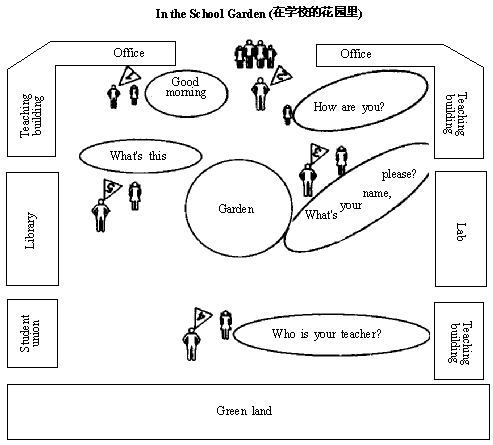
看图画,读句子,回答问题.

Notes注释:

①School gate学校大门  ②Teaching building教学大楼  ③Garden花园  ④Library图书馆  ⑤Lab实验室  ⑥Green land绿地  ⑦Student union学生会  ⑧Office办公室  ⑨Where are they talking?他们在哪儿谈话?

1.Good morning!

[  ]

A.Good morning!

B.How are you?

C.Hello!

2.How are you?

[  ]

A.How do you do?

B.Fine, thank you.

C.How are you?

3.What's your name, please?

[  ]

A.I'm thirteen.

B.I'm from New York.

C.My name is Joe.

4.Who is your teacher?

[  ]

A.Yes, I'm in Class 1.

B.No, I'm twelve.

C.My teacher is Miss Sue.

5.What's this?

[  ]

A.Stand up, please.

B.It's our Gardon.

C.This way, please.

查看答案和解析>>

阅读表达

  The Chinese are very generous when it comes to educating their children.Some parents send their children to the best schools or even abroad to England, the US or Australia, regardless of how much this costs.Many also want their children to take extra-curriculum activities(课外活动)where they either learn a musical instrument or ballet, or other classes that will give them a better start in life.The Chinese believe that the more expensive an education is, the better it is, so parents often spend a large amount of money on education.Even poor parents manage to buy a computer for their son or daughter.

  In fact, most parents fail to see that the best education they can give their children is usually very cheap.Parents can see that their children’s skills are different; they will usually be skilled in some areas while poor in others.However, they fail to realize that today's children are lack(缺乏)of self-respect and self-confidence.

  The problem is that parents are only educating their children on how to take exams and how to study effectively.They are not teaching them the most important skills they need.They do not teach them to be confident, happy and clever.

  Parents can help achieve this by teaching their children practical skills like cooking, sewing and other housework.

  Teaching a child to cook will improve many of the skills that he will need later in life.Cooking demands patience and time.It is an enjoyable but difficult experience.A good cook always tries to improve his cooking, so he will learn to work hard and finish his job step by step.The result, a well--cooked dinner, will give a child a lot of satisfaction and confidence.All these will help the children step to success in the future.

  An old machine such as a broken radio or TV set that you give your child as a toy may make him curious and arouse(唤醒)his interest.If he will spend hours looking at it, and try to mend it; your child might become an engineer when he grows up.Such activities do more than teaching a child to read a book.They teach them to think and to use their minds.This is much more important than learning by reading a book.

1.Is the writer satisfied with the Chinese parents’ ideas of educating their children?

_________________

2.Put the underlined sentence “the more expensive an education is, the better it is” into Chinese.

_________________

3.What are the children lack of today?

_________________

4.How is the experience of cooking according to the fifth paragraph?

_________________

5.What does the underlined word “They” refer to(所指的是)in the last paragraph?

_________________

查看答案和解析>>

根据短文内容选择可以填入空白处的最佳答案。(Choose the best answers to complete the passage.)

  Chinese are very generous(慷慨的)when it comes to educating their children.No caring about the   1  ,parents often send their children to the best schools or even abroad-to England, the USA or Australia.The Chinese believe that the more expensive the education is, the   2   it is.So parents will spend a lot of money on their son or daughter.  3   they're not rich, they would rather pay for the education.

  The problem is that parents are only educating their children on how to   4   tests and how to study well, but they are not teaching them the most important skills that they need.And these skills are important to help them to be   5  , happy and clever.

  Teaching a child to cook will   6   many of the skills that he will need later in life.Cooking needs patience and time.It is an interesting   7   difficult experience.A good cook   8   tries to improve his cooking, so he will learn to work hard and gradually(逐渐的)finish   9   job successfully.His result, a well-cooked dinner, will make him   10   good and give him a lot of self-confidence.

  Some old machines,   11   a broken radio or TV set that you give your child to play   12  , will make him   13   and want to know more.He will   14   hours studying them and trying to fix them.Your child might become an engineer when he   15   These activities are teaching a child not only to study at school, but also to think, to use his mind.And that is more important.

(1)

[  ]

A.

money

B.

education

C.

children

D.

schools

(2)

[  ]

A.

best

B.

better

C.

good

D.

worse

(3)

[  ]

A.

Because

B.

But

C.

Though

D.

When

(4)

[  ]

A.

success

B.

discuss

C.

pass

D.

give

(5)

[  ]

A.

educational

B.

different

C.

famous

D.

confident

(6)

[  ]

A.

improve

B.

choose

C.

miss

D.

reach

(7)

[  ]

A.

so

B.

but

C.

and

D.

as well as

(8)

[  ]

A.

sometimes

B.

always

C.

never

D.

seldom

(9)

[  ]

A.

my

B.

his

C.

her

D.

their

(10)

[  ]

A.

sound

B.

look

C.

feel

D.

taste

(11)

[  ]

A.

for example

B.

just like

C.

such as

D.

such like

(12)

[  ]

A.

with

B.

for

C.

against

D.

together

(13)

[  ]

A.

interesting

B.

interests

C.

interested

D.

interest

(14)

[  ]

A.

take

B.

pay for

C.

spend

D.

cost

(15)

[  ]

A.

wakes up

B.

grows up

C.

brings up

D.

turns up

查看答案和解析>>


同步练习册答案