
题目列表(包括答案和解析)
阅读理解
Letter ADear Etty Kit,
My roommate's family want me to have Thanksgiving dinner with them in their home. I accepted (接受) the invitation (邀请), and I'm excited about going, but I'm a little worried about it, too. The social customs (社交习惯) in my country are very different from here, so I'm a little afraid of making mistakes.
Should I bring a gift, such as candy or flowers? Should I arrive on time or a little late? At the dinner table, how can I know which fork or knife to use? How can I let the family know that I'm thankful for their kindness?
Confused
Letter B
Dear Confused,
It's a good idea to bring a small gift when you go to a dinner party. Flowers are always nice, or you might bring a bottle of wine if you know that the family drink it.
You should arrive on time or five to ten minutes late. Don't get there early. If you're going to be more than fifteen minutes late, you should call and tell them.
Try to be free at the dinner table. If you don't know about choosing the correct fork, knife, or spoon, just watch the other people, and follow them. If you still have no idea of what to do, don't be shy (害羞) about asking the person next to you. It's better to ask than to be quietly uncomfortable (不安) and nervous (紧张).
If you like the food, say so. Of course, you'll thank the host and hostess for the meal and for their kindness. It's also a good idea to send a card or thank-you note the day after.
Etty Kit
1.Letter A is sent to ________ while letter B is sent to ________.
[ ]
2.Etty Kit may be ________.
[ ]
A.Confused's close friend
B.a person who gives advice about personal problem
C.a person who always holds parties
D.a flower or a candy seller
3.The writer wrote Letter A because he ________.
[ ]
A.was worried about what present he should give
B.wanted to make the whole family happy
C.wanted to know some social customs for a dinner party
D.would be a little late for a dinner party
4.Letter B is written to tell that ________.
[ ]
A.you always bring a nice gift when you go to a dinner party
B.you just watch the guests at a party and follow them, and do not be shy about asking questions
C.the Americans and Canadians like having a lot of dinner parties
D.if you follow a few rules of dinner parties you will have a good time at the party
5.The words“host and hostess”in the last paragraph of Letter B mean ________.
[ ]
A.people who go to a party
B.people who cook dinner
C.people who hold a party
D.people who send invitations
An important question about eating out is who pays for the meal. If a friend of yours asks you to have lunch with him, you may say something like this: “I'm afraid it'll have to be some place cheap, as I have very little money.” The other person may say: “OK, I'll meet you at McDonald's.”
This means that the two agree to go Dutch, that is, each person pays for himself. He may also say: “Oh, no. I want to take you to lunch at Johnson's,” or “I want you to try the steak (牛排) there. It's great.” This means the person wants to pay for both of you. If you feel friendly towards this person, you can go with him and you needn't pay for the meal. You may just say: “Thank you. That would be very nice.”
American customs (风俗) about who pays for dates (约会) aremuch the same as in other parts of the world. In the old days, American women wanted men to pay for all the meals. But, today, a university (大学) girl or a woman in the business world will usually pay her way during the date. If a man asks her to dinner, outside the working hours, it means “come as my guest (客人)”. So as you can see, it is a polite thing to make the question clear at the very beginning (开始).
(1) In the old days ________ often paid for all the meals.
[ ]
(2) “To go Dutch” means to ________.
[ ]
A.go to play outside
B.eat out
C.pay for oneself
D.go to a cheaper eating-place
(3) “McDonald's” here means ________.
[ ]
(4) If you feel friendly to the person, ________.
[ ]
A.you should pay for him
B.you needn't pay for him
C.you can accept his invitation
D.you can't accept (接受) his invitation (邀请)
(5) We'd better know who will pay for the meal ________.
[ ]
A.at the beginning
B.at the end
C.in the middle of the meal
D.after drinking
In Britain ,people often invite friends for a meal , a party or just coffee. People who know each other very well may visit each other’s houses without an invitation(邀请),but if we invite new friends, usually an invitation is needed. When people invite someone to their homes , they often say ,“Would you like to come for dinner on Saturday ?” Answers are, “Thanks, we’d love to. What time?” or “I’m sorry, We’d love to ,but we have tickets for the concert.” However, it is not polite to say,“No, we wouldn’t.”
Sometimes, the British use expressions that sound like invitations but which are not invitations. For example. “You must come over for a drink sometime .” or “Let’s go out for a meal one of these days.” These are usually just polite ways of ending a talk . They are not real invitations because they don’t mention an exact time or day. They just show that the person is trying to be friendly and the answers are ,“Yes , that would be nice .” or “OK, yes ,thanks.”
So next time you hear what sounds like an invitation, listen carefully. Is it a real invitation or is the person just being friendly?
1.It’s always necessary for to visit each other’s houses with an invitation.
A.close friends B.family members
C.neighbours D.new friends
2.It is not polite to answer the real invitation by saying “ “
A.Sorry. We’d love to, but we have tickets for the concert .
B.Thanks. We’d love to, what time?
C.Sure. We’d like to. Thanks a lot.
D.No, we wouldn’t!
3.If the British just want to end a talk politely, they may say,” ”
A.Would you like to come for dinner on Saturday?
B.Let’s go out for a meal one of these days.
C.Let’s go out for a meal on Saturday.
D.Shall we go for a drink this afternoon .
4.The British often use “ ”to answer the invitations that are not real.
A.Yes , what time ?
B.No, that’s not a real invitation.
C.OK, yes , thanks.
D.No, you just want to be friendly.
5.Which is the best title for the passage?
A.Britain.
B.Invitation.
C.A Talk with Friends.
D.A Letter to Friends.
In Britain ,people often invite friends for a meal , a party or just coffee. People who know each other very well may visit each other’s houses without an invitation(邀请),but if we invite new friends, usually an invitation is needed. When people invite someone to their homes , they often say ,“Would you like to come for dinner on Saturday ?” Answers are, “Thanks, we’d love to. What time?” or “I’m sorry, We’d love to ,but we have tickets for the concert.” However, it is not polite to say,“No, we wouldn’t.”
Sometimes, the British use expressions that sound like invitations but which are not invitations. For example. “You must come over for a drink sometime .” or “Let’s go out for a meal one of these days.” These are usually just polite ways of ending a talk . They are not real invitations because they don’t mention an exact time or day. They just show that the person is trying to be friendly and the answers are ,“Yes , that would be nice .” or “OK, yes ,thanks.”
So next time you hear what sounds like an invitation, listen carefully. Is it a real invitation or is the person just being friendly?
【小题1】It’s always necessary for to visit each other’s houses with an invitation.
| A.close friends | B.family members |
| C.neighbours | D.new friends |
| A.Sorry. We’d love to, but we have tickets for the concert . |
| B.Thanks. We’d love to, what time? |
| C.Sure. We’d like to. Thanks a lot. |
| D.No, we wouldn’t! |
| A.Would you like to come for dinner on Saturday? |
| B.Let’s go out for a meal one of these days. |
| C.Let’s go out for a meal on Saturday. |
| D.Shall we go for a drink this afternoon . |
| A.Yes , what time ? |
| B.No, that’s not a real invitation. |
| C.OK, yes , thanks. |
| D.No, you just want to be friendly. |
| A.Britain. |
| B.Invitation. |
| C.A Talk with Friends. |
| D.A Letter to Friends. |
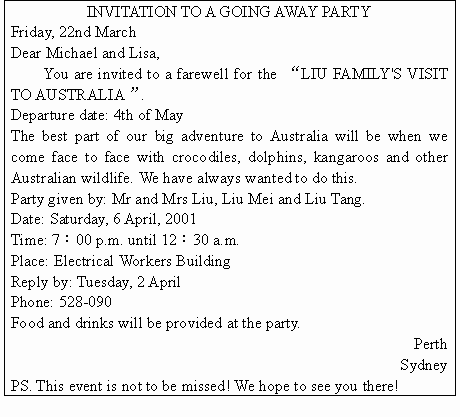
(1) This invitation was sent to ________.
[
]|
A .Liu Mei |
B .Liu Tang |
|
C .Mr and Mrs Liu Tang |
D .Michael and Lisa |
(2) By what date is it necessary to reply to the invitation?
[
]|
A .22nd March |
B .2nd April |
|
C .4th May |
D .5th August |
(3) What do the Liu family wish to see most of all on their trip to Australia?
[
]|
A .Countryside. |
B .Animals. |
C .People. |
D .Cities. |
(4) The expressions "come face to face with" could be replaced by ________.
[
]|
A .see |
B .learn about |
|
C .travel with |
D .stand beside |
(5) From the invitation we can tell that ________.
[
]A
.only Mr and Mrs Liu will travel to AustraliaB
.the Liu family will not return from AustraliaC
.the Liu family have been m Australia beforeD
.Liu Mei and Liu Tang will attend the farewell party湖北省互联网违法和不良信息举报平台 | 网上有害信息举报专区 | 电信诈骗举报专区 | 涉历史虚无主义有害信息举报专区 | 涉企侵权举报专区
违法和不良信息举报电话:027-86699610 举报邮箱:58377363@163.com