
题目列表(包括答案和解析)
There are few experiences quite pleasant as getting a good idea.You've had a problem, you've thought about it till you were tired; you've forgotten it and perhaps slept on it, and then flash! When you weren't thinking about it, suddenly the answer has come to you, as a present from the gods.You're pleased with it, and feel good.It may not be right, but at least you can try it out.Of course all ideas don't come like that, but the interesting thing is that so many do, particularly the most important one.They come into the mind, glowing(燃烧)with the heat of creation.
1.The most important ideas ____.
A.come when you are tired ????????????? ????????????? ????????????? ?????????????
B.are always right
C.are pleasing but not good ????????????? ????????????? ????????????? ?????????????
D.come as if they send out brightness and warmth
2.The ideas coming into the mind are worth ____.
A.thinking about
B.dreaming
C.trying out
D.sleeping on
3.What does “so many do” mean in the third paragraph?
A.Interesting ideas always turn out to be true.
B.Many ideas often come suddenly.
C.Many interesting things happen suddenly.
D.Many important ideas suddenly come from the gods.
| A.the writer was poor and didn’t buy the bookshelf for his wife |
| B.the writer’s wife didn’t like the bookshelf at all |
| C.the writer was always glad to buy something for his wife |
| D.the writer was not very glad to buy the bookshelf for his wife |
| A.He could drive slowly and it was safe. |
| B.Other drivers would let him go first. |
| C.His wife could use a new bookshelf. |
| D.He could save a lot of money and time. |
| A.Because they thought the writer liked studying very much and needed a bookshelf. |
| B.Because they didn’t think it was polite to overtake a car with a bookshelf on it. |
| C.Because they thought somebody in the writer’s family had died and he needed help. |
| D.Because they thought it was dangerous to carry a bookshelf on a car. |
| A.Before they arrived at the church. |
| B.Before they overtook the writer’s car. |
| C.After one of them looked at the flowers and the bookshelf carefully at the church. |
| D.After the writer’s family left the church. |
C
It was at least tow months before Christmas, when nine-year-old Almie Rose told her father and me that she wanted a new bike. Her Barbi bike was just too old, and it needed repairing as well.
As Christmas came nearer, her dream for a bike seemed to disappear, so we thought, for she didn’t mention it again. We were busy buying some beautiful storybooks, a doll house, a holiday dress and toys. Then much to our surprise, on December 24, she said she really wanted a bike more than anything else.
Now we didn’t know what to do. It was just toot late. We were busy with Christmas dinner and packing children’s presents, parents’ presents, a brother’s present and friends’ presents till midnight.So there was no time to take to buy the “right bike” for our little girl. Thinking that we were parents who would make their children unhappy, we felt guilty and sad.
Suddenly my husband came up with an idea. “What if I make a little bike out of clay(泥土) and write a note(便条) that she could trade in(交换) the model bike for a real one?” So he spent the next five hours carefully working with the clay to make a small bike.
On Christmas morning, we were so excited for Almie Rose to open the little box with the beautiful red and white clay bike and the note. She opened and read the note loudly.
She looked at me and Ron and said, ”So does this mean I can trade in this bike for a real one?” Smiling, I said, “Yes.”
Almie Rose had tears in her eyes when she replied, “I would never trade in this beautiful bike that Daddy made me. I prefer to keep it rather than get a real bike.” At that moment, we would have moved the God to buy her every bike on the Earth.
【小题1】Rose’s wish was to____ on Christmas Day.
| A.get a new bike | B.make a clay bike |
| C.receive a doll house | D.repair her old Barbi bike |
| A.didn’t want a bike any more |
| B.changed her idea to some story books |
| C.didn’t mention it in the last tow months |
| D.asked for it only on December 24 |
| A.unhappy | B.worried | C.happy | D.sorry |
| A.spend five hours finishing making a small bike with clay |
| B.make a small bike red and white |
| C.make her old bike red and white |
| D.put the present in the box |
| A.still wanted to get a real bike |
| B.didn’t know the meaning of the note |
| C.preferred a real bike to a model bike |
| D.was greatly moved by what her father had done |
We spent a day in the country and picked a lot of flowers. Our car was full of flowers inside! On the way home we had to stop at traffic lights, and there my wife saw the bookshelf. It stood outside a furniture(家具)shop. “Buy it,” she said at once. “We’ll carry it home on the roof-rack(车顶架). I’ve always wanted one like that.” What could I do? Ten minutes later I was twenty dollars poorer, and the bookshelf was tied on to the roof rack. It was tall and narrow, quite heavy too. As it was getting darker, I drove slowly. Other drivers seemed more polite than usual that evening. The police even stopped traffic to let us through. Carrying furniture was a good idea. After a time my wife said, “There’s a long line of cars behind. Why don’t they overtake(超车)?” Just at that time a police car did overtake. The two officers(警官)inside looked at us seriously when they went past. But then, with a kind smile they asked us to follow their car through the busy traffic. The police car stopped at our village church(教堂). One of the officers came to me. “Right, sir,” he said. “Do you need any more help now?” I didn’t quite understand. “Thanks, officer,” I said. “You’ve been very kind. I live just down the road.” He was looking at our things: first at the flowers, then at the bookshelf. “Well, well,” he said and laughed. “It’s a bookshelf you’ve got there! We thought it was--er, something else.” My wife began to laugh. Suddenly I understood why the police drove here. I smiled at the officer. “Yes, it’s a bookshelf, but thanks again.” I drove home as fast as I could.
1.From the story we know that _________.
|
A.the writer was poor and didn’t buy the bookshelf for his wife |
|
B.the writer’s wife didn’t like the bookshelf at all |
|
C.the writer was always glad to buy something for his wife |
|
D.the writer was not very glad to buy the bookshelf for his wife |
2.What made the writer think that carrying furniture was “a good idea”?
|
A.He could drive slowly and it was safe. |
|
B.Other drivers would let him go first. |
|
C.His wife could use a new bookshelf. |
|
D.He could save a lot of money and time. |
3.Why were the police and other drivers so kind to the writer?
|
A.Because they thought the writer liked studying very much and needed a bookshelf. |
|
B.Because they didn’t think it was polite to overtake a car with a bookshelf on it. |
|
C.Because they thought somebody in the writer’s family had died and he needed help. |
|
D.Because they thought it was dangerous to carry a bookshelf on a car. |
4.When did the officers begin to realize(意识到)they had made a mistake?
|
A.Before they arrived at the church. |
|
B.Before they overtook the writer’s car. |
|
C.After one of them looked at the flowers and the bookshelf carefully at the church. |
|
D.After the writer’s family left the church. |
Shaking It Off
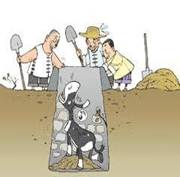
One day, a farmer’s donkey fell into a dry well(井). The poor animal cried for hours before his finally found him. The farmer tried hard to pull him out from the well but failed. He felt for the donkey but after carefully thinking about the situation, he that he would save neither the donkey nor the well. Since the donkey was too and it was not worth(值得) the trouble of saving. So he invited his neighbors to help him bury(埋葬) the old donkey in the __ so that it would make him end his pain.
many people coming to help, the old donkey was excited at first. As they began to scoop the dirt into the well with shovels(铲子), he soon what was happening. He felt upset and cried sadly again. As the farmer and his neighbors continued throwing the dirt on his , he suddenly had a good idea. Some time later, when the farmer finally looked down into the well, he was surprised at what he saw: the dirt landed on his back, he would shake it off and take a step up!
Soon, everyone was amazed when the donkey stepped over the edge of the well and ran away quickly! It seemed that it would him at first, but it actually helped him later because of the manner in which he faced his adversity(逆境).
That is life! Just like the donkey, life is going to throw dirt on us, all kinds of dirt. we face our problems in an active way, and refuse to to any trouble, each dirt is like a stepping stone with which we get out of the deepest wells. This is a key one of the secrets of life. stop and never give up. Success is just in its way.
1.A. neighbor B. owner C. relative D. kid
2.A. sorry B. lucky C. dangerous D. worried
3.A. complained B. decided C. agreed D. meant
4.A. strong B. tall C. old D. poor
5.A. water B. hole C. well D. house
6.A. Heard B. Hearing C. To hear D. Hears
7.A. realized B. remembered C. discovered D. found
8.A. leg B. stomach C. tail D. back
9.A. any time B. every time C. one time D. some time
10.A. angrily B. heavily C. proudly D. sadly
11.A. save B. bother C. fill D. bury
12.A. as soon as B. as long as C. as far as D. as well as
13.A. give up B. give out C. give in D. give off
14.A. to B. of C. on D. from
15.A. Always B. Never C. Sometimes D. Hardly
湖北省互联网违法和不良信息举报平台 | 网上有害信息举报专区 | 电信诈骗举报专区 | 涉历史虚无主义有害信息举报专区 | 涉企侵权举报专区
违法和不良信息举报电话:027-86699610 举报邮箱:58377363@163.com