
题目列表(包括答案和解析)
听力(20分)
一、听对话选择正确的答案。本部分共有10道小题,每道小题你将听到一段对话,每段对话听两遍。在听每段对话前,你将有5秒钟的时间阅读题目;听完后,你还有5秒钟的时间选择你认为最合适的备选答案。在听到嘀的信号后,进入下一小题。
1.What kind of TV programme does the boy like best?
A.

B.

C.

2.What type of TV programme is the man's son interested in?
A.

B.

C.

3.How will the weather be this afternoon?
A.

B.

C.

4.Who is the man's favourite actress?
A.

B.

C.

5.What is the boy's English teacher like?
A.Active.
B.Helpful.
C.Polite.
6.Why didn't Jenny look well?
A.She was ill.
B.She was afraid of math.
C.She stayed up late.
7.What's the boy's problem?
A.He is too shy.
B.His face turns red.
C.He is alone.
8.What's the relationship between the two speakers?
A.A father and a son.
B.A headmaster and a teacher.
C.A teacher and a student.
9.What does Bob like to do in his free time?
A.Collect cards.
B.Collect stickers.
C.Play football.
10.How will the woman probably go to the nearest hospital?
A.By bus.
B.On foot.
C.By taxi.
二、听对话和短文回答问题。你将听到一段对话和两篇短文,各听两遍。在对话或短文前,你将有时间阅读相关小题,每小题5秒钟;听完后,每小题你仍有5秒钟时间选择你认为最合适的备选答案。
听一段对话,回答第11-12小题。答题完毕,请等待嘀的信号,进入第一篇短文。
11.What are they talking about?
A.Last night's TV play.
B.Last night's film.
C.Last night's football game.
12.What are they going to have for supper?
A.Some coffee.
B.Sandwiches.
C.Some coffee and sandwiches.
听第一篇短文,回答13-15小题。请根据内容,从A、B、C三个选项中选择正确答案,完成信息记录表。

13.A.Science
B.PE
C.English
14.A.those who laugh at her
B.her Maths problems
C.how to swim faster
15.A.Much happier
B.Much sadder
C.Much more tired
听第二篇短文,回答16-20小题。
16.What does Liu Dehua do?
A.A singer and dancer.
B.A singer and actor.
C.A dancer and actor.
17.Liu Dehua's English name is ________.
A.Liu Furong
B.Dehua Liu
C.Andy Lau
18.He is ________ years old.
A.47
B.33
C.52
19.What ball does Liu Dehua like?
A.Football.
B.Driving.
C.Bowling(保龄球).
20.Liu Dehua has ________.
A.one brother
B.two brothers
C.four brothers
第一部分 听对话回答问题(共5分)
本部分共有10道小题,每小题你将听到一段对话,每段对话听两遍。在听每段对话前,你将有5秒钟的时间阅读题目;听完后,你还有5秒钟的时间选择你认为最合适的备选答案。在听到“嘀”的信号后,进入下一小题。
1.What sign is it there?
A.

B.

C.

2.Which animal are they talking about?
A.

B.

C.

3.Which country will the woman's brother study in?
A.

B.

C.

4.What is the girl doing at the moment?
A.

B.

C.

5.Where can the woman be?
A.At a library.
B.At the doctor's.
C.At a bookshop.
6.What does Alice mean?
A.She doesn't think watching English movies is helpful.
B.She thinks joining English club is interesting.
C.She likes watching English movies.
7.What does the woman mean?
A.She likes the show.
B.She thinks the show is boring.
C.She didn't watch the show.
8.What is her pen friend's native language (母语)?
A.English.
B.Japanese.
C.French.
9.What does the man most probably do?
A.A waiter.
B.A shopkeeper.
C.A doctor.
10.What are Mary and John going to do?
A.To get two tickets for the film.
B.To see an American film.
C.To make a film.
第二部分 听对话和短文回答问题(共5分)
你将听到一段对话和两篇短文,各听两遍。听每段对话和短文前,你将有时间阅读相关小题,每小题5秒钟;听完后,每小题你仍有5秒钟的时间选择你认为最合适的备选答案。
听第一段对话,回答11-12小题。答题完毕,请等待“嘀”的信号,进入第一篇短文。
11.How often is the World Cup held?
A.Every other four years.
B.Every four years.
C.Every other year.
12.When will the 30th Olympic Games take place?
A.In the year 2020.
B.In the year 2012.
C.In the year 2016.
听第一篇短文,回答13-15小题。请根据短文内容,选择正确答案,完成信息记录表。答题完毕,请等待“嘀”的信号,进入下一篇短文。
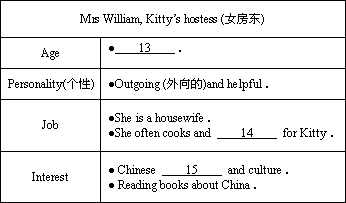
13.A.About 20 years old.
B.About 40 years old.
C.About 60 years old.
14.A.washes clothes
B.tidies the room
C.walks the dog
15.A.songs
B.tea
C.history
听第二篇短文,回答第16-20小题。
16.What did the farmer's friend grow?
A.Apples.
B.Oranges.
C.Bananas.
17.What present did the friend give the farmer?
A.A lot of apples.
B.A big apple tree.
C.A young apple tree.
18.Where did the farmer plant the tree?
A.In the open space on the farm.
B.In a place full of sunlight.
C.In a place where nobody could see it.
19.What happened to the tree?
A.It grew quickly.
B.It died.
C.The friend took it back.
20.What do you think of the rich English farmer?
A.He was kind-hearted.
B.He was quite clever.
C.He was not clever.
听力
第一部分 听对话回答问题(计10分,每小题1分)
本部分共有10道小题,每小题你将听到一段对话,每段对话听两遍。在听每段对话前,你有5秒钟的时间阅读题目;听完每段对话后,你将有5秒钟的时间选出你认为最合适的答案。请在听到“滴”的信号时,进入下一小题。
1.Which picture are they talking about?
A.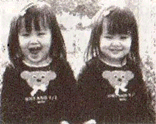
B.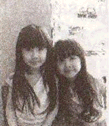
C.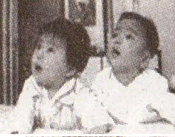
2.Which watch is the boy’s?
A.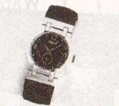
B.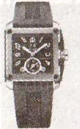
C.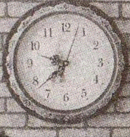
3.Which one is Peter?
A.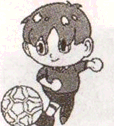
B.
C.
4.What does the woman like doing?
A.
B.
C.
5.What time did Lily get to school this morning?
A.At 7∶10 a. m.
B.At 7∶00 a. m.
C.At 6∶50 a.m.
6.Who has a big nose and small eyes?
A.Jack.
B.Jim.
C.Sorry, I don’t know.
7.What’s Sandy like?
A.She is very helpful.
B.She is very honest.
C.She is very generous.
8.Who is the best at English?
A.Jim.
B.Lucy.
C.Kate.
9.How is Sally’s maths teacher?
A.Pretty and slim.
B.Tall and handsome.
C.Beautiful and handsome.
10.Where are they talking?
A.In Sandy’s room.
B.In Sandy and Bob’s room.
C.In Bob’s room.
第二部分 听对话和短文回答问题(计10分,每小题1分)
你将听到两段对话和一篇短文,各听两遍。每段对话或短文后各有几道小题。在听每段对话或短文前,你有时间阅读相关小题,每小题5秒钟;听完后,每小题你将有5秒钟的时间选出你认为最合适的答案。
听第一段对话,完成第11-12小题。答题完毕,请等待“滴”的信号,进入下一段对话。
11.Why does Nick say Amy is his best friend?
A.Because Amy is pretty and helpful.
B.Because Amy is kind and likes helping people.
C.Because Amy is in the same class with Sandy.
12.Who is the oldest?
A.Amy.
B.Sandy.
C.Nick.
听第二段对话,完成第13-15小题。答题完毕,请等待“滴”的信号,进入下一篇短文。
13.What is the man going to do?
A.Watch a football match.
B.Watch a film.
C.Watch a cartoon show.
14.When will it begin?
A.At 6∶50.
B.At 7∶05.
C.At 7∶40.
15.Where will they watch it?
A.At the cinema.
B.At the theatre.
C.At home.
听一篇短文,回答第16-20小题。
16.Which school does Li Li come from?
A.No.54 Middle School.
B.No.45 Middle School.
C.No.40 Middle School.
17.Why did she choose such an English name?
A.Because she thought she was as lovely as an angle.
B.Because she wanted to be an angel.
C.Because her parents liked the name.
18.What’s her bobby?
A.She likes watching news.
B.She likes reading.
C.She likes sports.
19.What’s she going to be when she grows up?
A.She wants to be a news reporter.
B.She wants to be a sports reporter.
C.She wants to be a player.
20.What is she like?
A.She looks tall and slim.
B.She is strong and outgoing.
C.She looks little but she is outgoing.
A: Excuse me, Susan.( 1)Is this your backpack?
B: No, it isn’t. It’s Jack’s. (2)My backpack is green.
A: Is your computer game in the lost and found case?
B: No, it’s Jack’s. And that white eraser is Jack’s, too.
A: Do you know Jack?
B: Yes, I do. (3)他是一个英国男孩。He’s in Class One, Grade Seven.
A: Oh, What’s his telephone number?
B: 100-2116.
A: Is Miss Miller his English teacher?
B: Yes, she is.
【小题1】将划线部分(1)译成汉语。________________________________
【小题2】将划线部分(2)改为一般疑问句. ____________________________
【小题3】将划线部分(3)译成英语
______________________________________________________
【小题4】 What’s the English teacher’s last name?(回答问题)
______________________________________________________
【小题5】 What color is Jack’s eraser? (回答问题)
______________________________________________________
湖北省互联网违法和不良信息举报平台 | 网上有害信息举报专区 | 电信诈骗举报专区 | 涉历史虚无主义有害信息举报专区 | 涉企侵权举报专区
违法和不良信息举报电话:027-86699610 举报邮箱:58377363@163.com