
题目列表(包括答案和解析)
Winners Club
Winners Club is a bank account (账户) specially for teenagers. It has been sep up to help you better manage your money. The club is a bank account where you receive a key-card, so you can enjoy dealing with your money 24/7 — that’s 24 hours a day, 7 days a week!
Here are the features (特点) of the club.
? No account keeping fees (费用)!
You’re not a rich man, so we don’t expect you to pay large fees. In fact, it’s free for all the service!
? Excellent interest rates (利率)!
You want your money to grow, right? If you put money into the club without taking it out for a year, the club will give you a good rate of interest.
? Convenient (方便)!
Teenagers are busy — we get that. You may never need to come to a bank at all. With the club you can choose to use handy tellers and to bank from home using the phone and the Internet. This could be your pocket money or your pay from your part-time job!
? A free magazine included!
Besides your account report, you will receive a free magazine full of good ideas about making more money. There are also other fantastic offers only for the club members.
? Easy to be a member!
It is so easy to join. Simply fill in an application form (申请表). By the way, one of your parents must agree on it. Then you can become a member of the club.
Now you see the club is a great choice for teenagers. We can’t wait to have you as a Winners Club member.
【小题1】Is Winners Club specially for teenagers?
【小题2】How many features of Winners Club are mentioned in the passage?
【小题3】How do you make your money in Winners Club grow?
【小题4】What ideas can the club members read on the magazine?
【小题5】What does the writer mainly tell teenagers?
Winners Club
Winners Club is a bank account (账户) specially for teenagers. It has been sep up to help you better manage your money. The club is a bank account where you receive a key-card, so you can enjoy dealing with your money 24/7 — that’s 24 hours a day, 7 days a week!
Here are the features (特点) of the club.
? No account keeping fees (费用)!
You’re not a rich man, so we don’t expect you to pay large fees. In fact, it’s free for all the service!
? Excellent interest rates (利率)!
You want your money to grow, right? If you put money into the club without taking it out for a year, the club will give you a good rate of interest.
? Convenient (方便)!
Teenagers are busy — we get that. You may never need to come to a bank at all. With the club you can choose to use handy tellers and to bank from home using the phone and the Internet. This could be your pocket money or your pay from your part-time job!
? A free magazine included!
Besides your account report, you will receive a free magazine full of good ideas about making more money. There are also other fantastic offers only for the club members.
? Easy to be a member!
It is so easy to join. Simply fill in an application form (申请表). By the way, one of your parents must agree on it. Then you can become a member of the club.
Now you see the club is a great choice for teenagers. We can’t wait to have you as a Winners Club member.
1.Is Winners Club specially for teenagers?
2.How many features of Winners Club are mentioned in the passage?
3.How do you make your money in Winners Club grow?
4.What ideas can the club members read on the magazine?
5.What does the writer mainly tell teenagers?
There are hundreds of funny and strange expressions in the English language. A lot of them include country names or nationalities. Take these examples:
The Dutch(丹麦人)are the target of most English expressions about nationalities. Why are there so many jokes about the Dutch in English? And what do these expressions mean? In the 17th and early 18th centuries, there were three wars between the British and the Dutch, and Dutch became a bad word. So double Dutch means something that has no meaning or is impossible to understand. A Dutch uncle is someone who gives much stronger advice than they need to. There are later expressions, which are funnier and kinder, like to go Dutch, which is nowadays a popular expression. It means to pay for your part of a bill. This often happens when a group of friends have a meal together, and each person pays for the food they ate. I’m a Dutchman is another commonly used expression. This means not being able to believe something.
An expression with a similar meaning to double Dutch is it’s all Greek to me, which means I don’t understand. The expression was made famous in Shakespeare’s play Julius Caesar although the expression is actually hundreds of years older.
If you take French leave, you are not present or leave somewhere without permission. For example, you could take French leave from a classroom or the place where you work. This expression is from the 18th century when French people left parties without saying goodbye to the host or hostess.
There are Chinese whispers, which mean confused(令人困惑的)messages. This describes the fact that a message can often change as it is passed from person to person. This expression comes from the First World War when foreigners were often confused by Chinese language.
Many people find English expressions confusing, but now that you know about some of them, you can easily have fun finding out many more funny English expressions.
【小题1】Are there many jokes about the Dutch in English?
【小题2】When did Dutch become a bad word?
【小题3】What does “French leave” mean?
【小题4】Which three expressions mentioned above have similar meanings?
【小题5】What do the funny and strange expressions in the passage have in common?
There are hundreds of funny and strange expressions in the English language. A lot of them include country names or nationalities. Take these examples:
The Dutch(丹麦人)are the target of most English expressions about nationalities. Why are there so many jokes about the Dutch in English? And what do these expressions mean? In the 17th and early 18th centuries, there were three wars between the British and the Dutch, and Dutch became a bad word. So double Dutch means something that has no meaning or is impossible to understand. A Dutch uncle is someone who gives much stronger advice than they need to. There are later expressions, which are funnier and kinder, like to go Dutch, which is nowadays a popular expression. It means to pay for your part of a bill. This often happens when a group of friends have a meal together, and each person pays for the food they ate. I’m a Dutchman is another commonly used expression. This means not being able to believe something.
An expression with a similar meaning to double Dutch is it’s all Greek to me, which means I don’t understand. The expression was made famous in Shakespeare’s play Julius Caesar although the expression is actually hundreds of years older.
If you take French leave, you are not present or leave somewhere without permission. For example, you could take French leave from a classroom or the place where you work. This expression is from the 18th century when French people left parties without saying goodbye to the host or hostess.
There are Chinese whispers, which mean confused(令人困惑的)messages. This describes the fact that a message can often change as it is passed from person to person. This expression comes from the First World War when foreigners were often confused by Chinese language.
Many people find English expressions confusing, but now that you know about some of them, you can easily have fun finding out many more funny English expressions.
1.Are there many jokes about the Dutch in English?
2.When did Dutch become a bad word?
3.What does “French leave” mean?
4.Which three expressions mentioned above have similar meanings?
5.What do the funny and strange expressions in the passage have in common?
A person will breathe shallowly and high in the chest when getting visual
(视觉)information. She will breathe deeply and slowly when getting kinesthetic(肌肉运动知觉的)information. And somewhere in between when getting auditory(听觉)information.When getting visual information, the person will be likely to look up, straighten up her body, and make gestures
(手势)into space. When getting auditory, she/he will be likely to look to the side, maybe slant(倾斜)her/his head and cross her/his arms.When accessing kinesthetic, she will tend to look down and slump over.The person will speak faster and more loudly when getting visual information than when getting auditory information. When getting kinesthetic, she will speak with a lower, slower tone of voice.
You can be more or less of a specialist in understanding and explaining all of these. You don't really need to know them all well to do basic body movements. As long as you notice that,there are changes, and you notice when someone is looking happy and satisfied, and when she isn't, then you can do just well in your part.
But if you know body language really well you can do magic with it. People will see that you are reading their minds, when really you are just looking at them.
(1)The underlined word
“shallowly”means[ ]
|
A .浅 |
B .长 |
C .深 |
D .轻 |
(2)A person will breathe ________ in the chest when listening to something.
[ ]
A
.shallowly and highB
.deeply and slowlyC
.either shallowly and high or deeply and slowlyD
.neither shallowly and high nor deeply and slowly(3)Which of the following pictures shows that she/he is getting auditory?
[ ]
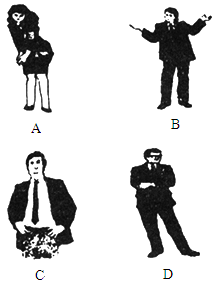
(4)A person will speak fastest and most highpitched when accessing________information.
[ ]
|
A .visual |
B .auditory |
C .kinesthetic |
D .language |
湖北省互联网违法和不良信息举报平台 | 网上有害信息举报专区 | 电信诈骗举报专区 | 涉历史虚无主义有害信息举报专区 | 涉企侵权举报专区
违法和不良信息举报电话:027-86699610 举报邮箱:58377363@163.com