
题目列表(包括答案和解析)
How would you like to study at an American university in China? With the news that New York University (NYU) is considering setting up a branch(分校)on Chinese mainland, the possibility of getting an American education becomes a reality. But how will Chinese students deal with a very different style of teaching? One that encourages debate(辩论), discussion and critical thinking (批判思维); one which puts little attention on rote learning.
You know how kids ask questions all the time? Asking questions shows they are curious (好奇). So when does that natural curiosity get weak? Not at kindergarten or nursery, nor at primary school. As you grow older perhaps refusing to draw attention to yourself by asking the teacher questions, you grow quiet. If so, that's a pity, because questioning your teachers should be encouraged. After all, they're the ones who've been educated, have a lot more experience than you and perhaps have a little wisdom. When I taught joumalim at college in Scotland I enjoyed answering students' questions. Some of them raised difficult questions. I didn't always know the answers. If I didn't, I'd accept it and try to find out later.
At university we were encouraged to challenge our classmates and teachers. There was often a regular meeting between teachers and some students. A student would prepare a paper on a subject and the other students would criticize it. It could be frightening. But it was a way of developing critical thinking.
We need to differentiate critical thinking with loudmouths. We've all come across loudmouths who speak out quickly as if they knew what they were talking about. I know one loudmouth who is paid a great deal of money by a British tabloid newspaper to entertain readers with his deeply-held prejudices(偏见). You might not agree with columnist(专栏作家) Richard Littlejohn, but you have to say that he is entertaining and there is an internal logic(内在的逻辑)to his statements. Having a logical mind can help develop critical thinking.
My wife doesn't have a logical mind, but she does have emotional intelligence(情商). I can't say that I have anything like her emotional intelligence. but I'd like to think some of it rubbed off on me. If you can't at least try to put yourself in someone else's shoes, how can you understand their situation, their problems and issues?
So try to develop your powers of critical thinking. Start with books, films, music and newspapers. And don't believe everything you read or see. Think independently.
57. According to the passage, to develop your critical thinking, you can____________.
A. keep curious and follow your heart
B. think logically, not emotionally
C. do more reading and think actively
D. voice your opinion like a loudmouth
58. The underlined words 66rubbed off on mc" in Paragraph 5 probably mean " __________".
A. helped me solve the problem better
B. had some influence on me in a way
C. moved it backwards and forwards
D. advised me to wear others' shoes
59. What can be the best title for the passage?
A. Want to be different? Think critically
B. Want to be critical? Think for yourself
C. Choose NYU, choose critical thinking
D. Importance of improving critical thinking
No one knows exactly how many disabled people there are in the world, but the number may be over 450 million. The number of disabled people in India alone is probably more than double the total population of Canada.
In the United Kingdom, about one in ten people have some disability. Disability is not just something that happens to other people. As we get older, many of us will become less mobile (可动的) , hard of hearing or have failing eyesight.
Disablement can take many forms and happen at any time of life. Some people are born with disabilities. Many others become disabled as they get older. There are many progressive disabling diseases. The longer time goes on, the worse they become. Some people are disabled in accidents. Many others may have disability in the form of a mental illness. All are affected by people’s attitude(态度) towards them.
Disabled people face many physical barriers(障碍). Next time you go shopping or to work or visit friends, imagine what would you do if you could not get up steps, or on to buses and trains. What would you do if you could not see where you were going or could not hear the traffic? But there are other barriers: prejudice(偏见)can be even harder to break down and ignorance (无知) represents by far the greatest barrier of all. It is almost impossible for the able-bodied to fully understand what the disabled go through, so it is important to draw attention to these barriers and show that it is the individual person(个人) and their ability, not their disability, which counts.
54. The first paragraph points out that ___________.
A. it is possible to get an exact number of the world’s disabled people
B. there are many disabled people in the world
C. the number of disabled people in India is the greatest
D. India has not much more disabled people than Canada
55. The key word in Paragraph 4 is ___________.
A. barriers B. disabled C. disability D. prejudice
56. Which of the following statements is NOT true according to the passage?
A. There are about 10 percent disabled persons in the UK.
B. The whole society should pay more attention to the barriers faced by the disabled people.
C. Even the able-bodied may lose some of their body functions when they get older.
D. There is still prejudice against the disabled which results mainly from ignorance.
57. It can be concluded from the passage that ___________.
A. we should try our best to prevent disablement
B. we must take a proper attitude towards the disabled
C. the able-bodied people will never fully understand the disabled
D. both physical and mental barriers are hard to break down
What do you do if you're in trouble on a lonely island? Surely you need to find a way to get in touch with the outside world. Your best chance of doing this is to draw the attention of a passing plane.
Body signals (信号)
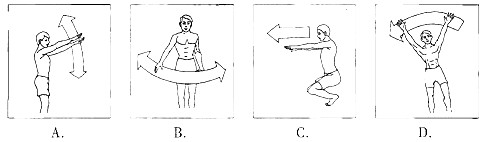
Pilots from different countries understand body signals if they have the correct training, When you wave your arms up and down in a straight line, it means, "yes". When you point downwards and swing your arm from side to side, it means "no". If you want the pilot to know that it's safe to land, push your hands out in front of you and bend (弯曲) your knees. If you want to say that it's not safe to land, put your arms in the air and move them to one side.
Smoke signals
The smoke from a fire can be seen from far away, so it’s a good way to draw attention. If the weather is dry, it isn’t hard to start a fire. Remember, however, that fires can be very dangerous if they get out of control. Never light a tire unless you're sure that it can’t spread. If the ground is dark, light smoke can be seen more easily. Green grass and leaves produce light smoke.
Ground-to-air signals
It's a good idea lo build some signals, too. Use large pieces of wood to make the symbols (标记). If you can't find any wood, use earth. Some useful symbols are:
F "I need food and water"
II "I need medicine."
I "I am badly hurt."
X "I am unable lo move from here."
Pilots' replies
If the pilot lowers the plane's wings from side to side, this means: "message received and understood" (At night, the pilot flashes the plane's green lights.) If the pilot flies the plane in a clockwise circle, this means "message received hut not understood" (At night, the: pilot flashes the plants red lights.)
However, there is no signal which means "message not received. Why not'?
1.How many signals can we use to draw the attention of the passing plane if you're in trouble?
A. Three. B. Four C. Five D. Six
2.Which picture means "it's not safe to land"?
3.What can we learn from the passage?
A. Swinging your arm from side to side means "yes"
B. If the ground is dark, light smoke can’t be seen.
C If you need some medicine, make a symbol “Ⅱ”.
D. The pilots make replies with a blue light at night.
4.What is the passage mainly about?
A. The explanation of building signals on an island.
B. The importance of making signals on an island.
C. Ways of sending out signals on a lonely island.
D. Ways of receiving signals from a lonely island.

The willful blindness in hockey toward concussions (头部撞击) has dropped. Hockey Canada has followed the lead of USA Hockey in preventing bodychecking (身体拦截) below age 13. A bad head injury of Sidney Crosby, the hockey's greatest star, opened the eyes of hockey people everywhere. This country's children have been facing similar danger at early ages, and Hockey Canada had to deal with a deep worry in the minds of Canadians to make the rule change. The liking for bodychecking from an early age is part of what makes Canadian hockey what it is.
The change in rules should be taken as a chance to draw special attention to skill development in an environment free of danger. It may also control the loss of thousands of young players who don't enjoy that environment.
For years, many Canadian hockey parents and coaches have insisted that bodychecking at early ages is necessary to ensure that players can do it safely at older ages. True or not, there may be a safer way to teach hitting than to make younger players pay a price for it in head injuries. When USA Hockey changed its rules for the 2011-2012 season, it also created bodychecking-education programs that will be mandatory(强制的) for all coaches, including those teaching players in the pre-checking ages. And it began to encourage more "touch" - without real bodychecking - from 9 t0 12. It also made the rules for 13 and up stricter. The USA is trying to show that it's possible to teach hockey protective skills without putting11 and 12-year-olds in greater danger. It's worth the try.
Hockey Canada has taken serious steps to do away with hits on the head. However, it's hard to change a sports culture so connected with who we are as a country. Too often, bodychecking has been used to try to separate a player from his head rather than from the ball. Children were paying a price for this country's love of the game.
There are always changes in Canada's game, and the change in the bodychecking age sends the clearest message yet to coaches and parents that player safety is paramount(至上的) in the game.
1.We can tell that the problem of bodychecking in Canada____________.
A. is controlled strictly
B. is taken more seriously now
C. is caused by players' carelessness
D. is connected with players' interest
2.What does the writer want to tell us in Paragraph 2?
A. The safe ways of controlling the loss.
B. The steps of drawing special attention.
C. The possible results of changing the rules.
D. The methods of improving the environment.
3.What can we learn from the passage?
A. The USA found a safer way to teach bodychecking.
B. Bodychecking-education programs in the USA are successful.
C. Bodychecking is a good way to value players' skills in the USA.
D. The USA has tried to create an environment of less bodychecking.
4.What is probably the best title' for this passage?
A. Which is more important?
B. How do we change the rules?
C. Why is hockey a dangerous game?
D. When should bodychecking be prevented?
| A.Draw a lesson from every failure | B.The attitudes towards failure ? | C.Failure is everywhere in our life | D.Failure is very important |
湖北省互联网违法和不良信息举报平台 | 网上有害信息举报专区 | 电信诈骗举报专区 | 涉历史虚无主义有害信息举报专区 | 涉企侵权举报专区
违法和不良信息举报电话:027-86699610 举报邮箱:58377363@163.com