
题目列表(包括答案和解析)
Two Chinese spacecrafts successfully completed China’s first space docking early November 3, 2011, which has taken the country a step closer to building its own space station.
Nearly two days after its launch, the unmanned spacecraft Shenzhou VIII docked with the space lab module Tiangong I more than 343 km above the earth surface. Shenzhou VIII and Tiangong I took apart after flying together for 12 days. On the 14th of November, the two spacecrafts finished the second docking. Then Shenzhou VIII parted from Tiangong I again and returned to the earth safely on the 17th. Tiangong I is still traveling around the earth in the space, waiting for the arrival of Shenzhou IX and X and so on in the near future.
That marked another great leap for China’s space program and made China the third country in the world, after the United States and Russia, to master the space docking technique (空间对接技术).
The world’s first space docking was achieved in 1966, when the manned U.S, spacecraft Gemini 8 (双子星8号) docked with an unmanned Agena Target Vehicle (阿金纳目标飞行器). Space docking is necessary to explore space beyond Earth’s orbit. “The capability increases China’s ability to act independently in space, as well as its ability to work together with others,” said Gregory Kulacki, a U.S. space scientist and senior analyst.
“With the success of its first space docking, China is now equipped with the basic technology and ability required for the construction of a space station,” said Zhou Jianping, chief designer of China’s manned space program.” The country is on its way to building a permanent manned space station around 2020.”
【小题1】What did the success of the first space docking mean to China?
| A.China has caught up with the United States in the space exploration field. |
| B.China took a step closer to building its own space station. |
| C.China became the first country to master the space docking technique. |
| D.China has the ability to build a permanent manned space station right now. |
| A.Shenzhou VIII. |
| B.Tiangong I |
| C.The Space Station |
| D.The success of China’s first space docking |
| A.Tiangong I will fly in the space for 12 days. |
| B.The first space docking of the world was achieved in 1966, by Russians. |
| C.Without space docking technique people can’t explore space beyond Earth’s orbit. |
| D.The U.S.A helped China achieve the first space docking. |
| A.The first space docking of China. |
| B.The history of space docking. |
| C.The first space docking of the world. |
| D.The space docking technique |
Two Chinese spacecrafts successfully completed China’s first space docking early November 3, 2011, which has taken the country a step closer to building its own space station.
Nearly two days after its launch, the unmanned spacecraft Shenzhou VIII docked with the space lab module Tiangong I more than 343 km above the earth surface. Shenzhou VIII and Tiangong I took apart after flying together for 12 days. On the 14th of November, the two spacecrafts finished the second docking. Then Shenzhou VIII parted from Tiangong I again and returned to the earth safely on the 17th. Tiangong I is still traveling around the earth in the space, waiting for the arrival of Shenzhou IX and X and so on in the near future.
That marked another great leap for China’s space program and made China the third country in the world, after the United States and Russia, to master the space docking technique (空间对接技术).
The world’s first space docking was achieved in 1966, when the manned U.S, spacecraft Gemini 8 (双子星8号) docked with an unmanned Agena Target Vehicle (阿金纳目标飞行器). Space docking is necessary to explore space beyond Earth’s orbit. “The capability increases China’s ability to act independently in space, as well as its ability to work together with others,” said Gregory Kulacki, a U.S. space scientist and senior analyst.
“With the success of its first space docking, China is now equipped with the basic technology and ability required for the construction of a space station,” said Zhou Jianping, chief designer of China’s manned space program.” The country is on its way to building a permanent manned space station around 2020.”
1.What did the success of the first space docking mean to China?
A. China has caught up with the United States in the space exploration field.
B. China took a step closer to building its own space station.
C. China became the first country to master the space docking technique.
D. China has the ability to build a permanent manned space station right now.
2.What does the underlined word “That” in the third paragraph refer to?
A. Shenzhou VIII.
B. Tiangong I
C. The Space Station
D. The success of China’s first space docking
3.What can we learn from the passage?
A. Tiangong I will fly in the space for 12 days.
B. The first space docking of the world was achieved in 1966, by Russians.
C. Without space docking technique people can’t explore space beyond Earth’s orbit.
D. The U.S.A helped China achieve the first space docking.
4.What’s the best title of this passage?
A. The first space docking of China.
B. The history of space docking.
C. The first space docking of the world.
D. The space docking technique
 Two Chinese spacecrafts successfully completed China’s first space docking (对接) early November 3, 2011, which has taken the country a step closer to building its own space station.
Nearly two days after its launch, the unmanned spacecraft Shenzhou VIII docked with the space lab module Tiangong I more than 343 km above the earth surface. Shenzhou VIII and Tiangong I took apart after flying together for 12 days. On the 14th of November, the two spacecrafts finished the second docking. Then Shenzhou VIII parted from Tiangong I again and returned to the earth safely on the 17th. Tiangong I is still traveling around the earth in the space, waiting for the arrival of Shenzhou IX and X and so on in the near future.
That marked another great leap for China’s space program and made China the third country in the world, after the United States and Russia, master the space docking technique (空间对接技术).
The world’s first space docking was achieved in 1966, when the manned U.S, spacecraft Gemini 8 docked with an unmanned Agena Target Vehicle. Space docking is necessary to explore space beyond Earth’s orbit (轨道). “The capability increases China’s ability to act independently in space, as well as its ability to work together with others,” said Gregory Kulacki, a U.S. space scientist and senior analyst.
“With the success of its first space docking, China is now equipped with the basic technology and ability required for the construction of a space station,” said Zhou Jianping, chief designer of China’s manned space program.” The country is on its way to building a permanent manned space station around 2020.”
1 What did the success of the first space docking mean to China?
A. China has caught up with the United States in the space exploration field.
B. China took a step closer to building its own space station.
C. China became the first country to master the space docking technique.
D. China has the ability to build a permanent manned space station right now.
2 What does the underlined word “That” in the third paragraph refer to?
A. Shenzhou VIII B. Tiangong I
C. The Space Station D. The success of China’s first space docking
3 What can we learn from the passage?
A. Tiangong I will fly in the space for 12 days.
B. The first space docking of the world was achieved in 1966, by Russians.
C. Without space docking technique people can’t explore space beyond Earth’s orbit.
D. The U.S.A helped China achieve the first space docking.
4 Which of the following statements is Not True?
A. Shenzhou VIII docked with the space lab module Tiangong I on November 3, 2011
B. Shenzhou VIII returned to the earth safely on November 17, 2011.
C. The USA , Russia and China have mastered the space docking technique
D. Tiangong I is still traveling around the earth, waiting for the arrival of Shenzhou IX and X around 2020.
5 What’s the passage mainly about?
A. The first space docking of China. B. The history of space docking.
C. The first space docking of the world. D. The space docking technique
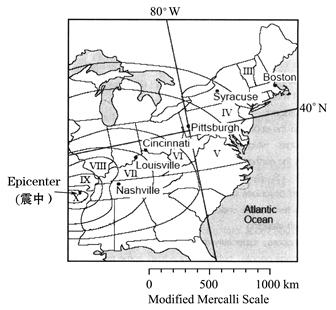
Earthquake Intensity & Observed Effects(强度与现象)
I. Felt by only a few people under very special conditions.
II. Felt by only a few people at rest, especially on the upper floors of buildings.
III. Felt noticeably indoors, especially on upper floors of buildings.
IV. Felt indoors by many people, outdoors by a few; some awaked.
V. Felt by nearly everyone; many awaked; dishes and windows break; plaster (灰泥) cracks (开裂).
VI. Felt by everyone; many frightened and run outdoors; heavy furniture such as tables and shelves moves.
VII. Everyone runs outdoors; small to moderate (中等的) damage(损毁) in usual buildings.
VIII. Considerable (相当大的) damage in usual buildings; monuments(碑) fall.
IX. Considerable damage in all buildings; ground cracks; underground pipes (管道) break.
X. Most buildings damaged; rails bend(弯曲); landslides (山崩) take place; water splashes(溅落) over banks.
XI. Few buildings left standing; bridges damaged; wide cracks in the ground; underground pipes break.
XII. Damage total; waves seen on ground; objects thrown into air.
【小题1】According to the picture, what is the possible position of the earthquake’s epicenter?
| A.36°N, 90°W. | B.36°N, 90°E. | C.90°N, 36°W. | D.90°N, 36°E. |
| A.Everyone runs outdoors. |
| B.Only a few people feel it. |
| C.Many people who stay indoors feel it. |
| D.Felt by people on the upper floors of buildings. |
| A.Cincinnati. | B.Louisville. | C.Pittsburgh. | D.Nashville. |
| A.Felt indoors by few people under very special conditions. |
| B.Few buildings left standing. |
| C.Felt noticeably indoors, especially on upper floors of buildings. |
| D.Felt indoors by many people, outdoors by a few, some awaked. |
| A.Nashville. | B.Louisville. | C.Syracuse. | D.Cincinnati. |
湖北省互联网违法和不良信息举报平台 | 网上有害信息举报专区 | 电信诈骗举报专区 | 涉历史虚无主义有害信息举报专区 | 涉企侵权举报专区
违法和不良信息举报电话:027-86699610 举报邮箱:58377363@163.com