
题目列表(包括答案和解析)
第一部分 听力考查(30分)
第一节 听句子,根据你所听到的句子,选择恰当的答语。(句子读两遍)(5分)
1.
A.I'm fine, thank you.
B.How do you do?
C.Nice to meet you, too.
2.
A.It's Sally's.
B.It's red.
C.It's under the desk.
3.
A.That's all right.
B.Sure, here you are.
C.No, you can't.
4.
A.In Canada.
B.Not far from here.
C.Today is Sunday.
5.
A.I was in the library.
B.With my uncle.
C.Good luck!
第二节 听对话
(A)从A、B、C三幅图画中选出符合对话内容的图画。(对话读两遍)(6分)
6.
A.
B.
C.
7.
A.
B.
C.
8.
A.
B.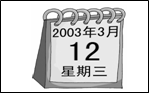
C.
9.
A.
B.
C.
10.
A.
B.
C.
11.
A.
B.
C.
(B)根据你所听到的对话,选择正确的答案。(对话读两遍)(14分)
听第一段对话,回答第12、13小题:
12.The boy went there with his ________.
A.brother
B.uncle
C.aunt
13.How was the weather in Beijing?
A.Rainy.
B.Cloudy.
C.Sunny.
听第二段对话,回答第14、15小题:
14.Wang Mei likes ________ best.
A.Christmas Day
B.Spring Festival
C.Children's Day
15.She likes it because she can ________.
A.eat nice food
B.get many toys
C.meet many friends
听第三段对话,回答第16、17小题:
16.Who will have a birthday party tomorrow?
A.Lucy.
B.Jane.
C.Maria.
17.What will the woman give her as a birthday gift?
A.ACD.
B.A notebook.
C.A cake.
听第四段对话,回答第18、19小题:
18.Where may this dialog happen?
A.In a classroom.
B.In a theater.
C.In a shop.
19.There is something wrong with the man's ________.
A.clock
B.computer
C.camera
听第五段对话,回答第20、21小题:
20.Sally hurt her ________ badly.
A.arm
B.eyes
C.leg
21.How long does Sally have to stay in bed?
A.Two days.
B.Two weeks.
C.Two months.
听第六段对话,回答第22、23小题:
22.They will go to the ________ tomorrow.
A.museum
B.park
C.theater
23.What time will they start tomorrow?
A.At 7∶00.
B.At 7∶30.
C.At 7∶40.
听第七段对话,回答第24、25小题:
24.What has Roy had?
A.Some apple juice.
B.Three apples.
C.Three apple pies.
25.Roy's mother thinks it's ________ for her to eat too much sweet food.
A.good
B.bad
C.nice
(C)听一段较长对话,回答第26-30小题。(对话读三遍)(5分)
26.How many subjects does Jane have in the morning?
A.Three.
B.Four.
C.Five.
27.Where are Jane's sports shoes?
A.In the bag.
B.On her feet.
C.Under the desk.
28.David has a P.E.lesson on ________.
A.Tuesday
B.Thursday
C.Friday
29.What is David's favorite subject?
A.Geography.
B.English.
C.History.
30.From the dialogue, we know that the two speakers are ________.
A.classmates
B.brother and sister
C.friends
During my childhood in the 1960s, my parents were always busy with work and meetings. They left early in the morning and came back late in the evening. My sisters, my brother and I were left alone with Grandma. We saw our parents only on Sundays and during the few holidays. The only long period (一段)of time during which the whole family could be together once a year was the Spring Festival. We missed our parents badly, but didn’t say so because we had been told that hard work was everyone’s duty and that we could not have our own small family without a big family. Later I was a hard working student and, during summer or winter holidays, often stayed alone at university to have more time to study. I was always encouraged by my parents, for whom the holiday was less important than “work” and “study”. Holidays were a waste of time and I felt as if I had done something wrong if I took a holiday or did nothing during a holiday.
I spent the most difficult period of my life abroad. But when I joined this company, my boss didn’t seem to think it right for me to work like that. When I called him at home after office hours for business purposes (目的), he politely told me that he preferred talking about work with me in the office.
When the holiday season came near, he asked me to plan my leave beforehand (提前). He talked with me about his holiday and also asked about mine. For him, leave was a right. Giving up a holiday for the company is encouraged in China, but is foolish here. I began to think about holidays.
Today my parents are retired (退休)and stay home with a lot of time for their children. But we are all grown- up and live far away. We miss each other, but we cannot afford to see each other very much and they often feel sorry for the fact that they were too busy to be able to take care of us when we were young.
Nowadays, Chinese take long weekends and have paid holidays. But do they use their holidays to enjoy family life? I hope so because my experience in China and Europe has helped me understand that work is not my whole life and that a family is also very important. I do not want to feel sorry in the future as my parents do and I certainly spend as much time with my son as possible. There is nothing wrong with either working hard or taking holidays, but we shouldn’t have one instead of the other. It is important to keep a balance (平衡)between work and play.
1. What do the underlined words “paid leave” mean?
A. You have to pay when you take a holiday.
B. Someone will pay for your holiday.
C. You are still paid when you have your holiday.
D. You can’t leave until you pay for the holiday.
2. What is the main idea of this passage?
A. Working is the only part of the life.
B. Traveling is the best way to spend your holiday.
C. Enjoying holidays is as important as working
D. Sharing happiness with your family is more important
3. The writer talks about her own experience because she hopes that the Chinese will _______. A. plan their holiday beforehand B. get used to long holidays and enjoy themselves C. give up a holiday for their work D. bring business home after work hours
(A)
A crow(乌鸦)is sitting in a big tree. She has a big piece of meat in her mouth.“My babies will have a nice breakfast,”she thinks. An old fox(狐狸)is looking for his breakfast. He sees the crow and the meat.“How can I get that piece of meat?”he thinks.
“Good morning, Mrs. Crow.”says the fox,“How are you?”But the crow doesn’t say a word. “You have very nice babies, Mrs. Crow.”says the fox,“How are they? May I see them ?”Still the crow doesn’t say a word.
“You are very beautiful, Mrs. Crow, and you have a beautiful voice(嗓子),too.”says the fox,“Would you please sing a song for me? ”Mrs. Crow thinks“How nice Mr. Fox is! I must sing him a song.”So she opens her mouth and begins to sing. At that time, the meat drops down(掉下)from her mouth.
( ) 1. There’s in the crow’s mouth.
A. a piece of bread
B. a cup of tea
C. a big piece of meat
( ) 2. The old fox very much.
A. wants to eat the piece of meat
B. wants to eat the crow
C. wants the crow to sing for him
( ) 3. The crow doesn’t say a word to the fox because .
A. she doesn’t like the fox at all
B. her babies are not well
C. she has a piece of meat in her mouth
( ) 4. When she opens her mouth, the fox .
A. gets the piece of meat
B. eats the baby crows
C. climbs up the tree
( ) 5. Who has a nice breakfast?
A. The crow.
B. The old fox.
C. The baby crows.
(B)
Mr. Day was a teacher at a school in a big city in the north of England. He usually went to France or Cuba for a few weeks during his summer holidays and he spoke French quite well.
But last year Mr. Day said to one of his friends,“I’m going to have a holiday in Japan, but I can’t speak Japanese. So I am going to go to evening classes and have Japanese lessons for a month before I go.”
He studied very hard for a month, and then his holidays began and he went to Japan.
When he came back a few weeks later, his friend asked him,“Did you have any trouble with your Japanese when you were in Japan, Dick?”
“No, I didn’t have any trouble with it,”answered Mr. Day,“But the Japanese did!”
Read the passage and choose the best answers.(阅读短文,选择最佳答案。)
( ) 6 Mr. Day was a teacher at a school in .
A. England B. France C. Cuba D. Japan
( ) 7 Every year he was in for a few weeks during his summer holidays.
A. France B. Cuba C. France and Cuba D. France or Cuba
( ) 8 But last year he went to .
A. China B. Japan C. Cuba D. France
( )9 Mr. Day stayed in Japan for .
A. a few days B. a few weeks C. ten months D. more than a year
( ) 10 Which of the following sentences is right?
A. Mr. Day studied very hard, and he could speak Japanese quite well.
B. Two months later, he went to Japan.
C. Mr. Day can speak English and French well.
D. Mr. Day didn’t have much trouble with his Japanse.
(C)
Skin-diving (潜水) is a new sport today. This sport takes you into a wonderful new world. It is like a visit to the moon. When you are under water,it is easy for you to climb big rocks (岩石),because you are no longer (不再) heavy.
Here, under water, everything is blue and green. In the day, there is much light. When fish swims nearby (附近), you can catch them with your hands.
When you have tanks (罐) of air on your back, you can stay in deep (深的) water for a long time. But you must be careful when you dive in deep water.
To catch fish is one of the most (最) interesting parts of this sport. Besides (除……之外),there are more uses for skin-diving. You can clean ship without taking them out of water. You can get many things from the deep sea.
Now you see that skin-diving is both useful and interesting.
根据短文内容,选择正确答案。
( ) 11 Skin-diving is a new sport. It can take you to .
A. the moon B. a new world of land
C. the mountains (山脉) D. deep water
( ) 12In deep water .
A. there is much light B. there is no light at all
C. you can find a lot of blue fish D. everything looks blue and green
( ) 13 With tanks of air on your back, you can .
A. catch fish very easily B. stay under water for a long time
C. climb big rocks D. have more fun
( )14 From this passage, we can know under water.
A. we become fat B. we become thin
C. we become lighter (更轻) D. we become heavier (更重)
( )15 Which of the following is NOT true?
A. Skin-diving is a new sport.
B. Skin-diving is like a new sport.
C. The only use of skin-diving is to have more fun.
D. Skin-diving is interesting and useful.
湖北省互联网违法和不良信息举报平台 | 网上有害信息举报专区 | 电信诈骗举报专区 | 涉历史虚无主义有害信息举报专区 | 涉企侵权举报专区
违法和不良信息举报电话:027-86699610 举报邮箱:58377363@163.com