
题目列表(包括答案和解析)
| |||||||||||||||||||||||||||||||||||||||||||||||||||||||||||||||||||||||||||||||||||||||||||||||||||||
| |||||||||||||||||||||||||||||||||||||||||||||||||||||||||||||||||||||||||
任务型阅读,阅读下列短文,根据短文中的信息完成文后表格。(每空一词)
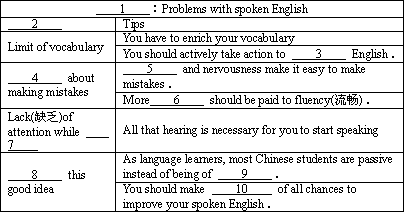
Although many Chinese students say that their knowledge of English grammar is good, most would admit(承认)that their spoken English is poor.Whenever I speak to a Chinese student, they always say, “My spoken English is poor.” However, their spoken English does not have to remain “poor.” I would like to suggest that there may be some reasons for their problems with spoken English.
First, they fail to find suitable words to express themselves because of a limited(有限的)vocabulary.Obviously the better answer is to enrich their vocabulary.However, you can speak with a limited vocabulary, if you are active.Others will follow you as long as you use the words that you know.
Second, they are afraid of making mistakes.Sometimes they make mistakes when they are speaking because they are shy and nervous.Yet students should remember that their goal should be FLUENTLY(流畅的)NOT ACCURACY(准确的).Sometimes you may worry about using a wrong word or tense, but it doesn't matter because the person you are speaking to will understand you and make allowances for any mistakes he hears.
The third reason is that not enough attention is paid to listening.You have one mouth but two ears! All that hearing is necessary for you to start speaking.
Fourth, most Chinese students are passive(被动的, 消极的)language learners.Instead of actively finding chances to improve their spoken English.If you have this good idea, then, you will see English chances wherever you go.
If you do not use your English beyond the classroom, you will forget that English you know.Remember: USE IT OR LOSE IT! You can learn how to speak English better by speaking English more.
| |||||||||||||||||||||||||||||||||||||||||||||||||||||||||||||||||||||||||
Most dictionaries will tell you a number of things about a language. There are three important things. The three things are spelling, pronunciation
(发音)and meanings.First, a dictionary will tell you the spelling of a word. If you are not sure about the spelling of a word, you can try to find the correct spelling in a dictionary. Words are listed in alphabetical order
(按字母顺序)--a, b, c and so on. For example, on a dictionary page the word“poor”--p, o, o, r --comes before“poverty”--p, o, v, e, r, t, y --and the word“poverty”comes before the word“power”--p, o, w, e, r. The words are always given in alphabetical order.The second thing, a dictionary will tell you pronunciation. Most dictionaries give phonetic
(语的),or sound, alphabet. The phonetic spelling will tell you how a word is pronounced. There are a few different phonetic alphabets. Many dictionaries use the International(国际的)Phonetic Alphabet to show pronunciation.The third thing, a dictionary will tell you the meaning of words. You can look up a word and find out what it means. Many words have more than one meaning, and a good dictionary will tell you all of the word's meanings. For example, in English the common word
“get”has over 20 different meanings.
(1
)In the passage, which of the following is among the three important things?[ ]
A
.How to write a word well.B
.How to use a word.C
.How to make a sentence.D
.How to read a word correctly.(2
)Of the three words“remove”,“remote”and“remount”, ________ in a dictionary.[ ]
A
.“remount”comes first and“remove”comes lastB
.“remove”first and“remote”lastC
.“remote”first and“remove”lastD
.“remove”first and“remount”last(3
)Many words have ________.[ ]
|
A .several meanings |
B .few meanings |
|
C .one meaning |
D .no meaning |
(4
)A better dictionary can tell you ________.[ ]
A
.more of the word's pronunciationB
.more of grammarC
.more of the word's meaningsD
.more of the word's spelling(5
)Phonetic alphabets are used to show ________.[ ]
|
A .spelling |
B .handwriting |
|
C .meanings |
D .pronunciation |
湖北省互联网违法和不良信息举报平台 | 网上有害信息举报专区 | 电信诈骗举报专区 | 涉历史虚无主义有害信息举报专区 | 涉企侵权举报专区
违法和不良信息举报电话:027-86699610 举报邮箱:58377363@163.com