
题目列表(包括答案和解析)
补全对话。从方框中选出适当的句子,完成对话。

M:It’s December 30th today.
W:________(1)A new year is coming.
M:________(2)
W:I am going to the shop to buy something for our evening party.
M:________(3)
W:On New Year’s Eve.We’ll have our teachers and students get together until New Year’s Day comes.Can you tell me something about your party?
M:________(4)First I will ask our Chinese teacher to give us a talk about the history of our country, then some students will sing and dance, and we will have our meal together.
W:I think it must be very interesting.________(5)
(A)
There are twelve months in a year. The names of the twelve months are January, February, March, April, may, June, July, August, September, October, November, December. Each month has thirty days or thirty-one days. In a leap-year (闰年), February has twenty-nine days. A leap year comes once in four years. There are 365 days in a year. There are seven days in a week. They are Sunday, Monday, Tuesday, Wednesday, Thursday, Friday, Saturday. The parts of the day are morning, afternoon, evening and night. April, June, September and November have thirty days. All the rest have thirty-one days, except February alone.
根据短文内容,指出能回答所提问题的最佳答案。
( )⒈ Which month has twenty-nine days?
A. Every month. B. Every month except February.
C. February in each leap-year. D. February in every year.
( )⒉ Is Monday the first day of the week?
A. Yes, it is. B. Yes, they are. C. No, it isn’t. D. No, they aren’t.
( )⒊ What day comes after Thursday?
A. Wednesday. B. Friday. C. Saturday. D. Tuesday.
( )⒋ How many days are there in a year?
A. 7. B. 365. C. 12. D. 29.
( )⒌ How many days are there in a leap-year?
A. 364. B. 365. C. 366. D. 367.
(B)
Jack works in a factory. The factory is far from his house. He gets up very early. He usually has breakfast at half six and takes the bus to the factory. He has lunch at the factory. And he has supper at home with his family. After supper he usually goes out for a walk. At seven he watches TV or listens to the radio. He is an old worker. He likes his work very much. He works very hard in the factory. He often says he works hard for the people. He is ready to (乐于) help the young men. He teaches them how to do their work better (更好). All the young workers like him.
根据短文内容,判断下列句子的正( R )与误 ( W )。
( )⒍ Jack is a teacher in a family.
( )⒎ Jack’s house isn’t far from the factory.
( )⒏ He doesn’t have lunch at home with his family.
( )⒐ He likes his work very much and works very hard in the factory.
( )⒑ He often helps the young workers and teaches how to speak English.
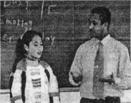
When I was a foreign teacher in China, every day I taught English to
my students and they taught me about China. One day the topic turned to
saying "I love you". I was shocked (震惊) to learn that not one of my
students had said this to their mothers, nor had their mothers said it to
them. "Does your mom love you?" "Of course ,"they answered.
 "How do you know ?"was my logical question. Some students
answered that their moms cooked and always told them what they were doing wrong to show their caring. I was shocked. So mom's cooking and criticizing read out as "I love you ". "Then how do you say 'I love you 'to her?" They agreed that getting good grades, followed by good jobs would be how they showed their love.
I come from a culture where most people are expressive enough, so I repeated these questions in classes over time. Gradually, I began to get different answers. Some of them had exchanged those sentiments with their moms.
One of my favorite stories of change came from a girl. When she came home from university, her mother met her at the door and hugged (拥抱) her. This had never happened before, but her mom said, "Now that you have gone I have more time to myself I noticed that in some places mothers and children hug each other and I decided it was a good idea and that I would begin hugging you."
In my family we all say "I love you" a lot .While it is true that we often say the words without having great depth(深度) of feelings at that moment, it is almost like a blessing we give each other. Those three little words carry a world of meaning, even when said as a greeting, but most especially if they are the last words we say to or hear from those we love.
81.The foreign teacher
A. comes from America B. is a young woman
C. doesn't understand Chinese culture D. knows much about China
82. Why was the foreign teacher shocked?
A. Because the students say "I love you" to her.
B. Because the students don't know the meaning of" I love you".
C. Because the students' moms don't love them.
D. Because her students and their mums didn't say "I love you" to each other.
83. Chinese mothers prefer to show love by_
A. saying "I love you" B. cooking
C. getting good grades D. doing something helpful
84. In paragraph 4,what's the meaning of the mom's hugging?
A. She doesn't want her daughter leave her again.
B. She loves her daughter and misses her.
C. She is glad that she has more time to herself
D. She finds it interesting to hug her daughter.
85. What's the main idea of the passage?
A. Say "I love you" to your family.
B. Say "I love you "a lot to Chinese people .
C. Say "I love you "as a greeting to others.
D. Say "I love you "without great depth of feelings.
湖北省互联网违法和不良信息举报平台 | 网上有害信息举报专区 | 电信诈骗举报专区 | 涉历史虚无主义有害信息举报专区 | 涉企侵权举报专区
违法和不良信息举报电话:027-86699610 举报邮箱:58377363@163.com