
题目列表(包括答案和解析)
Eating Chocolate Can Make You Smarter
Chocolate lovers know that eating chocolate makes them happy.Now it turns out that eating chocolate may also make them smarter.
Dr.Bryan Raudenbush recently made a study to see how eating chocolate affects people’s brains.The U.S.researcher knew that chocolate contained several stimulants(兴奋剂).But he wasn’t sure how those stimulants actually affected chocolate eaters.
To find out,Raudenbush had a group of volunteers eat 85grams of milk chocolate.He asked another group to eat no chocolate at all.After l 5 minutes,he tested their memory and their ability to solve problems.
The group that ate milk chocolate had higher scores.They were able to remember more words and pictures than the group that did not eat chocolate.Raudenbush concluded(得出结论) that the stimulants in chocolate increased mental(精神的)alertness(灵敏度).
Of course,eating chocolate doesn’t guarantee(保证)you’ll pass every test.You’ll still need to study hard!
1.Many people like eating chocolate because it can make them .
A.annoyed B.unhappy C.pleased D.funny
2.The American researcher knew that .
A.chocolate was a kind of stimulant
B.there were some stimulants in chocolate
C.chocolate contained many objects in it but not stimulants
D.many people loved to eat it because of its stimulants
3.Why did Raudenbush ask a group of volunteers to eat chocolate?
A.Because he thought it was exciting.
B.Because he wasn’t sure how many people eat chocolate.
C.Because his American friend asked him to do so.
D.Because he wanted to know how stimulants affected the eaters of chocolate.
4.The result of the test is that .
A.the stimulants in chocolate increased mental alertness.
B.the group that ate chocolate had higher scores than the group that didn't eat
C.one group ate chocolate but another didn’t eat it.
D.Nothing happened to the groups.
5.If you want to pass every exam, .
A.you will just eat enough chocolate
B.you will ask the expert to have a chocolate test
C.you will still need to study hard
D.you needn’t go to school
Since the 1970s, scientists have been searching for ways to link the brain with computers. Braincomputer interface (BCI) technology could help people with disabilities send commands to machines.
Recently, two researchers, Jose Millan and Michele Tavella from the Federal Polytechnic School in Lausanne, Switzerland, demonstrated (展示) a small robotic wheelchair directed by a person’s thoughts.
In the laboratory, Tavella operated the wheelchair just by thinking about moving his left or right hand. He could even talk as he watched the vehicle and guided it with his thoughts.
“Our brain has billions of nerve cells. These send signals through the spinal cord (脊髓) to the muscles to give us the ability to move. But spinal cord injuries or other conditions can prevent these weak electrical signals from reaching the muscles.’ Tavella says. “Our system allows disabled people to communicate with external world and also to control devices.”
The researchers designed a special cap for the user. This head cover picks up the signals from the scalp (头皮) and sends them to a computer. The computer interprets the signals and commands the motorized wheelchair. The wheelchair also has two cameras that identify objects in its path. They help the computer react to commands from the brain.
Prof. Millan, the team leader, says scientists keep improving the computer software that interprets brain signals and turns them into simple commands. “The practical possibilities that BCI technology offers to disabled people can be grouped in two categories: communication, and controlling devices. One example is this wheelchair.”
He says his team has set two goals. One is testing with real patients, so as to prove that this is a technology they can benefit from. And the other is to guarantee that they can use the technology over long periods of time.
41. BCI is a technology that can ________.
A. help to update computer systems B. link the human brain with computers
C. help the disabled to recover D. control a person's thoughts
42. How did Tavella operate the wheelchair in the laboratory?
A. By controlling his muscles. B. By talking to the machine.
C. By moving his hand. D. By using his mind.
43. Which of the following shows the path of the signals described in Paragraph 5?
A. scalp→computer→cap→wheelchair B. computer→cap→scalp→wheelchair
C. scalp→cap→computer→wheelchair D. cap→computer→scalp→wheelchair
44. The team will test with real patients to ________.
A. make profits from them B. prove the technology useful to them
C. make them live longer D. learn about their physical condition
45. Which of the following would be the best title for the text?
A. Switzerland, the BCI Research Center
B. New Findings about How the Human Brain Works
C. BCI Could Mean More Freedom for the Disabled
D. Robotic Vehicles Could Help to Cure Brain Injuries
High school ______ covers a lot, including Chinese, Math, Geography and so on.
A.ability B.information C.practice D.course
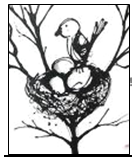
Oriole’s Nest
Picky, Picky
Scientists have no idea exactly why birds choose certain objects to build their nests. But scientists know that the main reason birds build nests is to keep their babies safe, warm and healthy.
Baby birds grow faster and are healthier when they are warm. They also learn to fly and leave the nests sooner than birds without warm homes.
What A Yarn (纱)
Yarn is big on an oriole’s shopping list during nest building. Scientists are still trying to work out why so many birds choose white yarn over other colors for nest building.
Scientists think that the white objects remind birds of cotton fluff (绒毛) they find in the wild.
Do It Naturally
Even though birds can help us recycle some of our junk by using it to build nests, they also need to use lots of natural things. Long grass, dried sticks, spider’s silk and mud are some of the natural ingredients that are good for nests, too.
You can make a collection box of things to leave for birds so they can help themselves. Hang a small plastic box with holes on a tree branch. Fill the box freely with nest building goodies. Hang the box on a tree and watch birds climb on board to pick through the junk to find their treasures.
Warning: Don’t let the birds turn into a tasty treat. Keep your bird station away from places where cats hang out.
For The Birds!
Stop! Don’t throw all that garbage out! Give some to the birds. Look and see how your old junk can help beautify and warm a bird’s new home.
【小题1】The baby birds with warm homes are able to _____.
| A.choose right objects | B.leave the nests sooner |
| C.build good nests | D.learn to fly higher |
| A.Holes on the tree. | B.Food out of the rubbish. |
| C.A warning board. | D.A collection box of things. |
| A.Birds build nests to store things. |
| B.Birds regard white objects as cotton. |
| C.Birds and humans can help each other. |
| D.Birds and cats fight against each other. |
Play is the basic business of childhood, and in recent years research has shown the great importance of play in the development of a human being. From earliest infancy(婴儿), every child needs opportunity and right materials for play, and the main tools of play are toys. The main function of toys is to suggest, encourage and play. To succeed in this, they must be good toys, which children will play with often, and will come back again and again. Therefore, it is important to choose suitable toys for different stages of a child’s development.
In recent years, research on baby development has shown that the standard a child is likely to reach, within the range of his inherited(遗传的)abilities, is largely determined in the first three years of his life. So a baby’s ability to benefit from the right play materials should not be underestimated. A baby who is encouraged, talked to and shown things and played with, has the best chance of growing up successfully.
In the next stage, from three to five years old, curiosity knows no bounds. Every type of suitable toys should be made available to the child, for trying out, experimenting and learning, for discovering his own particular ability: Bricks and jigsaws(七巧板)and construction toys; painting, scribbling(涂鸦)and making things; sand and water play; toys for imaginative and pretending play—the first social games for learning to play and get on with others.
But at the third stage of play development—from five to seven or eight years old— the child is at school. But for a few more years play is still the best way of learning, at home or at school.It is easier to see which type of toys the child most enjoys.
Until the age of seven or eight, play and work mean much the same to a child.But once reading has been mastered, then books become the main source of learning. Toys are still interesting and valuable, which lead up to new hobbies, but their significance has changed to a child of nine or ten years old, toys and games mean, as to adults, relaxation and fun.
1. What does the writer want to tell us in the first paragraph?
A. Children should choose toys by themselves.
B. Children like playing, but they don’t need any toys.
C. Children should be given different toys as they grow up.
D. Children should be given the same toys as they grow up.
E. 58.According to the passage, we can give the child every kind of toys ________.
A.when he is two B.when he is around four
C.when he is six D.when he is eight
2.When a child is seven years old, what is the main source of learning?
A. Toys. B. Books. C. Jigsaws. D. Paintings.
3. What is the article mainly about?
A.The importance of schooling.
B.The choice of toys for children.
C.The importance of pre-school education.
D.The role of play in a child’s development.
湖北省互联网违法和不良信息举报平台 | 网上有害信息举报专区 | 电信诈骗举报专区 | 涉历史虚无主义有害信息举报专区 | 涉企侵权举报专区
违法和不良信息举报电话:027-86699610 举报邮箱:58377363@163.com