
Key sentences 重点句子 Have you cleaned out the refrigerator yet? I haven’t cleaned out the refrigerator yet. Have you fed the cat yet? Not yet. I’ll do it in a minute. Ability goals 能力目标 Enable students to understand and talk about recent events and the chores people have to do before a vacation. Emotion & attitude goals 情感与态度目标 Enable the students to do preparation independently before vacation. Strategy goals 策略目标 Brainstorming. Culture awareness 文化意识目标 Learn the different habit of vacation between western countries and Chinese. Teaching important points 教学重点 The Present Perfect Tense Teaching procedures and ways 教学过程与方式 Step 1 Check the homework and lead-in Ask two or more students to show their work and how they did it. T: In the last unit, you were asked to write a passage about a story happened last weekend, using the Past Tense. Now I’d like to know who’d like to display your project on the classroom wall. T: Now tell us where you found these materials and how you did it. S1: I picked this information on the Internet. S2: I found it in some books with the help of my parents. S3: I wrote this composition with the help of my dictionary. One sample version: On the morning of last weekend, my friend Kangkang and I were on the way to Fenghua Park when we found a tree bend, we felt very sorry for the tree and set out to do something to help it. We straighten the tree by tying it to a stick. We put a rope around the tree and put up a notice, which read, “Take Care of Trees . When we had finished working, we all felt tired. When we got to the park, it was almost 12:00. It was very hot, we felt tired and hungry. But we were happy and very satisfied with what we had done because we had made a contribution to the protection of the environment. T: Well, summer holiday is coming. I wonder what you are going to do during summer holiday. S1: I’m going to Beijing to visit some places of interest. T: Good idea. You’d better visit the Great Wall, or you will not be a real man. What about you, Tina? S2: I want to go to Dalian to relax myself because Dalian is a beautiful city and the weather is nice too. T: I think so. By the way, do you like the sea? S2: O f course. We like it very much. It’s so wide and beautiful. T: Why not go to the beach and go on a beach vacation? S2: Good idea! T: When we go on a beach vacation what will you pack? S1: A camera. S2: some clothes. S3: A map. T: I think so. You’d better take a guidebook, a bathing suit and a towel. They are very useful when you are on a beach vacation. (Use real objects or pictures to teach guidebook, bathing suit and a towel. Read the new words with students.) What are you going to pack when you go on a trip? (Write pack on the blackboard. Get students to guess the meaning) S4: I think I am going to pack an umbrella. It is very useful because it can be used both on a sunny day and a rainy day. T: I agree with you. What else are you going to pack, Judy? S5: A camera is very useful, I think. It can give me a good memory about the trip. Collect more possible things to pack: some clothes, a lot of money, some snacks, some fruit, towel, map, umbrella, sunglasses, bathing suit, guidebook- T: Well, we have got so many things to pack. We can’t pack all of them into a small suitcase. What are the three most important things to pack for the trip? S6: A camera, some clothes and money. T: Have you packed your camera? S7: Yes, I have already packed it. T: Have you packed your money? S7: No, I haven’t. I have to go to the bank to get it. T: You must be careful with your money. Money is not everything, but you cannot have a pleasant holiday without it. Have you packed your bathing suit, Jessie? S8: No, I haven’t washed it yet. Get several more students to show their answers and write some important sentences on the blackboard. T: Thank you for your wonderful work. Show the students some pictures and get the students to practice small dialogues using have you-? Sample dialogue 1: S1: Hello, where are you going? S2: I’m going on a beach vacation? S1: Have you packed your guidebook? S2: Yes. I have already packed it in the suitcase. Sample dialogue 2: S3: Hi, where are you going? S4: I’m going to the supermarket to buy some rice and dumplings. S3: Have you locked your door? S4: Yes, I have. It is dangerous to leave the door open when I go out. S3: That’s right. You must be careful. T: Good. You really did a great job. Now I wonder what the three most important things to pack are when you go on a beach vacation/a city vacation. Write your ideas below in 1a on page 110. Sample answers: A beach vacation Sightseeing in a city Bathing suit Jeans Umbrellas Camera Sunglasses Comfortable shoes Slippers Umbrellas Step II Listening and practice (1b, 1c:P110; 2a, 2b:P111) T: What would you do if you are going to do some listening practice? S1: I think we should know what we are asked to do first. T: Then what are you asked to do according to the instruction? S1: We are asked to listen and check the chores the people have already done. T: Now I want to know before you leave for a holiday, what chores you should do at home? S1: I think we should close the window. S2: We should water the flowers. T: Good idea. If you do not water the flowers, they will dry and die soon. S3: We’d better take out the trash. S4: We should clean out the refrigerator. S5: Turn off the light. S6: Lock the door. T: That’s right. If you leave the door and the window open, a thief will visit your house. Well, I think all of your advice is wonderful. Listen to the recording and check the chores the people have already done in 1b on page 110. T: Just now we listened to a conversation between a woman, a man and a boy. I think they have prepared everything for their beach vacation. Now make conversations in pairs, using the information from activity 1b on page 110. Which pair would like to perform your conversation first? Good, you two, please. S1: Have you watered the plants yet? S2: Yes, I have already watered them. T: Well done. Next pair, please. S3: Have you packed the beach towels yet? S4: No, I haven’t. Can’t Judy pack them? S3: No, she’s busy. S4: Have you packed your guidebook and the street map? S5: I have already bought the guidebook, but I haven’t got the street map yet. T: Before we listen to the recording, let’s look at the picture on Page 111 first. What can you see in the picture? S1: I can see a boy and a girl in the picture. T: What else can you see? S2: I can see a lovely cat with a long tail. T: What are they doing? S3. They are talking about something. T: What do you think they are talking about? S4: I think they are talking about preparing a trip. T: Now listen and find out what they are talking about. Then tell us who said each thing. Write M for “Mark , write T for “Tina . Play the recording for the first time and check the answers. T: Listen again and match each question in activity 2b and check the answers. Step III Pairwork T: After listening, we’ve got some information from the conversation. Tina and Mark are going out with their parents. Tina hasn’t cleaned out the refrigerator yet. She has to do it right now. She has already put her bike in the garage, but she hasn’t locked the garage because she thinks that it’s Mark’s job. Mark thinks he has done most of his jobs. He has taken out the trash, but he hasn’t fed the cat. He will do it in a minute. Now use the information from activities 2a and 2b to role play a conversation. Sample conversation 1: S1: Hi, Tina. Are you ready for the beach vacation? S2: No, I haven’t cleaned out the refrigerator yet. S1; Have you fed the cat yet? S2: Not yet. I`ll feed it in a minute. S1: Have you turned off your radio? S2: Yes. I have. I think we’re almost ready. Sample conversation 2: S1: Hi, Tina. Are you ready for the beach vacation? S2: No, I haven’t locked the garage yet. S1: I’ve already done most of my jobs. S2: Have you taken the towels? S2: No, I’ will do it in a minute. Step III Grammar Focus T: Look at the Grammar Focus box on page 111. Now we will learn something about the Present Perfect Tense. It is used to indicate an action that took place in the past or just a moment ago when the resulting state is still present. Such as, I’ve dropped my pen on the ground. You can see the pen on the floor now. I’ve opened the door. Now the door is open, etc. Ask the other students to write some sentences on the board, using the Present Perfect Tense. Circle have done in the sentences. T: Well, do you know the differences between the Present Perfect Tense and the Past Tense? Show the following to students. (1) She has taught English for eight years. (2) Have you fed your dog yet? (3) Has he got up? (4) ---Come and have breakfast with us. --- Thank you. I’ve just had it. (5) What have I said to make you so angry? 表示过去某时发生的动作.这动作可能刚刚停止.也可能还在进行. (6) She taught English last year. (7) Did you feed your dog last night? (8) Did he get up early this morning? (9) I had my breakfast in the canteen. (10) What did you say just now? 表示过去某时发生的动作. T: From the above examples, we can see the differences between the Present Perfect Tense and the Past Tense. So we can reach the following conclusion: Show the following to the students. 现在完成时: 主语+ have/has done 一般过去时: 主语+past participle Show the following to the students and ask them to read aloud. 1. Have you received your letter? 2. Has the rain stopped yet? 3. She has gone to America. 4. I’ve already posted your letters. 5. I’ve just have had my lunch. Show students the following and ask them to make sentences one by one orally. Put the following sentences into English. 查看更多


题目列表(包括答案和解析)

阅读Fishing Can Be Dangerous

  Old Peter liked fishing.Whenever he had any free time he drove into the countryside, found a good place to fish, and spent a few hours fishing.The problem was that most of the best places to fish were on private land, and Peter often had to pull his rod out of the water quickly and run off with it when the owner of the land came along.

  One day he was sitting by a river that ran through a rich man's property when he fell asleep.

  He was awakened by a voice saying, “You'll never catch anything using that bait.”

  Peter looked up and saw a man standing behind him.

  “What do you mean?”Peter said.“There's nothing wrong with this bait.I always use it.I've caught thirty fish with it today already.”

  “How interesting!” the man said.“Do you know who I am?”

  Peter shook his head.

  “I'm the owner of this land.”

  Peter thought very quickly.

  “Do you know who I am?” he asked.

  The man shook his head.

  “I'm the biggest liar in the country,” Peter told him.

  And with these words he pulled his line out of the water and ran off as fast as he could.

  Notes:

  whenever/wen'ev+/adv.无论何时

  private/'praivit/adj.私人的

  rod/'r&d/n.竿

  owner/'+un+/n.所有者

  property/'pr&p+ti/n.财产

  awakened n.(awaken的过去分词…was awakened by…:……被……唤醒

  bait/beit/n.诱饵

  liar/'lai+/n.说谎者

  line/lain/n.线

Exercises

A.Choose the best answer to each question about the story.(根据故事内容,选择最佳答案)

1.Whenever Peter had some spare time he ________.

a)went for a drive in his car

b)visited his friends

c)went fishing

d)looked for some private land

2.Most of the best places to fish were ________.

a)owned by someone

b)a long way from Peter's home

c)difficult to find

d)near a river

3.Peter told the man ________.

a)not to use his bait

b)that his bait was very good

c)that he never used bait

d)that the bait wasn't any good

4.Why did Peter tell the man he was “the biggest liar in the country”?

a)He had lied to him about the fish.

b)He didn't know who he was.

c)He was using the wrong bait.

d)He wanted the man to believe he had lied(撒谎).

B.Complete sentences将句子a)、b)、c)、d)分别与短语e)、f)、g)、h)连线,使其成为完整的句子。)

a)Peter often spent a few hours

e)the most of the best places to fish were on private land.

b)He usually fished on private land because

f)the same kind of bait.

c)He always used

g)the owner of the land arrived.

d)He often had to run away when

h)fishing in the countryside.

C.What do you like doing in your free time?

1.列举业余时间你通常做的事:fishing, going for a drive, playing basketball, listening to the music________, ________, ________, ________, ________

2.What should we do in our spare time?Give comments评价所写的活动

如:We should go fishing in our spare time.It’s very relaxing.

3.写信给你的朋友告诉她/他,你业余时间喜欢做什么及原因(可以用I,…, you’ll…)。

查看答案和解析>>

阅读理解。

  What do you like most when you can get one of such things:freedom, true friends, love, honesty and so on? Here are some choices of students:

  Chen Cheng, 14, Jiangsu:I think I need a true friend.I had some friends before.However, it seemed that they didn't treat(对待)me well.I told them my secrets but they didn't share(分享)theirs with me.What's worse, they told my secrets to others, which made me very unhappy.I hope to find a true lifelong(终身的)friend who can share happiness and sadness with me and keep my secrets.

  Gan Xiaoning 14, Heilongjiang:Freedom is what I want most.I am a bird in two cages(笼子).In school, I have to follow the school's rules and listen to teachers.At home, my parents don't allow me to do what I like, either.I have to do everything that they tell me to do:study, study and study some more.So, freedom is the only thing I really want!

  Yuan Siyu, 15, Guangxi:I am a boy from a poor family.My father works very hard but only makes a little money every month to support(支撑)the family.I want to go to a key university(重点大学)so that I can find a good job in the future.Then, I can earn enough money to get my family out of poverty(贫困)and offer my parents a happy life.

  Qu Yi, 15, Hebei:I want a complete family.My parents got divorced(离婚)three years ago.Since then, I have had no chance to be together with both of them any more.Now, I am living with my mom and get her love, but I also want my dad's love.I am envious(羡慕)of my classmates who live with their parents.So, I would have a complete family if I could.

(1)

What is not mentioned in the passage?

[  ]

A.

freedom

B.

love

C.

a true friend

D.

hobby

(2)

Who is facing the problem of poverty and decides to fight?

[  ]

A.

Qu Yi

B.

Chen Cheng

C.

Gan Xiaoning

D.

Yuan Siyu

(3)

As for Chen Cheng, she wants a friend _________.

[  ]

A.

who often tells lies to her

B.

who only cares about her own happiness

C.

who can play with her

D.

who can share her feeling and keep secrets

(4)

Which of the following is true?

[  ]

A.

Qu Yi's father works very hard and makes much money to support his family.

B.

Chen Cheng gets along very well with his friends

C.

If Qu Yi's parents didn't get divorced, he would be much happier.

D.

Gan Xiaoning says he is a bird because he wants to fly like a bird.

查看答案和解析>>

下面是牛津译林版八年级英语下册 Unit 3 Online travel的重点句子,请结合提示完成句子
1. ________ ________ ________ (被设计) by Nancy Jackson.
2. These words________ ________ (写在) on it.
3. When you play the game,you will________  ________  ________  ________ (扮演角色)
    Itchy Feet.
4. ________ ________ (例如) , when you reach London,you will learn about the museum of London
    and many other interesting places.
5. Get it before it________ ________ ________ (卖光) .
6. I hope I can have more ________  ________ (空余时间) to play.

查看答案和解析>>

听对话和对话后的问题,选择正确的答案。
1. A. 7 years ago.  
    B. 6 years ago.  
    C. 6 years old.
2. A. It's hard to spell.  
    B. It's hard to write.  
    C. It's easy to learn.
3. A. She spoke English as much as possible.
    B. She read English as much as possible. 
    C. She wrote English as much as possible.
4. A. He understood everything.
    B. He couldn’t understand anything.  
    C. He only could understand something.
5. A. By drawing pictures.
    B. By remembering key sentences.
    C. By remembering the first letter of each sentence.

查看答案和解析>>

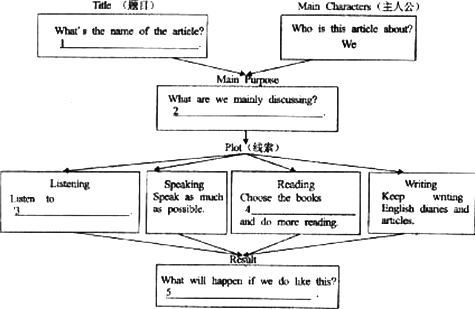
Swimming and English Learning

  Can you swim?Do you like swimming?Yes?Well, how can you learn to swim?I think the best way is to go into the water and learn.I' m afraid you'll never learn to swim just by reading books about swimming or look-ing at others swimming.It's the same with the English study for us kids today.We must practice, practice and practice.

  Listening and speaking are very important for beginners.The children in English-speaking countries first listen to others.Then they try to imitate(模仿)and speak.We can listen to English programs on radio.You may just understand a few words.It doesn' t matter.Just be relaxed, try to get the main topics(论题,话题), then the main ideas, then the main sentences(句子), then the key words, then the full meaning.As for speaking, speak as much as you can.

  Reading and writing are more important for school students.First we must choose the books we're interested in.A lot of reading will improve your language sense(语感).This is the most important.

  Keep writing English diaries(日记).We can also write English articles.You may even post them to English magazines.Don't be afraid of failure(失败).Failure is the mother of success.

  Easier said than done.Well, let's do more practice from now on.I' m sure you' ll learn English well in this way.
查看答案和解析>>


同步练习册答案