
题目列表(包括答案和解析)
One of the most remarkable things about the human mind is our ability to imagine the future. In our minds we can see what has not yet happened. For example, while we are looking forward to 1._____a new place or country, we 2._____what it will be like. We predict( 预料) the habit people will eat, dress and act. Of course, we do not always predict things 3._____. Things are often very different from the way we 4._____them to be.
One of the 5._____ dreams in history is the dream of the German scientist, Kekule, who had been 6._____ to work out a very difficult problem in physics. He had studied and analyzed(分析) the problem from every angle(角度) for days, but there 7._____ to be no way of 8._____ out the answer. Then one night he went to bed and dreamed. When he 9._____ up, he realized that he knew the answer. He had solved the problem in his 10._____.
The hypnotist(催眠者) sat in the chair opposite him and spoke 11._____: I want you to concentrate on my voice. Think about 12._____. You know nothing but my voice. And as you pay attention to my voice, your 13._____ will get heavier. Soon you’ll be asleep.
You will hear my voice and understand my words, but your body will be asleep, your eyes are too heavy. You are almost asleep, and when you wake up you will 14._____ nothing.
You will forget everything. Now I am going to 15._____ slowly from one to five. One, two, three, four, five.
1. A.visiting B.seeking C.reaching D.discovering
2. A.imagine B.know C.feel D.guess
3. A.quickly B.simply C.correctly D.neatly
4. A.required B.wished C.left D.expected
5. A.funny B.dull C.famous D.silly
6. A.managing B.trying C.thinking D.hoping
7. A.used B.ought C.seemed D.had
8. A.making B.finding C.turning D.letting
9. A.gave B.sat C.woke D.got
10. A.dream B.lesson C.research D.exercise
11. A.softly B.loudly C.slowly D.firmly
12. A.everything B.something C.nothing D.anything
13. A.eyes B.feet C.head D.body
14. A.accept B.remember C.hear D.receive
15. A.count B.say C.add D.speak
Here are some tips on listening. We hope it can help you in one way or another.
●Relax yourself.
Before you start to listen to something, You need to relax.
1 This will help you with your listening.
●Listen carefully to the first sentence.
2 For example, if eyou hear“Many shops in many parts of China have decided to take away all kinds of Japanese goods off their shelves, but some people say it’s not a good idea. Our reporter says…”,you know you will hear a piece of news, not a children’s story or a science report.
●Think when you’re listening.
3 For example, you can think of the following questions: What happened? When , where and how? What was the result and what does the speaker want to tell us? In this way, you may undersrand the passage better.
●Listen for important facts.
4 For example, if the passage is a science report, you should try to remember its findings , and how the scientists got their results.
●Don’t think about one or two words for too long.
You may hear some words that you don’t know. But don’t spend too much time on them.
5 But you can remember some words or sentences that you think are important, and you can use them when you’re answering the questions.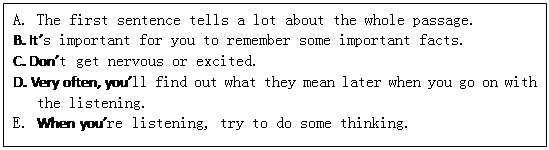
Here are some tips on listening. We hope it can help you in one way or another.
●Relax yourself.
Before you start to listen to something, You need to relax.
1 This will help you with your listening.
●Listen carefully to the first sentence.
2 For example, if eyou hear“Many shops in many parts of China have decided to take away all kinds of Japanese goods off their shelves, but some people say it’s not a good idea. Our reporter says…”,you know you will hear a piece of news, not a children’s story or a science report.
●Think when you’re listening.
3 For example, you can think of the following questions: What happened? When , where and how? What was the result and what does the speaker want to tell us? In this way, you may undersrand the passage better.
●Listen for important facts.
4 For example, if the passage is a science report, you should try to remember its findings , and how the scientists got their results.
●Don’t think about one or two words for too long.
You may hear some words that you don’t know. But don’t spend too much time on them.
5 But you can remember some words or sentences that you think are important, and you can use them when you’re answering the questions.
|
||
|
阅读下面有关“Keep词组”短文,了解这些词组的不同含义,然后从方框中选出合适的词组,将其字母序号填入空格中,使句子意思正确。
Keep off the grass
There are notices(告示牌)with “keep off the grass” in gardens and parks. Don’t walk or lie on the grass. You must protect the environment(环境).
Keep the change
You go to buy something in a shop. You give more money to pay for it, the assistant or waiters will pay back some money. You can say “keep the change” to let them keep the money for themselves.
Keep goal
When you watch a football, hockey(曲棍球)or cricket(板球)game, you will hear the words “ keep goal”. Guards(守门员)should stop the opposing(对方的)players from scoring(得分)。
Earn the keep
You should earn the keep to make a living. You need money to buy food, clothes and all the other things. If you don’t work hard, you won’t have enough money to eat, wear or live.
Keep going
If you are in a difficult situation(境况), you must keep going. The life will be better in the future. You should try to live a happy life.
A. keep off the grass B. keep the change C. keep goal
D. earn the keep E. keep going
1.The poor family although they now have a bad life.
2.You are old enough. It’s time for you to get a job to .We will never give you money.
3.Did you see the football game yesterday? The guar d
well in the game,
d
well in the game,
4.The notice says “ .” Sam, get out of the garden.
5.Here are ten dollars. Please for a tip.(小费)
阅读下面短文,根据短文内容,将方框内所给句子填入短文的适当位置,使短文意思完整
Here are some tips on listening.We hope it can help you in one way or another.
●Relax yourself.
Before you start to listen to something, You need to relax.
1 This will help you with your listening.
●Listen carefully to the first sentence.
2 For example, if eyou hear“Many shops in many parts of China have decided to take away all kinds of Japanese goods off their shelves, but some people say it's not a good idea.Our reporter says…”, you know you will hear a piece of news, not a children's story or a science report.
●Think when you’re listening.
3 For example, you can think of the following questions:What happened? When, where and how? What was the result and what does the speaker want to tell us? In this way, you may undersrand the passage better.
●Listen for important facts.
4 For example, if the passage is a science report, you should try to remember its findings, and how the scientists got their results.
●Don't think about one or two words for too long.
You may hear some words that you don't know.But don't spend too much time on them.
5 But you can remember some words or sentences that you think are important, and you can use them when you’re answering the questions.
A.The first sentence tells a lot about the whole passage.
B.It's important for you to remember some important facts.
C.Don't get nervous or excited.
D.Very often, you'll find out what they mean later when you go on with
the listening.
E.When you’re listening, try to do some thinking.
湖北省互联网违法和不良信息举报平台 | 网上有害信息举报专区 | 电信诈骗举报专区 | 涉历史虚无主义有害信息举报专区 | 涉企侵权举报专区
违法和不良信息举报电话:027-86699610 举报邮箱:58377363@163.com