题目列表(包括答案和解析)
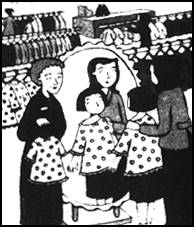
Betty needed some new clothes. Mrs. Jones took her to the department store. They went to the children's department. A saleswoman came up to them.
“Can I help you?” she asked.
“Yes,” Mrs. Jones said. “My daughter needs a new blouse.”
“What size is she?” the saleswoman asked.
“She was a size six last year, but she's bigger now.”
“We'll try a size seven,” the saleswoman said.
Betty tried on several blouses. She didn't like any of them. Some were too big. Some were too small. Then she tried on one that was the right size.
“That one looks right,” her mother said.
“No, Mom,” Betty said. “It's too heavy. I'll be hot.”
At last Betty found one she liked. “This is just right,” she said. “It's not too heavy. It's not too thin. I like the color.”
“Good,” her mother said. She turned to the saleswoman. “How much is this blouse?” she asked.
“One hundred dollars,” the saleswoman said.
“That's much too expensive!” Mrs. Jones said.
Poor Betty. She didn't get a new blouse that day.
Circle the correct answer.
1. Where did Betty and her mother go to buy clothes?
A. A saleswoman
B. A department store
C. A blouse shop
D. A children's shop
2. Which blouse cost $100?
A. The last blouse
B. The heavy blouse
C. The big blouse
D. The small blouse
3. What does “at last” mean?
A. Soon
B. If only
C. Finally
D. At first
4. Why didn't Betty get a new blouse that day?
A. They were all too expensive
B. She didn't like any of the blouses
C. They were all the wrong size
D. The one she liked was too expensive
在每段对话的空白处填入适当的单词、短语或句子,使对话完整。
(A)
A: Excuse me, madam. Could you (1) how to get to the hospital?
B: Sorry, (2). I'm new here. Please ask that man.
A: Excuse me, sir. Could you show me the (3) the hospital?
C: Go (4) this street until you reach the second traffic lights. Turn left at the end of the road. (5) the hospital.
A: Thank you.
(B)
A: (6),sir?
B: Yes, please.(7) a pair of sports shoes.
A: What size do you want, please?
B: Size ten or eleven.
A: OK! What about this pair?
B: Sorry! I (8) black shoes.
A: Oh, we've also got blue ones.
B: Can I (9) on?
A: Yes, please.
B: (10) each pair?
A: Thirty-five yuan.
B: All right. I'll take it.
| |||||||||||||||||||||||||||||||||||||||||||||
阅读理解(Reading comprehension)
A French girl outside Buckingham Palace said:“I was so excited. I saw the Queen! She came out in a Rolls Royce. I've been interested in your royal family since I was a little girl. I've read all the stories, especially about Charles and Diana, in French newspapers and magazines. They tell me what your royal family really do. Your newspapers can't tell the truth about them!”
An Italian boy, who was in Britain for the first time, talked about the weather. “I can' t understand it. I've been here for over a week, and I still haven' t seen any fog!”
A Japanese student from Tokyo said:“I've been in Britain since April, and I' m living with a British family. I've noticed one big difference between British and Japanese families. British men do jobs like cooking, washing up and ironing. They're jobs which I've never seen Japanese men do. They think it' s women's work. But I don' t agree!”
A German student, at a language school in Oxford said:“I thought Britain was a modern European country, you've been in the EEC for years now. So why do you still use miles, pints, and pounds, instead of kilometres, litres and kilos? And why do you still drive on the wrong side of the road?”
A Danish girl in Brighton said:“I came to Britain a month ago. I've noticed one very strange thing here. After British people have washed the dishes, they never rinse(remove…with water) them. They just take them out of the dirty, soapy water and leave them to dry!”
A Swedish girl said:“I've watched a lot of television since I arrived in Torquay two weeks ago. British television's wonderful! But the “programmes” which I've enjoyed most are the advertisements. They're very funny a very clever, or both. Back home in Sweden we don't have any TV advertisements at all!”
Who said what?

Who do you think said these things? Write them on your answer sheet.
1.□
It makes shopping very difficult. For example, I don't know what size shoes or jeans to ask for.
2.□
Did you know that he did not speak to her at that time, except in public?
3.□
I enjoy guessing what they're for, you know beer or toothpaste or whatever, before they actually name the product.
4.□
I help too-my friends at home would be very surprised if they could see me.
5.□
In fact the sun hasn't stopped shining-it's not at all like in old films and Dickens novels.
6.□
Surely it's not difficult to put them under the cold tap for a moment.
根据情景和对话内容,从A、B、C、D中选择合适的句子完成对话。
A: 1 ?
B: Yes, please. Have you any shirts?
A: Yes, we have. 2 ?
B: I want a blue one.
A: 3 .
B: 4 ?
A: Forty-five yuan.
B: It's expensive. 5 ? What about forty?
A: Sorry, I'm afraid not.
1.
[ ]
2.
[ ]
3.
[ ]
4.
[ ]
5.
[ ]
湖北省互联网违法和不良信息举报平台 | 网上有害信息举报专区 | 电信诈骗举报专区 | 涉历史虚无主义有害信息举报专区 | 涉企侵权举报专区
违法和不良信息举报电话:027-86699610 举报邮箱:58377363@163.com