
题目列表(包括答案和解析)
听力部分(25分)
I.听小对话,选择图片(共5小题,计5分)
1.What is the man looking for?
A.

B.

C.

2.What did his father do before?
A.

B.

C.

3.Where does Mrs Jackson work?
A.

B.

C.

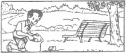
4.Which is the right picture for the dialogue?
A.
B.

C.

5.How can he find the CD shop?
A.

B.

C.

II:听小对话,回答问题(共5小题,计5分)
6.A.It’s red
B.It’s black
C.It’s yellow
D.It’s white
7.A.He’s shopping
B.He’s drawing
C.He’s smoking
D.He’s writing
8.A.About 1,000
B.About 1,500
C.About 2,000
D.About 2,500
9.A.They live in Washington
B.They live in New York
C.The boy went to Washington
D.The boy went to New York
10.A.Because he didn’t like fish
B.Because the fish wasn’t so good
C.Because he was hungry
D.Because he was full
III:听长对话,回答问题(共5小题,计5分)
听下面一段较长的对话,回答第11至第12两小题.
11.Who fell off the bike yesterday?
A.Jim
B.Ann
C.Tom
12.What will Jim help Tom with?
A.Chinese
B.Maths
C.English
听下面一段较长的对话,回答第13至第15三小题
13.Who got the tickets?
A.Ben
B.Jane
C.Lan
14.What time will they meet?
A.First Saturday in March
B.Saturday, March the first
C.First Saturday in April
15.Where will they meet?
A.Outside the bookshop
B.Outside the cinema
C.Outside the school gate
IV.听短文,回答问题(共5小题,计10分)
16.Jack was the name of________.
A.the master(主人)
B.the dog
C.the cat
D.a boy
17.The master didn’t want it any more because it________.
A.because old
B.was ill
C.didn’t eat
D.was a big eater
18.The master brought Jock to a river because________
A.the weather was fine
B.he wanted to have a boating
C.he liked it very much
D.he wanted to kill it
19.After the boat sank,________.
A.Jock saved his master
B.both of them died
C.both swam to land
D.Jock was killed
20.The master wasn’t thankful to the dog, was he?
A.yes, he wasn’t
B.No, he was
C.No, he wasn’t
D.Yes, he was.
Choose the best response from A to G in the box to complete the dialogue. Each choice should be used only once.
Tom: Excuse me. I'm from our school newspaper. My classmates and I would like to interview some students. Can I ask you a few personal questions?
Emily: Um …
Tom: 1.__ _________. They're not too difficult!
Emily: OK. What would you like to know?
Tom: Well, what does it feel like to be at school in China?
Emily: It's great! 2.___.But people here are friendly, so 1 am never alone any more!
Tom: What do you think is the most difficult thing for a foreigner living in China?
Emily: 3. ________. I'm learning it now, but it's going to take a long time.
Tom: 4.__ _____________
Emily: My parents. But they’re coming over to visit me in a few months.
Tom: OK! Thank you!
Emily: 5._ ____________.

In most languages, a greeting is usually followed by “small talk”. Small talk means the little things we talk about at the start of a conversation.
In English-speaking countries people often make small talk about the weather: “Nice day, isn’t it?” “Terrible weather, isn’t it?” But there is something special about small talk. It must be about something which both people have the same opinion about. The purpose of small talk is to let both people agree on something. This makes meeting people easier and more comfortable. People usually agree about the weather, so it is a safe topic for small talk. But people often disagree about religion or politics so these are not suitable topics for small talk in English. The topics for small talk also depend on where the conversation is taking place. At football matches, people make small talk about the game they are watching: “Great game, isn’t it?” At bus stops, people may comment about the transport system: “The bus service is terrible, isn’t it?”
Greetings and small talk are an important part of conversation in any language. The way people great each and the things they talk about, however, may be different from one language to another. This shows that there is much more to learn when we learn a language than just the vocabulary and the grammar of the language. We also have to learn the social behavior of the people who speak it.
【小题1】Small talk ___.
| A.is a kind of conversation with short words |
| B.is a greeting when people meet each other |
| C.is to let people disagree about something |
| D.is something we talk about to start a conversation |
| A.the weather | B.politics | C.Games | D.languages |
| A.we should learn about the transport system of the country |
| B.we should only master the grammar and vocabulary |
| C.we should know the culture about the country |
| D.we should grasp the importance of the language |
| A.ask a question | B.have a conversation |
| C.greet each other | D.begin a small talk |
| A.different language has different grammar |
| B.small talk is an important part in a language |
| C.small talk depends on the purpose of the conversation |
| D.in English-speaking countries we should talk about the weather. |

Two Chinese spacecrafts successfully completed China’s first space docking early November 3, 2011, which has taken the country a step closer to building its own space station.
Nearly two days after its launch, the unmanned spacecraft Shenzhou VIII docked with the space lab module Tiangong I more than 343 km above the earth surface. Shenzhou VIII and Tiangong I took apart after flying together for 12 days. On the 14th of November, the two spacecrafts finished the second docking. Then Shenzhou VIII parted from Tiangong I again and returned to the earth safely on the 17th. Tiangong I is still traveling around the earth in the space, waiting for the arrival of Shenzhou IX and X and so on in the near future.
That marked another great leap for China’s space program and made China the third country in the world, after the United States and Russia, to master the space docking technique (空间对接技术).
The world’s first space docking was achieved in 1966, when the manned U.S, spacecraft Gemini 8 (双子星8号) docked with an unmanned Agena Target Vehicle (阿金纳目标飞行器). Space docking is necessary to explore space beyond Earth’s orbit. “The capability increases China’s ability to act independently in space, as well as its ability to work together with others,” said Gregory Kulacki, a U.S. space scientist and senior analyst.
“With the success of its first space docking, China is now equipped with the basic technology and ability required for the construction of a space station,” said Zhou Jianping, chief designer of China’s manned space program.” The country is on its way to building a permanent manned space station around 2020.”
1.What did the success of the first space docking mean to China?
A. China has caught up with the United States in the space exploration field.
B. China took a step closer to building its own space station.
C. China became the first country to master the space docking technique.
D. China has the ability to build a permanent manned space station right now.
2.What does the underlined word “That” in the third paragraph refer to?
A. Shenzhou VIII.
B. Tiangong I
C. The Space Station
D. The success of China’s first space docking
3.What can we learn from the passage?
A. Tiangong I will fly in the space for 12 days.
B. The first space docking of the world was achieved in 1966, by Russians.
C. Without space docking technique people can’t explore space beyond Earth’s orbit.
D. The U.S.A helped China achieve the first space docking.
4.What’s the best title of this passage?
A. The first space docking of China.
B. The history of space docking.
C. The first space docking of the world.
D. The space docking technique
湖北省互联网违法和不良信息举报平台 | 网上有害信息举报专区 | 电信诈骗举报专区 | 涉历史虚无主义有害信息举报专区 | 涉企侵权举报专区
违法和不良信息举报电话:027-86699610 举报邮箱:58377363@163.com