
题目列表(包括答案和解析)
It is very important for us students to learn to use dictionaries. Try to find the answers to the questions in this dictionary extract(摘要). 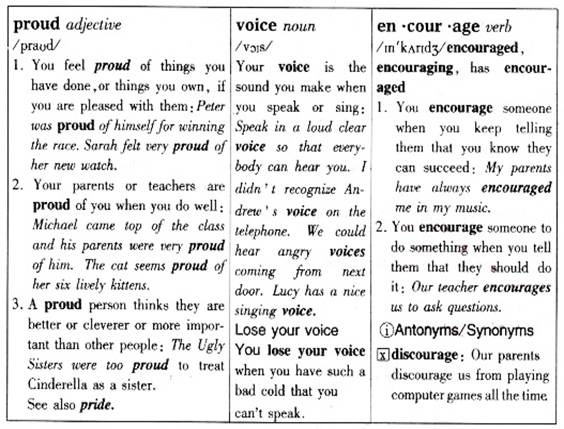
【小题1】We can find these explainations(解释)in _________ dictionary.
A. an English-English B. a Chinese-English C. an English-Chinese
【小题2】If you try to find a word similar to “proud”, you can look up the word “______”.
A. pleasure B. pride C.person
【小题3】If you have a bad cold, you will ______ according to the extract.
A. feel proud of yourself B. lose your voice C.encourage your parents
【小题4】The word “encourage” is a (an)______.
A. adjective B. noun C. verb
【小题5】In the sentence “Your parents may △ you from smoking”, △ stands for _____ according to the extract.
A. proud B. voice C. discourage

There are many idioms(习语)in English that are about animals.Today let's chat a little about some of the idioms about dogs that make English language fun and colorful.
We love dogs;they are our best friends.When you first started to learn English,your teacher might teach you a number of phrases about dogs,such as:“you are a lucky dog,” “I'm dog tired,” “every dog has its day,” or “our team was the underdog but won the first place at last.”
When I first got into high school。my English teacher used the idiom “dog-ear”,which interested me very much.This word can be used as a noun,a verb,and an adjective as well.As a noun,it means a turned-down(折叠的)corner of a page as a bookmark(书签).As a verb,it means someone makes a bookmark by turning down the corner of a page in the book.And,as an adjective,the word describes an old book with many broken pages.Examples:
John made a dog-ear(noun)of the page he was reading before closing the book.
Jane was reading a book;when the telephone rang,she dg-eared(verb)the page before answering the phone.
In the old room,the children found some dog-eared(adjective)books left there for more than 30 years.
The idiom “dog-ear” gives a lively image of a page being turned down like a curled(卷起来的)dog ear,but some dogs don't have curled ears;rather,they have pointed(竖起来的)ears.
1.Which of the following can be the best title of the passage?
A.Idioms about colors. B.Idioms about history.
C.Idioms about animals. D.Idioms about dogs.
2.How many idioms about dogs are mentioned(提及)in this passage?
A.3. B.4. C.5. D.6.
3.Which of the following statements is NOT true about the meaning of the idiom “dog ear”?
A.It means a turned-down corner of a page as a bookmark.
B.It means someone makes a bookmark by turning down the corner of a page in the book.
C.It means an old book with many broken pages.
D.It means something is short and small like a dog's ear.
For most people, the word “fashion” means “clothes”. But people may ask the question, “What clothes are in fashion?” And they use the adjective “fashionable” in the same way, “She was wearing a fashionable coat.” “His shirt was really a fashionable color.”
But of course there are fashions in many things, not only in clothes. There are fashions in holidays, in restaurants, in films and books. There are even fashions in school subjects, jobs…and in languages.
Fashions change as time goes. If you look at pictures of people or things from the past, you will see that fashions have always changed. An English house of 1750 was different from one of 1650. A fashionable man in 1790 looked very different from his grandson in 1860.
Today fashions change very quickly. Some of this is natural. We hear about things much more quickly than in the past. Newspapers, radios, telephones and television send information from one country to another in a few hours.
New fashions mean that people will buy new things, so you see there is money in fashion.
1. The word “fashionable” means .
A. clothes B. most of the popular things C. everything D. many things
2. If someone says, “Your dress is very beautiful.” It means your dress is .
A. fashionable B. interesting C. nice D. important
3. Which of the following things is fashionable today? .
A. Having a family dinner on New year’s Day B. Talking online
C. Learning to sing songs on the radio D. Doing morning exercises every day
4. Today fashions change very quickly because .
A. people read newspapers every day
B. radios send information from one country to another
C. New things that people like are often shown on TV
D. people quickly learn what is happening in the world
5. From the passage we know that .
A. there won’t be fashions without money. B. clothes are expensive
C. people like many things D. money comes from fashion
湖北省互联网违法和不良信息举报平台 | 网上有害信息举报专区 | 电信诈骗举报专区 | 涉历史虚无主义有害信息举报专区 | 涉企侵权举报专区
违法和不良信息举报电话:027-86699610 举报邮箱:58377363@163.com