
题目列表(包括答案和解析)
Read and tell true (T)or false (F).
Do you think it would be fun to remember just what you did on a certain day, a few years ago? One way to remember each day is to write about it in a diary. Many people write their diaries every day. They write about what they did, what they ate, whom they saw, how they did something and how they felt during that day. Most people do not want anyone else to read their diaries. Some Chinese students try to keep diaries in English. They keep the diaries not only to help themselves to remember something, but also to practise English.
Long ago, many people wrote diaries, too. Some of those old diaries have been found since
(自从)the writers died. Some diaries are famous because we can learn about life long ago, or we can get to know something important, something interesting or something we want to know.There are many famous diaries in the world. Most people in China and many people in other countries know the Diary of Lei Feng. Lei Feng was a Chinese soldier. In his short life he did a lot of good things. He was always ready to give but not to receive
(得到). He kept a diary. From the diary, people know what a man he was.And many people in the world know Ann Frank's diary. From her diary people learn that how her family did from the German soldiers in Amsterdam, Holland during World War
Ⅱ. Her diary tells about her life at that time. Some pages of her diary have been chosen for students to learn.(1)People keep diaries so that
(以便)they can tell others what they did.(
)(2)Some of the old diaries are famous because they can help us to learn many things.
(
)(3)Both Lei Feng's and Ann Frank's diaries tell us what happened in China and in Holland.
(
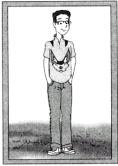
)Simon wants to write about what his best friend looks like, but he does not know which words he should use. Here is the picture of his friend. Help him describe his friend.
阅读理解:
Do you keep a diary(日记)every day? Do you think it is great to remember just what you did on a day many years ago? One way to remember each day is to write about it in a diary.Many people write their diaries every day.They write about what they did, what they ate, whom they saw and met, how they did something and how they felt during that day.
Most people do not want anyone else to read their diaries.They keep them in a safe(安全的)place.Some Chinese students try to keep diaries in English not only to help themselves to remember something, but also to practice English.
Long ago, many people wrote diaries, too.People have found some of those old diaries.Some diaries are useful because we can learn about the life long ago, or we can get to know something important or something interesting.
There are many famous diaries in the world.Most people in China have read the Diaries of Lei Feng.Lei Feng was a soldier(战士).In his short life, he did a lot of good things for others and for his country.He was always ready to give, but never asked for anything from people.He kept diaries and from them, people learn what a great man he was.In China’s schools, students learn some of his diaries as texts(课文).
1.Many people write diaries every day because they don’t want to forget what they did or how they ________.
2.Some Chinese students ________ ________ in English to remember something and practice English.
3.From Lei Feng’s diaries, people know that he was always ready to _______, but asked for _______ from people.
4.In order to stop anyone else reading their diaries, most people keep them in a _______.
5.You can find some of Lei Feng’s diaries in _______ _______ textbooks(课本).
| |||||||||||||||||||||||||||||||||||||||||||||||||||||||||||||||||||||||||||||||||||||||||||||||||||||||||||||||||||||||||||||||||||||||||||||||
There is no quick and easy way to learn English. But there is a simple and good way. Speak English as much as you can. Speak only English with your teacher and your classmates. Speak English with them while you are in class and cut of class. Speak and listen to English as much as you can. Listen to your teacher when he speaks to you in English in class. Listen to your classmates when they speak English to you out of class. Listen to English on the radio.
Speak, listen and read English as much as you can. Doff t just read the textbook that you use in class. Go to the library of your school, or to a bookshop and read easy English books.
Speak, listen, read and write English as much as you can. Buy a small notebook and write in it every day. Write about what you learned in class.
These things are not hard, but they are the work you should do. If you do them, with the help of your teacher, you will learn English well.
根据短文内容判断下列句子的正 (T) 、误 (F)。
(1) There is a quick and easy way to learn English.
( )
(2) A simple and good way to learn English is to speak it only.
( )
(3) Speak English with your teachers and classmates both in class and out of class.
( )
(4) Listen to English only on the radio.
( )
(5) You should read not only the textbooks but also easy English books.
( )
湖北省互联网违法和不良信息举报平台 | 网上有害信息举报专区 | 电信诈骗举报专区 | 涉历史虚无主义有害信息举报专区 | 涉企侵权举报专区
违法和不良信息举报电话:027-86699610 举报邮箱:58377363@163.com