
题目列表(包括答案和解析)
补全对话
A: OK. It's a good idea.
B: I like grapes, apples and bananas.
C: Of course. He does.
D: Oh, I don't know. Maybe he does.
E: For dinner, he likes chicken and rice.
1.For supper, let's have rice and chicken.
________________________________________.
2.Does your brother like pineapples?
________________________________________.
3.What fruits do you like?
________________________________________.
4.What does Tom have for dinner?
________________________________________.
5.Does Tom have breakfast every day?
________________________________________.
Listening
A)听下面四个问句,然后从A,B,C三个选项中选出能回答所提问题的最佳答案.
1.A.Short
B.Brown
C.Nice
2.A.In September
B.At night
C.In China.
3.A.A Volleyball
B.Music
C.English
4.A.In half a month
B.For a week
C.Two days ago.
B)听下面四个句子,然后根据意思将各图的字母序号分别填入5-8小题的横线上.

5.________ 6.________ 7.________ 8.________
C)听下面四段话,然后从A,B,C三个选项中选出最佳答案.
9.What does the man think of Mr Green’s speech?
A.Only a little.
B.too fast.
C.Very easy.
10.What does the woman ask the man do?
A.Meet Brown.
B.Spell the name.
C.Know his name.
11.How does the woman go to school?
A.By bus.
B.By taxi.
C.By bicycle.
12.What do you know about Jack?
A.He’s at school.
B.He’s all
C.He studies best.
D)听下面一段对话,然后从A,B,C三个选项中选出最佳答案.
13.What time does the woman get up?
A.At eight.
B.At nine.
C.At ten.
14.Does the woman start work in the morning or in the afternoon?
A.In the morning
B.At night.
C.In the afternoon.
15.Where does the woman work?
A.In TV station.
B.For weather report
C.On newspaper.
16.What do you know about the man?
A.He knows the woman well.
B.He doesn’t watch TV.
C.He goes to work at three.
E)听下面一段对话,然后判断正误.
17.The parents are writing something.
18.The children are playing games in the evening.
19.The children are doing their homework in their room/
20.Lily and Lucy are students.
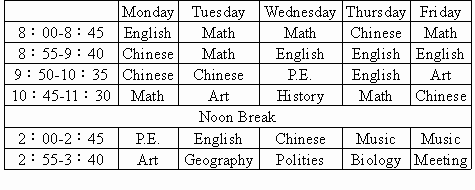
根据表格提供的信息,选择最佳答案.
(1) Which lesson does Sam have every day?
[ ]
|
A .English |
B .Music |
C .Art |
(2) What time does he finish his morning lessons?
[ ]
|
A .3∶40 |
B .2∶45 |
C .11∶30 |
(3) Does he go to school on Saturday?
[ ]
|
A .Yes, he is |
B .No, he isn't |
C .No, he doesn't |
(4) How many P.E.lessons does he have in a week?
[ ]
|
A .One |
B .Two |
C .Three |
(5) How many subjects does he have altogether?
[ ]
|
A .20 |
B .15 |
C .10 |
“Using the Internet, doctors can answer more questions from more patients in a shorter time,” writes Dr. Dada Pal, a famous doctor in Manchester, UK.
According to Pal, nearly forty percent of American patients say they have used e-mail to communicate with a doctor.
He notes, however, that although patients have such interest, only up to two percent of doctors in the united States offer e-mail service.
Using e-mail, doctors can make sure of their advice and point, patient to patient information materials and other resources on the Internet. It's said that more than ten thousand healthoriented websites already exist now.
However, some people worry that widespread use of medical e-mail might set up two kinds of care—one for Internet“haves” and another for the “have-nots”
But Pal points out that“ by the year 2000 nearly every library will offer (Internet and e-mail) services in the United States, allowing even low-income patients to use such means.” Pal also talks about other possible barriers to the acceptance of medical e-mail.
“Doctors may be unwilling to offer e-mail services for fear of increasing workload and uncertainty about payment for the time they spent,” he explains, and patients may worry that their medical information might be read by others.“But these problems can all be solved,” he adds.
E-mail may well help us a lot in health care, Pal concludes. “Patients can get in normal clinics,” he points out, “and they might find communication on the information superhighway less fearful, than face-to-face dialogues with their doctors.”
( )(1). The article introduces a new way of patient-doctor communication __________.
A. by e-mail B. by visiting
C. by searching the Internet D. by using the computer
( ) (2). According to the passage, some people worry that __________.
A. it might have to serve both who have access to the Internet and those who don't
B. it might meet double doubts from those who have access to the Internet and those who don't
C. it might make trouble between those who can use the Internet and those who can't
D. it might make trouble between those who have Internet experiences and those who haven't
( ) (3). All the following points are advantages of using medical e-mail except __________.
A. it is more reliable
B. it is less frightening
C. it troubles patients and doctors to understand each other better
D. it provides patients more choices of treatment
( )(4). What does the word “barriers” mean?
A.可能 B. 危险 C. 障碍 D.秘密
( ) (5). Which of the following is true about e-mail in the United States?
A. Every patient cannot use it.
B. Only doctors can use it.
C. Patients needn't pay for their treatment by using e-mail.
D. No others can read the information sent by e-mail.

请根据Ken的课程表选择正确答案。
(1) What subject does Ken have every day?
[ ]
(2) The English class starts at ________ on Monday.
[ ]
(3) Ken has biology on ________.
[ ]
(4) Ken doesn't have ________ in the morning.
[ ]
(5) Ken has ________ class (es) in the afternoon.
[ ]
湖北省互联网违法和不良信息举报平台 | 网上有害信息举报专区 | 电信诈骗举报专区 | 涉历史虚无主义有害信息举报专区 | 涉企侵权举报专区
违法和不良信息举报电话:027-86699610 举报邮箱:58377363@163.com