
work on 2 on Page 58 Firstly say something about Deng Yaping they have known. Secondly, some super students give short composition. Thirdly, they write an article about Deng Yaping. 查看更多


题目列表(包括答案和解析)

完形填空

  You may think that English dictionaries have been used for many, many centuries.In fact,an English dictionary you   1   today wasn’t made until the Qing Dynasty(清朝).Three men did most of the important   2   work on dictionaries.They spent nearly all their lives tring to   3   words for their dictionaries.For them, it was a wonderful journey.The largest dictionaries in the world is Qxford English Dictionary.The   4   for this dictionary came from an important meeting in Britain in 1857.Twenty-two years later, Oxford University asked James Murray to be the editor(编者)of its new dictionary.

  Murray had never been to   5  .At the age of fourteen, he left his village school in Scotland and taught himself while working in a bank.  6   he became a great teacher.After Oxford gave him the job, Murray had small house   7   in his garden to do the work.Every morning, Murray got out of bed at five and   8   in the small house several hours before breakfast.Often he would work into the night.Murray hoped to finish the new dictionary in ten years.But after five years, he was   9   adding(增加)for the letter“A”!He worked on the dictionary   10   he was very old.Forty-four years later, in 1928,other editors finished the dictionary.

(1)

[  ]

A.

use

B.

write

C.

copy

D.

miss

(2)

[  ]

A.

easy

B.

late

C.

early

D.

dangerous

(3)

[  ]

A.

spell

B.

invent

C.

collect

D.

make

(4)

[  ]

A.

way

B.

idea

C.

use

D.

prize

(5)

[  ]

A.

school

B.

cinema

C.

village

D.

college

(6)

[  ]

A.

Later

B.

Long before

C.

So far

D.

Ever since

(7)

[  ]

A.

sold

B.

built

C.

broken

D.

drawn

(8)

[  ]

A.

read

B.

wrote

C.

worked

D.

thought

(9)

[  ]

A.

already

B.

still

C.

usually

D.

always

(10)

[  ]

A.

if

B.

because

C.

till

D.

since

查看答案和解析>>

(完形填空)

You may think that English dictionaries have been used for many, many centuries. In fact, an English dictionary you (1)   today wasn’t made (2)   the Qing Dynasty (清朝). Three men did most of the important (3) work on dictionaries; they spent nearly all their lives trying to (4) words for their dictionaries. For them, it was a wonderful journey. The (5) dictionary in the world is Oxford English Dictionary. The (6) for this dictionary came from an important meeting in Britain in 1857. Twenty two years (7) , Oxford University asked James Murray to be the editor (编者) of its new dictionary. Murray had never been to (8) . At the age of fourteen, he left his village school in Scotland and taught himself while working in a bank. (9) he became a great teacher. After Oxford gave him the job, Murray had a small house (10)in his garden to do the work. Every morning, Murray got out of bed at five o’clock and (11) in the small house several hours before breakfast. Often he would work into the night. Murray hoped (12) the new dictionary in ten years. But after five years, he was (13) adding (增加) words for the letter “A”! He worked (14) the dictionary (15) he was very old. Forty four years later, in 1928, other editors finished the dictionary.

(1)

A. use    B. write    C. copy    D. miss

[  ]

(2)

A. until    B. after    C. when    D. as

[  ]

(3)

A. easy    B. boring    C. early    D. dangerous

[  ]

(4)

A. spell    B. invent    C. collect    D. make

[  ]

(5)

A. large    B. larger    C. the largest    D. largest

[  ]

(6)

A. way    B. idea    C. use    D. prize

[  ]

(7)

A. ago    B. later    C. later on    D. before

[  ]

(8)

A. school    B. cinema    C. village    D. college

[  ]

(9)

A. Later    B. Long before    C. So far    D. Ever since

[  ]

(10)

A. sold    B. built    C. broken    D. drawn

[  ]

(11)

A. read    B. wrote    C. worked    D. thought

[  ]

(12)

A. finishing   B. finish   C. to finish   D. him to finish

[  ]

(13)

A. already    B. still    C. usually    D. always

[  ]

(14)

A. in    B. on    C. with     D. out

[  ]

(15)

A. if    B. because    C. until    D. since

[  ]

查看答案和解析>>

  In some magazines, tables of contents(目录) list articles in numerical order. The football article begins on page 5, the baseball article begins on page 7, the football story begins on page 13, and so on.

  Other magazine table of contents are organized by subjects(题目), by columns(栏目) and by features(特写). Subjects are the topics covered in the articles. A feature is a specific(特殊的) kind of article, such as an article about sports or about cooking. “Feature” also has another meaning. A “regular feature” is something that appears in every issue(期), such as letters to the editor, movie reviews, sports statistics(统计) and other things. Some magazines also call regular features “departments”.

  Columns are another kind of “regular feature” published in every issue. Columns are often written by the same person each time. A person who writes columns is called a columnist!

  Most magazine tables of contents will also give you an idea of what a story is about. Look at the sample(例子) below.
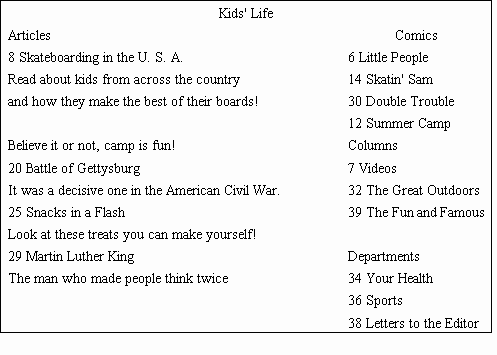
1.What page does the sports section begin on?

[  ]

A.7
B.13
C.36
D.38

2.List the titles of the regular feature in this magazine: ________.

[  ]

A.Your Health, Sports, Letters to the Editor

B.Summer Camp, Little People, Skatin' Sam

C.Your Health, Sports, Double Trouble

D.Sports, Letters to the Editor, Summer Camp

3.What was the Battle of Gettysburg according to the table of contents?

[  ]

A.The name of an American.

B.The name of an American city.

C.A battle of the World War Ⅱ.

D.A battle in the American Civil War.

4.Is there any information in this magazine about roller skating?

[  ]

A.There is a lot of information.

B.It's under the health heading.

C.Not unless it's under the sports heading.

D.Yes, there is no information about it.

查看答案和解析>>

补全对话。

Ann: Uncle Li, is the work in your factory very hard?
Li:    1    
Ann: So you get up early on weekdays.
Li:    2    So I get up at about 6:30.
Ann:   3   
Li: Yes, I have some bread and a glass of milk. Sometimes I have an egg.
Ann:    4   
Li: Work begins at 7:30 and I have lunch at about 11:30.
Ann: What time do you go home?
Li:    5    

A. And what time do you get to work?
B. Oh, yes. We work very hard in our factory.
C. I leave work at 5:30 and get home at 5:50.
D. Do you have breakfast?
E. Well, my home is near the factory.
F. Do you have lunch?
G. How do you go to work?
1._____ 2._____ 3._____ 4._____ 5._____

查看答案和解析>>

Now look ________ the picture 2 at page 5.

[  ]

A.in

B.at

C.after

D.like

查看答案和解析>>


同步练习册答案