
题目列表(包括答案和解析)
Zhang Zhaojie, a 13-year-old schoolboy in Xiamen enjoyed many snacks during Spring Festival. “I love chocolate and chips very much. They are high in sugar and fat. But I can’t help eating them,” Zhang said.
Recently, an online list of favorite snacks in China became popular. It said that peanuts, walnuts and chocolate are good for our health, and jelly, potato chips and lollipops(棒棒糖) are “bad”. Almost every kid on the planet loves snacks, and they seldom care how healthy they are. Although some snacks like chocolate and candy are found everywhere, others are unique(独特的) to a country or a culture.
In Japan, Matcha(抹茶) is a kind of green tea powder. It’s made from tea leaves and can be used with ice cream or cakes. In fact, Matcha originated in China but took off in Japan. Biscuits or cookies covered with chocolate are also a Japanese favorite.
Potato chips and French fries are very popular in the US. They are cheap but tasty. But they are high in calories and eating too much may make you fat. Popcorn(爆米花) is another typical snack. People eat it when they are watching sports games or visiting the amusement park. Most cinemas also sell Popcorn.
In the UK, many people sit down for snacks at around 4 p.m. every day. They call it “afternoon tea”. Traditional afternoon tea is biscuits and tea. People also have scones(烤饼) with jam and cream, which is probably the most classic English snack.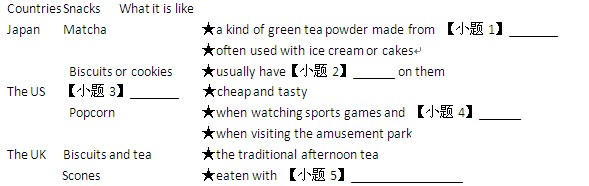
“How are you?” is a nice question. It’s a friendly way that people in the U.S.A greet each other. But “How are you?” is also a very unusual question. It’s a question that often doesn’t need an answer. The person who asks“ How are you?” hopes to hear the answer “Fine”, even if the person’s friend isn’t fine. The reason is that “How are you?” isn’t really a question and “Fine” isn’t really an answer. They are simply other ways of saying “Hello” or “Hi”.
Sometimes, people also don’t say exactly what they mean. For example, when someone Asks “Do you agree?”, the other person might think, “No, I disagree. I think you’re Wrong...”But it isn’t very polite to disagree so strongly, so the other person might say “I’m not sure.” It’s a nicer way to say that you don’t agree with someone.
People also don’t say exactly what they are thinking when they finish talking with other people. For example, many talks over the phone finish when one person say “I’ve to go now.” Often, the person who wants to hang up gives and excuse: “Someone’s at the door.”“Something is burning on the stove.” The excuses might be real, or not. Perhaps the person who wants to hang up simply doesn’t want to talk any more, but it isn’t polite to say that. The excuse is more polite, and it doesn’t hurt the other person.
Whether they are greeting each other, talking about an idea, of finishing a talk, people don’t say exactly that they are thinking. It’s an important way that people try to be nice to each other, and it’s part of the game of language.
【小题1】“How are you?”is another way of saying"Hello."or"Hi."
【小题2】 It is polite lo say"No.I disagree I think you are wrong, "if you don’t agree with others.
【小题3】When someone says"I have to go now "On the phone.it means he wants to go on talking.
【小题4】"Someone is at the door."may be an excuse for finishing a plume can.
【小题5】Sometimes people don't say exactly what they are thinking about just became they try to be nice to each other.
YUXI, China — Many people of this city in southwester China spent Saturday night in tents, too scared to sleep in their homes after an earthquake which killed 188 people early that morning.
Countless homes were destroyed and lots of people became homeless after the earthquake which is believed to have a magnitude of 7.
The quake was not as serious as the 7.9-magnitude earthquake in 2008 that left more than 70,000 people dead in the Wenchuan area. But villagers who work in Chengdu, about 100 miles away, hurried back home Sunday morning, many on foot, the lucky ones on motorbikes, to check on their homes.
Song Yuanqing, 43, a worker, arrived back after a 22-hour trip and found his house was still there but had already been very unstable(摇摇欲坠). “We would like to do something, but we can’t do anything,” Mr. Song said as he sat with neighbors around an outdoor fire built by the village leader in his backyard.
In all, the government sent about 7,000 soldiers and People’s Armed Police officers to the earthquake-hit area. By Saturday evening, there were so many rescue workers in the area that the government asked volunteers to stop coming.
Li Keqiang, China’s prime minister, flew to the area and slept in a tent on Saturday evening in Lushan County.
The earthquake shook Sichuan Province at 8 a.m., when people were getting up a little later than usual because schools and universities were closed.
“We were just getting up and getting dressed in our dormitory when the building shook, and I looked outside from our window and saw a row of houses had collapsed,” Xu Yan, 22, a student at the Agricultural University in Ya’an, said in a telephone interview. “I had never flew down the stairs faster.”
The Chinese government said early Sunday that the death toll was 174, and about 5,700 people had been injured.
The earthquake was also felt in Chengdu, one of China’s biggest cities and the capital of Sichuan Province. People described water getting out of home aquariums and things like balls falling to the floor.
In the town of Longmen, another hard-hit area near Ya’an, a local man, Zhang Yan, said 90 percent of the buildings had collapsed.
“About 100 people died around here,” Ms. Zhang said in a telephone interview. “Rescue teams have not yet arrived. There is no water or electricity.”
In the 2008 quake, many schools of poor quality collapsed and killed thousands of students. This time, many people also expressed their worries about students on their micro-blogs.
Sichuan Province is also one of China’s best-known hometowns for pandas, and at the Bifengxia reserve, about six miles north of Ya’an, workers said that 20 pandas in the park were safe. “We examined the panda area after the quake, and they were not affected,” said Chen Yong, an officer of the reserve.
1.When did the quake take place in Ya’an? On_______________________.
A.Saturday morning B.Sunday morning
C.Saturday night D.Sunday night
2.Why did many people hurriy home after the earthquake.
A.They wanted to provide rescue to the hit area and give other people a helping hand as volunteers.
B.They wanted to find out the situation of their home.
C.They felt it too dangerous to stay where they had been.
D.There weren’t enough soldiers in the hit-area.
3.What does the underlined sentence mean?
A.Xu Yan didn’t make it through the stairs.
B.Xu Yan get out of the dorm quickly.
C.Xu Yan felt the earthquake shaking the stair.
D.Xu Yan was scared that he wouldn’t be able to catch up with the stair.
4.Which of the following is NOT true.
A.Tens of thousands of students were killed in Ya’an.
B.The earthquake also influenced some other cities.
C.The government took very quick actions.
D.Most buildings has collapsed in Longmen.
5.Where would you most probably read this passage?
A.Reader.
B.A History of China’s Earthquakes
C.How to Survive(求生) in an Earthquake
D.China Weekly
Zhang Zhaojie, a 13-year-old schoolboy in Xiamen enjoyed many snacks during Spring Festival. “I love chocolate and chips very much. They are high in sugar and fat. But I can’t help eating them,” Zhang said.
Recently, an online list of favorite snacks in China became popular. It said that peanuts, walnuts and chocolate are good for our health, and jelly, potato chips and lollipops(棒棒糖) are “bad”. Almost every kid on the planet loves snacks, and they seldom care how healthy they are. Although some snacks like chocolate and candy are found everywhere, others are unique(独特的) to a country or a culture.
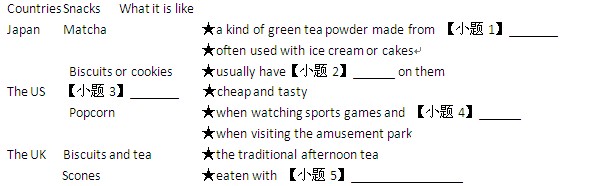
In Japan, Matcha(抹茶) is a kind of green tea powder. It’s made from tea leaves and can be used with ice cream or cakes. In fact, Matcha originated in China but took off in Japan. Biscuits or cookies covered with chocolate are also a Japanese favorite.
Potato chips and French fries are very popular in the US. They are cheap but tasty. But they are high in calories and eating too much may make you fat. Popcorn(爆米花) is another typical snack. People eat it when they are watching sports games or visiting the amusement park. Most cinemas also sell Popcorn.
In the UK, many people sit down for snacks at around 4 p.m. every day. They call it “afternoon tea”. Traditional afternoon tea is biscuits and tea. People also have scones(烤饼) with jam and cream, which is probably the most classic English snack.
“How are you?” is a nice question. It’s a friendly way that people in the U.S.A greet each other. But “How are you?” is also a very unusual question. It’s a question that often doesn’t need an answer. The person who asks“ How are you?” hopes to hear the answer “Fine”, even if the person’s friend isn’t fine. The reason is that “How are you?” isn’t really a question and “Fine” isn’t really an answer. They are simply other ways of saying “Hello” or “Hi”.
Sometimes, people also don’t say exactly what they mean. For example, when someone Asks “Do you agree?”, the other person might think, “No, I disagree. I think you’re Wrong...”But it isn’t very polite to disagree so strongly, so the other person might say “I’m not sure.” It’s a nicer way to say that you don’t agree with someone.
People also don’t say exactly what they are thinking when they finish talking with other people. For example, many talks over the phone finish when one person say “I’ve to go now.” Often, the person who wants to hang up gives and excuse: “Someone’s at the door.” “Something is burning on the stove.” The excuses might be real, or not. Perhaps the person who wants to hang up simply doesn’t want to talk any more, but it isn’t polite to say that. The excuse is more polite, and it doesn’t hurt the other person.
Whether they are greeting each other, talking about an idea, of finishing a talk, people don’t say exactly that they are thinking. It’s an important way that people try to be nice to each other, and it’s part of the game of language.
1.“How are you?” is another way of saying "Hello." or" Hi."
2. It is polite lo say" No. I disagree I think you are wrong, "if you don’t agree with others.
3.When someone says "I have to go now "On the phone.it means he wants to go on talking.
4."Someone is at the door." may be an excuse for finishing a plume can.
5. Sometimes people don't say exactly what they are thinking about just became they try to be nice to each other.
湖北省互联网违法和不良信息举报平台 | 网上有害信息举报专区 | 电信诈骗举报专区 | 涉历史虚无主义有害信息举报专区 | 涉企侵权举报专区
违法和不良信息举报电话:027-86699610 举报邮箱:58377363@163.com