题目列表(包括答案和解析)
| 完形填空。 I was tired. I had been studying English for 8 years, but my spoken English was still terrible. I went to English school every night. I read different textbooks and learned the grammar rules 1 them every day. But during the eight years, I hadn't got any 2 at all! Being tired of school, I searched (搜索) the Internet for "Learn English" one night. Then I found a 3 English learning system (系统). Seven days later I started using the system to learn English. My life 4 from then on. I used the system every day. I was 5 to find that learning English in this way was so easy and interesting. No boring grammar rules. The articles were interesting and the stories were very funny. Then something amazing happened. One day I 6 an American man named James in a coffee shop. Without thinking, I started to 7 him. My English words came out automatically (无意识地). It was hard for me to believe it. I could speak English so easily. I didn't feel any 8 or worry. James understood my ideas and feelings. We talked for two hours without 9 . Then we exchanged e-mails and Skype IDs. We decided to talk to each other on the Internet every week. My English has 10 greatly now. I think there are many ways of learning English for us to use. You should stop using a way that doesn't work and find out what is helpful to you. | ||||
|
| |||||||||||||||||||||||||||||||||||||||||||||||||||||||||||||||||||||||||||||||||||||||||||||||||||||||||||||||||||||||||||||||||||||||||||||||||||||||||||||||||||||||||||||||||||||||||||||||||||||||||||||||||||||
听力部分(共两节;满分20分)
第一节:(共5小题;每小题1分,满分5分)
听下面五段对话,每段对话后有一个小题,从题中所给的A、B、C三幅图片中选出最佳选项。每段对话读两遍。
1.Which of the following pictures are they talking about?
A.
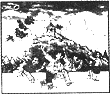
B.
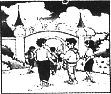
C.
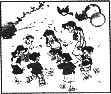
2.What did Linda do over the weekend?
A.
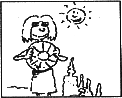
B.
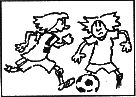
C.
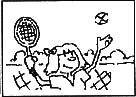
3.Which of the pictures is the two speakers talking about?

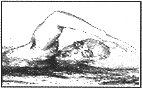
4.What does the man like?
A.
B.

C.

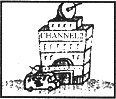
5.Where does Mike’s father work?
A.

B.
C.

第二节:(共15小题;每小题1分,满分15分)
听下面5段对话或独白,每段对话或独白后有几个小题,从题中所给的A、B、C三个选项中选出最佳选项,每段对话或独白读三遍。
听第6段材料,回答6-8题。
6.How many ring roads are around the city of Beijing?
A.Four
B.Five
C.Six.
7.What's inside the Second Ring Road?
A.New stores.
B.Old stores.
C.Old houses.
8.What do old people do in parks?
A.Read newspapers.
B.Play with children.
C.Study.
听第7段材料,回答9-11题。
9.Which holiday does Jenny want?
A.Chinese Spring Festival.
B.Hot Christmas.
C.White Christmas.
10.Which country does Jenny come from?
A.China.
B.Australia.
C.America.
11.What does Jenny think of the Chinese Christmas?
A.It's wonderful.
B.It's surprising.
C.It's crazy.
听第8段材料,回答12-15题。
12.Why does Nancy like her socks very much?
A.They are different.
B.They are beautiful.
C.They are clean.
13.What color of socks does she wear on Thursdays?
A.Yellow ones.
B.Blue ones.
C.Orange ones.
14.What socks did she choose this Friday?
A.A different pair.
B.The clean pair.
C.The red pair.
15.Why did her classmates laugh at her?
A.She wore different pair of socks.
B.She wore dirty socks.
C.She was late for school.
听第9段材料,回答16-18题。
16.What may the two speakers be?
A.Husband and wife.
B.Father and daughter.
C.Teacher and student.
17.Why is the woman so excited?
A.Because Sun will hold a concert in Beijing.
B.Because Sun sings so well.
C.Because Sun is so lovely.
18.What does the man believe about Sun Yanzi?
A.She's lovely.
B.She's a singer.
C.She sings very well.
听第10段材料,回答19至20题。
19.Why weren't the students listening to the teacher?
A.Because she talked to herself.
B.Because she didn't find it out.
C.We can't find the reason.
20.What was really strange in this Chinese lesson?
A.The students weren't listening to the teacher.
B.The teacher decided to talk to herself all the time.
C.The teacher didn't know that nobody listened to her.
听力选择
(一)听句子。选择适当的答语.每个句子仅读一遍。
1.
A.Only a little.
B.Yes.please.
C.You're welcome.
2.
A.I've no idea.
B.It's not mine.
C.No problem.
3.
A.Ten yuan, please.
B.Two kilos.please.
C.This one, please.
4.
A.I think I can.
B.Here you are.
C.Thanks a lot.
5.
A.Yes, help yourself.
B.Not at all.
C.That's all right.
(二)听小对话,选择图片。每段对话读两遍。
6.What's the weather like?
A.
B.
C.
7.What did the students do yesterday?
A.
B.
C.
8.Which is Joy's favorite animal?
A.
B.
C.
9.How is the woman going to Hanzhou?
A.
B.
C.
10.Where will Kate probably go?
A.
B.
C.
(三)听对话,根据问题选出正确答案。每段对话读两遍。
听第一段对话,回答第11、12小题.
11.Why weren't the students listening to the teacher?
A.Because she talked to herself.
B.Because she didn't find it out.
C.We can't find the reason.
12.What was really strange in this Chinese lesson?
A.The students weren't listening to the teacher.
B.The teacher decided to talk to herself all the time.
C.The teacher didn't know that nobody listened to her.
听第二段对话,回答第13-15小题。
13.What day is tomorrow?
A.Saturday
B.Monday.
C.Friday.
14.What clothes will they wear?
A.School uniform.
B.Old clothes.
C.New clothes.
15.What are they going to do?
A.To have a football match.
B.To watch a basketball match.
C.To plant trees.
四、听力填空(共5小题)

| 通读下面短文,掌握其大意,然后在各小题所给的四个选项中,选出一个最佳答案。将其字母编号写在题号前的括号内。 | ||||
| When I began to study English, I didn't like it at all. I think it was 1 to learn. But last year a new teacher from the United States came to teach 2 English. We 3 him Mr James. He often 4 us that English was very useful. And he also told us that English was quite 5 to learn if we decided to learn it well. In order to make us 6 learning English, he always asked us to recite (背诵) the text and played games 7 us in class. He also liked 8 us jokes in English. At first I could hardly understand a word and I was 9 to say anything in English. Mr James often smiled at me and said, "Don't be 10 . You are a clever boy. If you think you can, you can." Soon I found English was interesting. I began to see English films and listen to English songs. Now I can talk with my classmates in English. | ||||
|
湖北省互联网违法和不良信息举报平台 | 网上有害信息举报专区 | 电信诈骗举报专区 | 涉历史虚无主义有害信息举报专区 | 涉企侵权举报专区
违法和不良信息举报电话:027-86699610 举报邮箱:58377363@163.com