
题目列表(包括答案和解析)
用所给词的正确形式填空:(共5 分,每小空 0.5分)(每空词数不限)
96. The old man makes a _________________ (live)by selling fruits.
97. Paul doesn’t know how _______________(make) a chicken sandwich.
98. Could you please give me some_____________ (advice) on how to learn English well?
99. While I________________ (walk) in the street, I met my best friend Jim.
100. Thank you for_____________ (teach) us so well, my dear teacher.
101. Don’t be late again. You’re (suppose) to get to school on time.
102. Linda couldn’t see Alice ____________ (somewhere).
103. Do you enjoy______________(listen ) to the music?
104. When is a good time _____________(have) the party ?
105. If you become rich , you will have a difficult time______________ (make) real friends.
We can make mistakes at any age. Some mistakes we make are about money. But most mistakes are about people.
Why do we go wrong about our friends? Sometimes people hide their real meanings when they say something. And if we don’t really listen, we miss the feeling behind the words. Suppose someone tells you, “You’re a lucky dog.” That’s being friendly. But “lucky dog”? There’s a bit of envy(嫉妒) in those words. Maybe he doesn’t see _it_ himself. But “lucky dog” puts you down a little. He may mean you don’t deserve your luck.
How can you tell the real meaning behind someone’s words? One way is to take a good look at the person talking. Do his words fit the way he looks? Do his words agree with the tone(语调) of voice? His posture(姿态)? The look in his eyes? Stop and think. If you spend the minute thinking about the real meaning behind one’s words, it may save another mistake.
【小题1】According to the passage, the reason why we go wrong about our friends is that ______.
| A.we fail to listen carefully when they talk |
| B.we become angry when we realize what they really mean |
| C.they sometimes said one thing but meant another |
| D.we never believe what people say |
| A.Being friendly | B.A bit of envy | C.A lucky dog | D.The good luck |
| A.Three | B.Five | C.Six | D.Four |
| A.teacher | B.psychologist(心理学家) |
| C.farmer | D.doctor |
| A.how to tell the real meaning behind our words |
| B.what to do when you listen to others talking |
| C.how to avoid(避免) mistakes when communicating with people |
| D.why we must know the wrong we will do |
We can make mistakes at any age. Some mistakes we make are about money. But most mistakes are about people.
Why do we go wrong about our friends? Sometimes people hide their real meanings when they say something. And if we don’t really listen, we miss the feeling behind the words. Suppose someone tells you, “You’re a lucky dog.” That’s being friendly. But “lucky dog”? There’s a bit of envy(嫉妒) in those words. Maybe he doesn’t see _it_ himself. But “lucky dog” puts you down a little. He may mean you don’t deserve your luck.
How can you tell the real meaning behind someone’s words? One way is to take a good look at the person talking. Do his words fit the way he looks? Do his words agree with the tone(语调) of voice? His posture(姿态)? The look in his eyes? Stop and think. If you spend the minute thinking about the real meaning behind one’s words, it may save another mistake.
1.According to the passage, the reason why we go wrong about our friends is that ______.
A.we fail to listen carefully when they talk
B.we become angry when we realize what they really mean
C.they sometimes said one thing but meant another
D.we never believe what people say
2.What does the underlined word “it” in the second paragraph refer to(指) ?
A.Being friendly B.A bit of envy C.A lucky dog D.The good luck
3.From the passage, how many things should we pay attention to when we take a good look at the person talking?
A.Three B.Five C.Six D.Four
4.According to the passage, the writer most probably is a ______.
A.teacher B.psychologist(心理学家)
C.farmer D.doctor
5.This passage is about __________.
A.how to tell the real meaning behind our words
B.what to do when you listen to others talking
C.how to avoid(避免) mistakes when communicating with people
D.why we must know the wrong we will do
Small children often laugh at(
嘲笑) a lame(瘸子) or a blind person, or at someone who isn't dressed as well as they are. But as they grow up, they learn not to hurt people's feelings by laughing at their problems. They learn to laugh at other things. Most important, they learn to laugh at themselves.Suppose (
假设) you're playing a game. You make a mistake and lose. Do you become angry? Or can you laugh at yourself and hope to do better next time?Suppose you're at a special dinner. You spill (
溢出) some food. Why keep worrying? Why not laugh it off and enjoy yourself anyway? If you can, it's a good sign you have grown up.(1)This passage is about______.
[ ]
A
.why laughter is good for your bodyB
.what you should laugh atC
.when babies learn to laughD
.where you may laugh(2)The writer says small children laugh at people who______.
[ ]
|
A .have problems |
B .spill food |
|
C .dress well |
D .play games |
(3)The writer shows how laughter could help you not to_______.
[ ]
|
A .make a mistake |
B .lose a game |
|
C .become angry |
D .try again |
(4)Next the writer shows how laughter could keep you from______.
[ ]
|
A .spilling food |
B .worrying |
|
C .enjoying yourself |
D .growing up |
(5)If you find a new skill (
技能) hard to learn, you should______.[ ]
A
.laugh at your own slownessB
.keep trying until you learn itC
.give up and never try againD
.both A and BThe year was 1839. Vice (副……) President Richard M.. Johnson was in New York City on his way to Philadelphia. He was expected(希望) at a meeting at 6:30 that evening. When did he begin his trip? At noon! In 1839, it took six and one-half hours by train and ferry(渡船) to get from New York City to Philadelphia. That wasn't so bad. In 1817, the trip took three days!
If this were a cold winter day, Vice President Johnson would have started much earlier. The Delaware River might freeze over. There would be no ferry and he would have had to walk across the ice.
Today, it's possible to leave New York City on the 9:00 a. m.train and be in Philadelphia at 10:29 a. m. In fact, some people live in New York City and work in Philadelphia. They use the train schedule(时刻表) below.
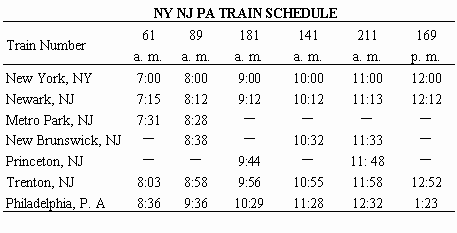
How do you read the train schedule? Suppose(假设) you're in New York City and you want to go to Princeton. Run your finger down the list of cities to find Princeton. Next, move your finger to the right. You will see the times that trains arrive in Princeton. Then run your finger up to the times listed across from New York. That's when the trains leave New York. Make your choice and enjoy the ride !
1.A doctor's office in Philadelphia opens at 9:00 a. m. What time must the doctor leave New York City to get there on time?
[ ]
2.Suppose Vice President Johnson rode today's trains. What time would he have to leave New York to be in Philadelphia by 1:30 p. m. ?
[ ]
3.You board the train in Newark at 8:13. When do you arrive in Trenton?
[ ]
4.Which is the fastest train to Philadelphia?
[ ]
5.Which two trains make the most stops?
[ ]
湖北省互联网违法和不良信息举报平台 | 网上有害信息举报专区 | 电信诈骗举报专区 | 涉历史虚无主义有害信息举报专区 | 涉企侵权举报专区
违法和不良信息举报电话:027-86699610 举报邮箱:58377363@163.com