
题目列表(包括答案和解析)
根据句意及汉语提示,填写句中所缺的单词。
1.------(星期二)is the third day of a week, between Monday and Wednesday.
2.Bob was very careless, He made so many (错误)that he failed the exam.
3.My mother always (鼓励) me face to the difficulties bravely.
4. Our teacher always all very (严格)with us students in the study.
5. Last year we went to Egypt, but this summer we are going to visit an (亚洲) country.
6. (除……之外)singing English songs, there are any other fun ways to learn English.
7.We’ll have a party next Saturday for Lily’s (二十) birthday.
8.Thanks to the (政府), thousands of people in Wenchun have moved into their new houses.
9.I can’t hear you (清楚地), Could you please speak more slowly.
10.They invited me to the play, but I had to (拒绝) because I was very busy.

Tang Hai is chatting with his e-pal David on QQ (T: Tang Hai D: David)
D: Hi. How is it going these days?
T: Pretty good! We celebrated our Dragon Boat Festival(端午节) last week.
D: Dragon Boat Festival? 【小题1】
T: To remember an ancient Chinese poet(诗人)。
D: How do you usually celebrate it?
T: 【小题2】 But this year, we did something more interesting.
D: What did you do?
T: Our school had a Dragon Boat race.
D: 【小题3】 who won the race?
T: Our class.
D: 【小题4】
T: Thanks a lot. I hope you can come to China sometime.
D: 【小题5】 I’m interested in Chinese traditions. Tell me more about them next time.
T: Ok, I will. See you.
D: See you!
| 【小题6】 |
|
| 【小题7】 |
|
| 【小题8】 |
|
| 【小题9】 |
|
| 【小题10】 |
|
We wanted to study how students at our school spend money. In order to study this, we made some questions to ask our classmates. First, we asked our classmates how much money they spent in one month. Then we asked how much money they spent on things like drinks, music, books, movies, computer games, and other things. Our math teacher helped us make a graph of our classmates’ answers.
Then we thought it would be interesting to compare these answers with our classmates’ expenses from last year. We used their answers to make another graph for their expenses last year.
Looking at the two graphs, it is easy to compare the expenses for the two years. Some of their expenses increased, but others decreased. This was a very interesting project for us.
注:⑴ graph 图表 ⑵ expense消耗,消费
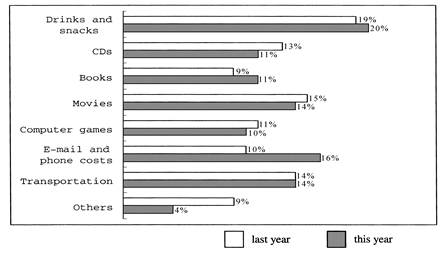 |
| A.Books. | B.Movies. | C.Drinks and snacks. | D.Computer games. |
| A.CDs. | B.Phone costs. | C.Others. | D.Transportation. |
| A.减少 | B.变化 | C.增加 | D.删除 |
| A.Books& Others | B.CDs & Movies | C.Movies & Books | D.all the above |
| A.Students spent the least money on e-mail and phone costs this year. |
| B.Students spent the same money on movies and transportation this year. |
| C.The expenses on e-mails and phones increased from 10% to 16% this year. |
| D.The expenses on others decreased from 9% to 4% this year. |
I think the Buddy Club is great. I really enjoy talking with the older students about school life and growing up. They can tell me a lot. One student told me how he relaxed (放松) before exams. Another student told me about great websites about learning History and English.
The Buddy Club is also a good place to just forget about school altogether! One of the older students taught us origami (日本折纸). We made paper planes, birds and hats together.
The table tennis tournament(锦标赛) was a great idea. I didn’t do very well, but I learnt a lot from watching the doubles tournament won by a fourteen-year-old girl and a seventeen-year-old boy.
Last year, we had the annual (每年的) Buddy Club Picnic. Everyone enjoyed the games we played. After I learnt how to fish, I caught two fish in the lake. I think it might be a good idea to change the Buddy Club Picnic to a weekend camping trip. We could learn how to put up (架起) tents (帐篷) and how to find our way through a forest. Many of the older students know how to do this already, and I think they would like to teach the younger students.
I want to say again how much I enjoy the club. When I’m older, I will make friends with younger students. Then, I can tell them all about school life and growing up.
1.What does the writer enjoy doing at the club?
A. Learning Japanese. B. Talking to older students.
C. Losing at table tennis. D. Surfing the Internet.
2.What websites did the writer learn about?
A. Paper planes. B. Origami.
C. History and English. D. Relaxing.
3.Did the writer win the table tennis tournament?
A. No, and he was very unhappy. B. No, but came second.
C. Yes, he won the doubles. D. No, but he enjoyed watching it.
4.How does the writer want to change the picnic?
A. He wants more fish to be caught.
B. He wants to make it shorter.
C. he wants to have it in a tent.
D. He wants to change it to a camping trip.
5.What does the writer want to learn?
A. How to put up a tent and make a fire.
B. How to put up a tent and find his way through a forest.
C. How to make clean water and find his way through a forest.
D. How to find his way through a forest and climb a mountain.
湖北省互联网违法和不良信息举报平台 | 网上有害信息举报专区 | 电信诈骗举报专区 | 涉历史虚无主义有害信息举报专区 | 涉企侵权举报专区
违法和不良信息举报电话:027-86699610 举报邮箱:58377363@163.com