
题目列表(包括答案和解析)
Every morning, the newspaper chief editor(主编) holds a meeting with the reporters. They discuss the main events(事件) of the day. Reporters are then sent to cover the events.
As soon as the reporters know what to write about, they get down to work. They telephone people and fix a time for a face-to-face interview with them. Sometimes they do telephone interviews. Checking information is very important. They go to the newspaper's own library to look up any information that they need. This is called “doing one's homework”.
At the same time, the picture editor decides which photographs will be used for the next day's paper. All the people who work on a newspaper must be able to work fast. Reporters have to stop working on one story and start working at once on the important new one. They must find out the new information as quickly as possible. Later in the day, everything is put together at the news desk. Reporters return, type their stories into the computer and hand them to the editor.
The chief editor decides which will be the most important story on the front page. Sometimes this will have to be changed if something more important happens late in the day. Other editors read the stories which the reporters have written and make any necessary changes.
Finally, there is no more time left for adding new stories, and the time for printing(印刷) the newspaper has come. This is done on fast-moving printing machines. The newspapers are then delivered(发送) by truck, plane or rail. Speed is important. People want to buy the latest newspaper; nobody wants to buy yesterday's.
【小题1】What is the work in a newspaper office like?
| A.Interesting and confusing | B.Important and patient. |
| C.Particular and necessary. | D.Fast and busy. |
| A.c-b-a-d-e | B.c-d-e-a-b | C.c-b-d-a-e | D.c-a-d-b-e |
| A.the importance of the events |
| B.how well the stories are written |
| C.the knowledge of the chief editor |
| D.whether they are the latest |
| A.help the chief editor with the morning discussion |
| B.decide when and how the papers can be printed |
| C.read the stories and make necessary changes |
| D.get together information from reporters and photographers |
| A.How a newspaper is produced | B.How newspapers are delivered |
| C.What kind of papers readers like | D.Whose work is more important |
Every morning, the newspaper chief editor(主编) holds a meeting with the reporters. They discuss the main events(事件) of the day. Reporters are then sent to cover the events.
As soon as the reporters know what to write about, they get down to work. They telephone people and fix a time for a face-to-face interview with them. Sometimes they do telephone interviews. Checking information is very important. They go to the newspaper's own library to look up any information that they need. This is called “doing one's homework”.
At the same time, the picture editor decides which photographs will be used for the next day's paper. All the people who work on a newspaper must be able to work fast. Reporters have to stop working on one story and start working at once on the important new one. They must find out the new information as quickly as possible. Later in the day, everything is put together at the news desk. Reporters return, type their stories into the computer and hand them to the editor.
The chief editor decides which will be the most important story on the front page. Sometimes this will have to be changed if something more important happens late in the day. Other editors read the stories which the reporters have written and make any necessary changes.
Finally, there is no more time left for adding new stories, and the time for printing(印刷) the newspaper has come. This is done on fast-moving printing machines. The newspapers are then delivered(发送) by truck, plane or rail. Speed is important. People want to buy the latest newspaper; nobody wants to buy yesterday's.
1.What is the work in a newspaper office like?
A. Interesting and confusing B. Important and patient.
C. Particular and necessary. D. Fast and busy.
2.According to the passage, the right order for a reporter's work is ____________.
a. writing stories b. doing interviews c. joining in a discussion
d. doing homework e. handing stories to the editor
A. c-b-a-d-e B. c-d-e-a-b C. c-b-d-a-e D. c-a-d-b-e
3.The front page contents(内容) are decided by ___________.
A. the importance of the events
B. how well the stories are written
C. the knowledge of the chief editor
D. whether they are the latest
4.Word editors' work is to ____________.
A. help the chief editor with the morning discussion
B. decide when and how the papers can be printed
C. read the stories and make necessary changes
D. get together information from reporters and photographers
5.The best title for this passage is “____________”。
A. How a newspaper is produced B. How newspapers are delivered
C. What kind of papers readers like D. Whose work is more important
完形填空
Mrs White wrote a novel. Last month she sent it to a famous magazine. A few days later the novel was 1 to her. Mrs White was 2 . She rang up the editor(编辑) of the magazine 3 . She said, “Yesterday you sent back a novel of 4 . How do you know that the novel is 5 ? You didn't 6 it. Before I sent you the novel I stuck (粘) together pages 25, 26 and 27.This was a test to see whether you would read the novel. When the novel came back, the pages were 7 stuck together. Is this the way you read all the novels that are 8 to you?”
The editor said, “At breakfast when I have an egg, I don't have to 9 the whole egg only to 10 that it is bad.”
1.
[ ]
A.returned B.sent C.given
2.
[ ]
A.glad B.pleased C.angry
3.
[ ]
A.the same day B.the next day C.the other day
4.
[ ]
A.someone else's B.yours C.mine
5.
[ ]
A.so good B.too long C.not good
6.
[ ]
A.read B.write C.like
7.
[ ]
A.already B.still C.usually
8.
[ ]
A.carried B.sold C.sent
9.
[ ]
A.see B.watch C.eat
10.
[ ]
A.discover B.show C.notice
In some magazines, tables of contents(目录) list articles in numerical order. The football article begins on page 5, the baseball article begins on page 7, the football story begins on page 13, and so on.
Other magazine table of contents are organized by subjects(题目), by columns(栏目) and by features(特写). Subjects are the topics covered in the articles. A feature is a specific(特殊的) kind of article, such as an article about sports or about cooking. “Feature” also has another meaning. A “regular feature” is something that appears in every issue(期), such as letters to the editor, movie reviews, sports statistics(统计) and other things. Some magazines also call regular features “departments”.
Columns are another kind of “regular feature” published in every issue. Columns are often written by the same person each time. A person who writes columns is called a columnist!
Most magazine tables of contents will also give you an idea of what a story is about. Look at the sample(例子) below.
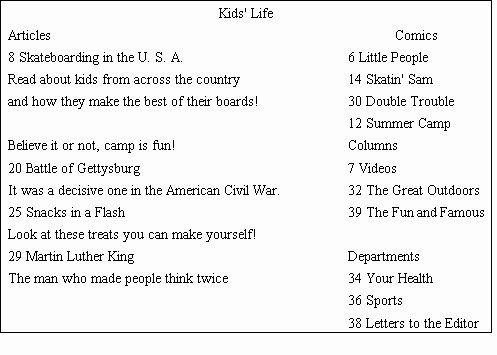
1.What page does the sports section begin on?
[ ]
2.List the titles of the regular feature in this magazine: ________.
[ ]
A.Your Health, Sports, Letters to the Editor
B.Summer Camp, Little People, Skatin' Sam
C.Your Health, Sports, Double Trouble
D.Sports, Letters to the Editor, Summer Camp
3.What was the Battle of Gettysburg according to the table of contents?
[ ]
A.The name of an American.
B.The name of an American city.
C.A battle of the World War Ⅱ.
D.A battle in the American Civil War.
4.Is there any information in this magazine about roller skating?
[ ]
A.There is a lot of information.
B.It's under the health heading.
C.Not unless it's under the sports heading.
D.Yes, there is no information about it.
阅读理解
No. 4 Middle School
Kunming, Yunnan
April 2nd, 2004
Dear editor(编辑),
I live in a beautiful city. Many visitors come to my city. There are so many beautiful peacocks(孔雀) here.
The peacocks mostly live on the grass land of Dongfeng Square. Visitors give them food freely. They usually throw food to them, and don't think about at all whether the food is right or wrong. Some of the peacocks became ill, some even died after eating the bad food given by the visitors. I'm sure most of the visitors who throw food to the peacocks really like the birds, but don't realize that they may be doing them harm. The visitors should be told that what they have done is very harmful to the birds, and this kind of thing must be stopped from happening.
Perhaps we can build some small shops beside Dongfeng Square to sell peacock food. For us every person, it's our duty to give more love to these beautiful birds and to look after them carefully.
Yours,
Sun Yah
(1) Many visitors come to the writer's city to________.
[ ]
A. do some shopping
B. see beautiful peacocks
C. play on Dongfeng Square
D. eat nice food
(2) Some peacocks became ill and died because some visitors________.
[ ]
A. didn't give them any food
B. gave them too much food
C. threw them some bad food
D. loved them and played with them
(3) Some shops can be built beside Dongfeng Square so that they may_________.
[ ]
A. sell food for visitors
B. sell food for peacocks
C. make the square more beautiful
D. have the beautiful birds
(4) From the passage we know that people should
[ ]
A. live and play with the birds
B. stop the birds from eating too much
C. give right food to the birds
D. give more food to the birds
(5) We can guess the writer of this letter, Sun Yan, may be a_________.
[ ]
湖北省互联网违法和不良信息举报平台 | 网上有害信息举报专区 | 电信诈骗举报专区 | 涉历史虚无主义有害信息举报专区 | 涉企侵权举报专区
违法和不良信息举报电话:027-86699610 举报邮箱:58377363@163.com