
题目列表(包括答案和解析)
| A.①③④② | B.②③①④ | C.④①②③ | D.①④②③ |
听力理解(本大题共30小题,每小题1分,共30分)
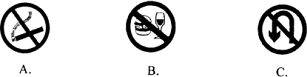
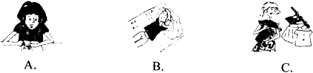
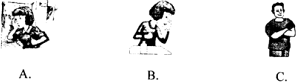
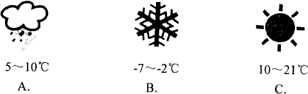
A.在下列每小题内,你将听到一个或两个句子并看到供选择的A、B、C三幅图画。找出与你所听句子内容相匹配的图画。
1.
2.
3.
4.
B.在下列每小题内,你将听到一个问句并看到供选择的A、B、C三个答语。找出能回答你所听到的那个问句的最佳选项。
5.A.I’m from Tianjin.
B.Tianjin is a beautiful city.
C.I’m a student.
6.A.It’s white.
B.It’s tall.
C.It’s young.
7.A.You’re welcome.
B.That’s a good idea.
C.Don’t mention it.
8.A.I like the school.
B.The school is far away.
C.I go by bus.
9.A.I was born in a small town.
B.I came here yesterday.
C.I had lunch at home.
10.A.I like holidays.
B.I went to Qingdao.
C.I stayed there for 2 weeks.
11.A.Since 1998.
B.Next year.
C.Last week.
12.A.I’m in Class One.
B.My name’s John.
C.I’m fifteen.
13.A.Her classes are interesting.
B.She is strict.
C.She is 26 years old.
14.A.Yes, go straight ahead.It’s opposite a school.
B.The hotel is very big.
C.People like going there.
C.下面你将听到十组对话,每组对话都有一个问题。根据对话内容,从每组所给的A、B、C三个选项中找出能回答所提问题的最佳选项。
15.What’s Harry’s favourite sport?
A.Football.
B.Table tennis.
C.Basketball.
16.When did the man come to China?
A.In August 1989.
B.In October 1999.
C.In October 2002.
17.Is Betty going to play the piano tomorrow morning?
A.No, she isn’t.
B.Yes, she is.
C.Yes.She likes playing the piano.
18.In Tom’s opinion, what’s the population of Shanghai?
A.10 million.
B.13 million.
C.15 million.
19.Where does the woman want to go?
A.Australia.
B.Africa.
C.Europe.
20.Who gave the man the advice?
A.The woman’s teacher.
B.The man’s pen friend.
C.The woman’s pen friend.
21.What haven’t they got at home?
A.Oranges.
B.Bananas.
C.Apples.
22.How many times has the woman been to the United States?
A.Three times.
B.Four times.
C.Five times.
23.What does Sam do on his birthday?
A.Have a party.
B.Make a cake.
C.Go dancing.
24.When is Charlie’s chemistry lesson?
A.At half past one.
B.At half past two.
C.At half past three.
D.听下面长对话或独白。每段长对话或独白后都有几个问题,从题中所给的A、B、C三个选项中选出最佳选项。
听下面一段材料,回答第25至第27题。
25.Where is Mary now?
A.At school.
B.At home.
C.On the Great Wall.
26.What are the students getting together for?
A.Having a school trip.
B.Having a swim.
C.Having a meeting.
27.Who is writing postcards?
A.Tony.
B.Wang Hui.
C.Lingling.
听下面一段材料,回答第28至第30题。
28.What does David like doing in the evening?
A.Staying at home.
B.Watching television.
C.Going out with his friends.
29.Where does David’s brother work?
A.In a school.
B.In a bank.
C.In a hospital.
30.What’s the difference between the two brothers?
A.The character.
B.The colour of eyes.
C.The colour of hair.
阅读理解
先阅读短文,然后根据短文内容从文后每小题的四个选项中,选出一个能完成所给句子或回答所提问题的正确答案。

1.Susan needs a house to study in for her exams, but she doesn't want to rent the house in the first ad, because it ________ for her.
[ ]
A.must be too old
B.must be too expensive
C.might not be quiet enough
D.might not be big enough
2.M:Look at that ad for the dance club! The lessons are free. You can join it.
W:I'm afraid I can't, my dear. On Saturday, I have an English lesson in the morning, an art lesson in the afternoon and a maths lesson in the evening. I want some free time.
Why can't the woman join the club?
[ ]
A.She has no favourite CDs.
B.The dance lessons are free.
C.She has too many lessons.
D.She must attend a maths class.
3.How long does one need to take the swimming lessons according to(根据) Ad ③?
[ ]
4.If Nick chooses to do garden work, what should he do first?
[ ]
A.To help Tom with his lessons.
B.To meet Tom at 16 Park Street.
C.To look after the flowers and grass.
D.To clean the kitchen and rooms.
My name is Daisy. I 1 my parents in an apartment(公寓). The apartment is on 2 floor of a tall building(建筑物). 3 14 floors and a car park in the basement(地下室). My father parks(停放) his 4 there.
Our apartment isn’t in the center 5 the city. It’s 3 km 6 the center. My father works in the city, 7 he goes to work 8 every morning. He doesn’t drive(驾驶) his car. He uses(用) his car only at 9 . Then he 10 us to the country or to the beach(海滩).
( )1. A. live in B. live with C. have
( )2. A. six B. sixth C. the sixth
( )3. A. There have B. There is C. There are
( )4. A. car B. taxi C. bus
( )5. A. in B. of C. with
( )6. A. from B. in C. of
( )7. A. because B. but C. so
( )8. A. take a bus B. by bus C. in bus
( )9. A. weekdays B. weeks C. weekends
( )10. A. takes B. helps C. wants
湖北省互联网违法和不良信息举报平台 | 网上有害信息举报专区 | 电信诈骗举报专区 | 涉历史虚无主义有害信息举报专区 | 涉企侵权举报专区
违法和不良信息举报电话:027-86699610 举报邮箱:58377363@163.com