A. goods B. drinks C. medicine D. shoes 查看更多


题目列表(包括答案和解析)

读对话,判断正(T)误(F)

  A:Hello,Tom.Nice to meet you.

  B:Nice to meet you,too,Gina.

  A:What's this in English?

  B:It's a dictionary.

  A:How do you spell it?

  B:D-I-C-T-I-O-N-A-R-Y.

  A:Is it your dictionary?

  B:No,it isn't.It's John's.

  A:Is that John's notebook?

  B:No,it isn't.It's mine.

  A:Is this my computer game? Your brother(兄弟) borrowed(借)it from me.Right?

  B:Yes,it's your computer game.

1.Tom can(能够)not spell dictionary.

(  )

2.The dictionary is John's dictionary.

(  )

3.That notebook is Gina's notebook.

(  )

4.The computer game is Gina's computer game.

(  )

查看答案和解析>>

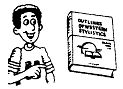
根据图画,补全下面的对话。

  A: What's this in English?

  B: It's a ________.

  A: How do you spell dictionary?

  B: D-I-C-T-I-U-N-A-R-Y.

查看答案和解析>>

阅读理解

  When the earthquake hit Japan on March 11,workers in a supermarket in Japan didn't run away when they felt the shaking.Instead, they held on to the shelves and tried to stop the goods(货物)from falling down.

  Reporters from NHK, the country's largest TV station, stayed calm in front of cameras during the earthquake, even though some were facing real danger.

  The earthquake was the most powerful one to hit Japan in the country's history.But Japan's reaction(反应)to the accident has shown that it is the most earthquake-prepared country in the world.The calm the Japanese showed during and after the quake has impressed the world.

  This is because Japan has “an earthquake culture”.Japanese people are taught how to prepare for and react to earthquakes from a young age.

  Schools in Japan organize earthquake practices every month.They make students become familiar with being in an earthquake.

  Japan also has a good earthquake warning system(警报系统).Warnings were broadcast on television, radio and mobile phones nine seconds after experts(专家)first knew about the quake on March 11.

  The warning system is unable to predict earthquakes.But it can usually alert people about 15 seconds before they feel the effects.Even 15 or 20 seconds can be enough time to save people's lives.

(1)

How did Japanese people react when the big earthquake hit Japan on March 11?

[  ]

A.

They felt angry.

B.

They were scared.

C.

They stayed calm.

D.

They were frustrated.

(2)

Which of the following is TRUE according to the passage?

[  ]

A.

Japan's reaction to the earthquake impressed the world.

B.

Japanese schools organize earthquake practice every day.

C.

Japan has a warning system that can predict earthquakes.

D.

Japanese people learn about earthquake safety only from universities.

(3)

After experts first knew about the quake on March 11,warnings were not broadcast ________.

[  ]

A.

on radio

B.

on the movie

C.

on television

D.

on mobile phones

(4)

What does the underlined word “alert”mean in Chinese?

[  ]

A.

改善

B.

提高

C.

提醒

D.

改变

(5)

What does the story mainly tell us about?

[  ]

A.

Japan's earthquake culture.

B.

The bad results caused by the earthquake.

C.

Japanese people were scared after the earthquake.

D.

Japanese people were homeless after the earthquake.

查看答案和解析>>

阅读下面短文,根据短文内容,将方框内所给句子填入短文的适当位置,使短文意思完整

  Here are some tips on listening.We hope it can help you in one way or another.

  ●Relax yourself.

  Before you start to listen to something, You need to relax.

    1   This will help you with your listening.

  ●Listen carefully to the first sentence.

    2   For example, if eyou hear“Many shops in many parts of China have decided to take away all kinds of Japanese goods off their shelves, but some people say it's not a good idea.Our reporter says…”, you know you will hear a piece of news, not a children's story or a science report.

  ●Think when you’re listening.

    3   For example, you can think of the following questions:What happened? When, where and how? What was the result and what does the speaker want to tell us? In this way, you may undersrand the passage better.

  ●Listen for important facts.

    4   For example, if the passage is a science report, you should try to remember its findings, and how the scientists got their results.

  ●Don't think about one or two words for too long.

  You may hear some words that you don't know.But don't spend too much time on them.

    5   But you can remember some words or sentences that you think are important, and you can use them when you’re answering the questions.

A.The first sentence tells a lot about the whole passage.

B.It's important for you to remember some important facts.

C.Don't get nervous or excited.

D.Very often, you'll find out what they mean later when you go on with

the listening.

E.When you’re listening, try to do some thinking.

查看答案和解析>>

阅读理解

  What's your dream vacation? Watching wildlife in Kenya? Boating down the Amazon? Sunbathing in Malaysia? New chances are opening up all the time to visit the world.So we visit travel companies, compare prices, and pay our money.

  We know what our vacation costs us.But do we know what it might cost someone else? It's true that many poorer countries now depend on tourism for foreign income.Unfortunately, though, tourism often harms the local(本地的)people more than it helps them.

  It might cost their homes and lands.In Myanmar, 5,200 people were forced to leave their homes among the pagodas(佛塔)in Bagan so that tourists could visit the pagodas.

  Tourism might also cost the local people their jobs and dignity(尊严).Local workers often find only low-paying jobs in the tourist industry.And most of the money do not help the local economy(经济).Instead, money return to the tour operators in richer countries, When the Maasai people in Tanzania were driven from their lands, some moved to poor places of the city.Others now make a little money selling things or acting for photos.

  Problems like these were noticed more than 20 years ago.But now tour operators and local governments are working together to begin correcting them.Tourists, too, are putting on the pressure.

  The result is “ethical(合乎职业道德的)tourism”.Ethical tourism has people at its heart.New international agreements and rules can help protect the people's lands, homes, economies and cultures.The beginnings are small, though, and the problems are complex(复杂的).

  But take heart.The good news is that everyone, including us, can play a part to help the local people in the places we visit.Tour operators and companies can help by making sure that local people work in good conditions and earn the money they should get.

  They can make it a point to use only locally owned hotel, restaurants and guide services.They can share some money to help the local economy.And they can help the local people plan and manage tourism.

  What can tourists do? First, we can ask tour companies to provide information about the conditions of local people.We can then make our choices and tell them why.And while we're abroad, we can:

  Buy local foods and products.

  Pay a fair price for goods and services and not bargain for the cheapest price.

  Ask before taking photographs of people.

  They are not just part of the scenery!

  Let's enjoy our vacation and make sure others do, too.

(1)

Which of the following is not mentioned?

[  ]

A.

Local people protected the pagodas in Bagan well.

B.

Tourists may stay in hotels opened by local people.

C.

Local people are mainly provided with low-paying work.

D.

Tourists had better not bargain with local people for a cheap price.

(2)

The underlined phrase "take heart" means "__________".

[  ]

A.

pay attention

B.

take care

C.

cheer up

D.

give up

(3)

According to the passage, the writer thinks ________.

[  ]

A.

tourism is not a promising industry

B.

dream vacations should be spent abroad

C.

the problems caused by tourism are easy to settle

D.

tourists should respect local customs and cultures

(4)

What is probably the best title for the passage?

[  ]

A.

Tourism Causes Bad Effects.

B.

Tourism Calls for Good Behavior.

C.

Vacations Bring a Lot of Fun.

D.

Vacations Cost More Than You Think.

查看答案和解析>>


同步练习册答案