
题目列表(包括答案和解析)
听力理解(共24分)
一、听对话,从下面各题所给的A、B、C三幅图片中选择与对话内容相符的图片。每段对话读两遍。(共4分,每小题1分)
1.
A.
B.
C.
2.
A.
B.
C.
3.
A.
B.
C.
4.
A.
B.
C.
二、听对话或独白,根据对话或独白内容,从下列各题所给的A、B、C三个选项中选择最佳选项。每段对话或独白朗读两遍。(共12分,每小题1分)
听第一段对话,回答第5至第6小题。
5.How much is the shirt?
A.13.
B.15.5.
C.30.
6.What colour is the dress?
A.Blue.
B.Black.
C.Brown
听第二段对话,回答第7至第8小题。
7.How is the woman after the long trip?
A.Tired.
B.OK.
C.Sleepy.
8.Where does the dialogue happen?
A.At the airport.
B.At the bus stop.
C.At the train station
现在请听一段对话,回答第9至第10小题。
9.What are the man and the woman talking about?
A.Their weekend.
B.Their hobbies.
C.Their summer holiday.
10.When did the woman go to London?
A.Two years ago
B.Two months ago
C.Two weeks ago
现在请听一段对话,回答第11至第13小题。
生词:poster海报 earthquake地震
11.Why was Lily absent from school that day?
A.Her leg got hurt.
B.She caught a cold.
C.She was on a vacation.
12.They are talking ________?
A.on the Internet.
B.face to face
C.on the telephone
13.What happened in their class that day?
A.They wrote a letter.
B.They collected money.
C.They made a speech competition.
请听一段独白,回答第14至第16小题。
14.The speaker may be a ________.
A.teacher
B.boss
C.guide
15.In the first few months, the new students should
________.A.look for a job.
B.meet their friends and relatives
C.do their best to get used to the life
16.When the students meet with problems they should
________.A.think of their parents
B.think everything over carefully
C.make a decision quickly for the future
三、听独白,记录关键信息。独白读两遍。(共8分,每小题2分)
请根据所听到的独白内容和卡片上的提示词语,将所缺的关键信息填写在下面卡片中的相应位置上。

听力测试(本大题共20分,每小题1分)
第一部分 听对话回答问题(共10小题)
听下面10段短对话,每段对话后有一个小题,从题中A、B、C三个选项中选出最佳选项。听完每段对话后,你都有10秒钟的时间来回答有关小题和阅读下一小题。每段对话读两遍。听第1至10段材料,回答第1至10题。
1.What will the girl buy for her father?

2.What's the weather like tomorrow?

3.How will Sally go to Xiamen?

4.Which picture matches the conversation?
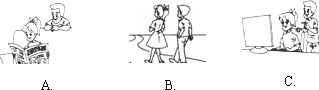
5.Where are the two speakers?
A.In the room.
B.At the bus stop.
C.On the way to the meeting.
6.What are they talking about ?
A.The cinema.
B.The film.
C.The TV set.
7.Why didn't the woman catch the train?
A.She didn't start early.
B.The traffic was too heavy.
C.She didn't know the way to the station.
8.How long does the film last?
A.Seventy minutes.
B.An hour.
C.Fifty minutes.
9.What do you learn about the two persons in the dialogue?
A.Both the man and the woman were at work last Friday.
B.The woman wasn't at work because she went to the hospital.
C.The woman liked her work very much.
10.How many maths problems has Rose finished?
A.Eight.
B.Ten.
C.Two.
第二部分 听对话和短文回答问题
你将听到对话和短文,从题中A、B、C三个选项中选出最佳选项。听完每段对话或短文后,你都有10秒钟的时间来回答有关小题和阅读下一小题。每段对话读两遍。听第一段对话,回答第11-12小题。
11.What did the man buy?
A.Two newspapers.
B.One newspaper and one magazine.
C.Two magazines.
12.How much did the man pay?
A.He paid one yuan.
B.He paid two yuan and fifty.
C.He paid three yuan and fifty.
听短文,完成信息表13-15题
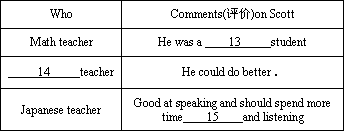
13.A.hard-working
B.best
C.lazy
14.A.Physics
B.Chinese
C.Science
15.A.reading
B.writing
C.talking
听一篇短文,回答16-20小题
16.Who is speaking to the students?
A.A guide.
B.A doctor.
C.A soldier.
17.Where did the guide dogs program start?
A.The USA.
B.France.
C.England.
18.When did Americans know the guide dogs?
A.After the doctor taught a dog to guide a person.
B.After the American woman went to Germany.
C.After the American woman wrote about it for a magazine.
19.What kind of dogs are the best ones for the job?
A.Strong.
B.Bright.
C.Old enough.
20.How long does it take to train a little dog to be a guide?
A.Over 2 years.
B.14 months.
C.4 weeks.
第一部分:听力
第一节:(共5小题;每小题1.5分,满分7.5分)
听下面5段对话。每段对话后有一个小题,从题中所给的A、B、C三幅图中,选出一个与你所听到的内容相符合的选项。每段对话读两遍。
1.Which is Jim’s house?

2.How did the boy sleep last night?
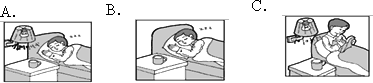
3.What are on the table?
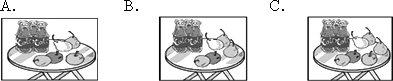
4.How does Limei go to school every day?

5.Where does the boy’s father work?

第二节(共5小题;每小题1.5分,满分7.5分)
听下面5段对话。每段对话后有一个小题,从题中所给的A、B、C三个选项中选出最佳选项。每段对话读两遍
6.A.At a bus stop
B.At an airport
C.At a train station
7.A.Next to a supermarket.
B.Next to a post office.
C.Next to a bank
8.A.On Tuesday morning
B.On Thursday morning
C.On Saturday morning
9.A.By car.
B.By bus.
C.By train.
10.A.Under the table.
B.On the chair
C.Under the window
第三节(共10小题;每小题1.5分,满分15分)
听下面3段对话或独白。每段对话或独白后有几个小题,从题中所给的A、B、C三个选项中选出最佳选项。每段对话或独白读两遍。
听下面一段材料,回答11至13三个小题。
11.What is the girl doing now?
A.Studying.
B.Watching a game.
C.Writing a letter.
12.What do we know about the boy’s computer?
A.It’s old
B.It’s slow
C.It’s being mended.
13.Why does the girl often go to the library?
A.To do her part-time job
B.To meet her friends.
C.To waste the time.
听下面一段材料,回答14至16三个小题。
14.When is their mother’s birthday?
A.May 10.
B.May 11.
C.May 12.
15.What will they buy as a present for their mother?
A.A pair of shoes.
B.A handbag.
C.A cake.
16.Where will Sam wait for Mary after class?
A.At the school gate.
B.In the classroom.
C.On the playground.
听下面短文,回答17至20四个小题。
17.What was the weather like that day?
A.Rainy.
B.Snowy.
C.Sunny.
18.What was Tim doing when he met the speaker at first?
A.Having a holiday.
B.Studying abroad.
C.Going on a business trip.
19.Where does the speaker come from?
A.Germany.
B.America.
C.France
20.What was the relationship between the speaker and Tim later?
A.Good friends.
B.Husband and wife.
C.Workmates.
听力部分
长对话理解(本题共10分,每小题1分)
听下面四段长对话,每段对话后有2-3个小题。从各小题所给的选项中选出一个最佳选项。听每段对话前,你有时间阅读各小题,每小题5秒钟。听完后,每小题有5秒钟的作答时间。每段对话听两遍。
听第一段对话,回答第1-2小题。
1.Where is the woman going?
A.To the City Park.
B.To the Children’s Park.
C.To the Zhongshan Park.
2.Which bus can take the woman there?
A.Bus No.
2.B.Bus No.
12.C.Bus No.5.
听第二段对话,回答第3-4小题。
3.When is Kangkang’s birthday party going to be held?
A.On Saturday.
B.On Friday.
C.On Sunday.
4.Why is the boy not going to the party at first?
A.Because he has no time.
B.Because he doesn’t want to make new friends.
C.Because he doesn’t think he knows anyone there.
听第三段对话,回答第5-7小题。
5.Where did the woman lose her handbag ?
A.Outside the supermarket.
B.Inside the supermarket.
C.On the way to the supermarket.
6.What does her handbag look like?
A.
B.
C.
7.What’s in her handbag?
A.A pair of shoes.
B.Some keys.
C.A telephone.
听第四段对话,回答第8-10小题。
8.What is the relationship(关系)between the two speakers?
A.Classmates in primary school.
B.Teacher and student.
C.Brother and sister.
9.What does Lili like doing now?
A.Swimming a lot.
B.Talking to people.
C.Learning English.
10.What does Daming go to London for?
A.He wants to help his sister.
B.He wants to find a job.
C.He wants to study further.
二、听选信息(本题共5分,每小题1分)
听下面一段短文,短文后有5个小题。从各小题所给的选项中选出一个正确的选项。听短文前你有25秒钟时间阅读各小题。听完后,你有25秒钟的作答时间。短文听两遍。
11.Where did the film team shoot(拍摄)a movie?
A.In the desert.
B.In the forest.
C.In the mountain.
12.What did the old Indian say to the director first?
A.There’s a storm the next day.
B.There’s a sandstorm the next day.
C.There’s rain the next day.
13.When did the old Indian say there was a storm?
A.Two days later.
B.A week later.
C.Two weeks later.
14.What did the director ask the old Indian to do?
A.To play a role in the movie.
B.To report the weather.
C.To be his secretary.
15.Why didn’t the old Indian help them any longer?
A.He didn’t want to do it any more.
B.He didn’t like the director.
C.His radio didn’t work.
三、短文理解(本题共5分,每小题1分)
听下面一篇短文,短文后有5个小题。从各小题所给的选项中选出一个最佳选项。听短文前,你有25秒钟时间阅读各小题。听完后,你有25秒钟的作答时间。短文听两遍。
16.What did the city government call her people to do?
A.To build the city into a big city.
B.To make the city look more beautiful.
C.To build more street parks.
17.What did the whole class do on Sunday?
A.Cleaned the street park.
B.Played in the street park.
C.Planted trees in the street park.
18.How many students were there in one group?
A.4 students.
B.40 students.
C.10 students.
19.What did the first group do in the park?
A.Cleaned the park benches(长凳).
B.Pulled up wild grass.
C.Picked up the rubbish.
20.How did the students feel after they finished the work?
A.They felt tired and unhappy.
B.They felt tired but happy.
C.They didn’t feel tired at all.
Many strong and out-of-control emotions are recognized as an illness. People who are always very sad have depression (抑郁症); those who worry a lot have anxiety.
But what about anger problems? Anger is largely viewed as a secondary emotion – one caused by other emotions. People are thought to be angry because they are sad, anxious or stressed. In the past, many doctors didn’t accept the idea that anger could be a problem all on its own.
Today, though, a growing number of mental health experts think that anger is a serious problem that needs its own treatment.
How to tell the difference between “normal” anger and “anger problem” is difficult. After all, everyone gets really mad from time to time. Experts point out a few ways.
Disordered anger, as it is sometimes called, tends to be of greater intensity (强度). It takes very little to set off a person with an anger problem, and their responses (反应) are very strong. An example: While most people would get upset if a driver cut them off, someone with disordered anger might try to chase down the car and force it off the road.
And in cases of disordered anger, the person gets angry more frequently and his/her anger lasts longer. For most people, angry feelings disappear quickly. But people with anger problems often stay angry for days, weeks or even years; their feelings of anger don’t disappear over time.
Consequences are also important to consider: Disordered anger often damages people’s lives. “It interferes (干扰) with people’s relationships and their jobs,” says Raymond Chip Tafrate, a US psychologist. “Even their health is affected.”
Anger clearly increases the risk of certain health problems, as many studies have shown. “When a person is angry, their heart beats faster and their blood pressure goes up,” says Howard Kassinove, a professor at Hofstra University in New York. Over time, these changes take their toll on the body, he adds.
Experts suggest that people with an anger problem take anger-management programs. The programs teach people to control their responses to stressful situations through the use of relaxation techniques. The programs sometimes include life-skills training as well: increasing someone’s level of competence (竞争)– whether on the job or as a parent or partner – helps bring down stress and cut angry feelings.
【小题1】A person who _________ most possibly has disordered anger in the experts’ opinion?
| A.can’t get out of anger quickly |
| B.is dissatisfied with relationships |
| C.has high blood pressure |
| D.is worried about his job |
| A.Responses. | B.Effects. | C.Reasons. | D.Feelings |
| A.Anger is an secondary emotion that makes people sad and stressed. |
| B.Anger was recognized as an illness by most doctors in the past. |
| C.A person with an anger problem gets angry more often and easily. |
| D.The use of relaxation techniques is the best way to manage anger. |
| A.Can anger be an illness? |
| B.Is it disordered anger? |
| C.Can anger influence our life? |
| D.Is anger management important? |
湖北省互联网违法和不良信息举报平台 | 网上有害信息举报专区 | 电信诈骗举报专区 | 涉历史虚无主义有害信息举报专区 | 涉企侵权举报专区
违法和不良信息举报电话:027-86699610 举报邮箱:58377363@163.com