
题目列表(包括答案和解析)
A. on B. in
C. at D. for
阅读理解
John:Why is Bob absent from school today?
Bill:He is in bed at home with a broken leg.
John:That's too bad. What happened?
Bill:A car ran through a red light and hit him while he was on his way home after school yesterday.
John:I'm sure it was the driver's mistake.
Bill:It certainly was. Many drivers just drive carelessly though there are better roads today.
John:But there are also many cars today and they seem to run faster and faster.
Bill:In fact, smoother (更平坦) and wider roads only bring about more dangers.
John:That's true. We can't travel fast and safely if we don't obey (遵守) the traffic rules (交通规则).
1.Why didn't Bob go to school?
[ ]
A.He liked to lie in bed.
B.He wanted to stay home.
C.He couldn't walk.
D.He liked to drive on wide roads.
2.What brought about Bob's trouble?
[ ]
A.Bob's absence (缺席) from school.
B.Bob's going home after school.
C.Too many traffic rules.
D.The driver's careless driving.
3.What was the driver's mistake?
[ ]
A.He drove carefully on his way home.
B.He didn't obey the traffic rules.
C.He drove on smooth and wide roads.
D.He had to look out for other cars.
4.Why do smoother and wider roads bring more dangers?
[ ]
A.Because there are more and more cars.
B.Because people get legs broken easily.
C.Because there are more new traffic rules.
D.Because there are many cars and people drive fast.
5.Traffic accidents happen easily for ________.
[ ]
A.people are fond of travelling long distance (距离)
B.better roads today bring about more cars and the fast speed driving
C.few drivers know little about the traffic rules
D.travellers prefer driving to walking when they go out in the street
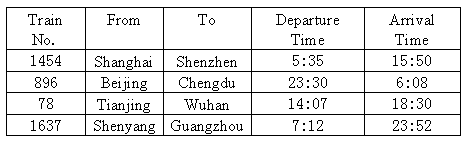
根据表格信息选择最佳答案。
(1)
The train from Shanghai to Shenzhen leaves at ________.[ ]
|
A .16:50 |
B .14:07 |
C .5:35 |
(2)
We must be on the train for ________ if we go to Shenzhen from Shanghai.[ ]
A
.16 hours and 50 minutesB
.24 hours and 25 minutesC
.10 hours and 15 minutes(3)
If you want to go to Chengdu from Beijing. You can take ________ train.[ ]
|
A .the No.1454 |
B .the No.896 |
C .the No.78 |
(4)
The No.78 train arrives in Wuhan at ________.[ ]
|
A .6:30 p.m. |
B .2:07 p.m. |
C .5:30 a.m. |
(5)
Which train takes the longest time?[ ]
A
.The one from Tianjin to Wuhan.B
.No.1637.C
.The one from Beijing to Chengdu.Miss Scott arrived ______ Australia ______ 5:00 ______ March 7.
[ ]
A. at, in, at B. in, at, on C. to, on, at D. in, on, at
完形填空.
When July comes, children know they'll have_(1)_examinations and the school year will end soon. Boys and girls will have a nearly two month's holiday, and they'll leave school_(2)_train or by car to_(3)_ to see their fathers and mothers.
The summer holidays are the_(4)_ time of the year of most children. The weather is usually good, so one can_(5)_ most of his time playing outside. If one lives in the country, he can_(6)_ into the woods and in the fields. If one lives in a big town, he can usually go to a park to play.
The best place for a summer holiday is the_(7)_ Some children are_(8)_enough to live near the sea. But for the others who do not, if they have the chance to stay at one of the big seaside towns for a week or two, they will talk about it all the following school year.
Now, _(9)_makes children like the seaside so much? I think it is the sand, the sea and the sun, not anything else. of course, there are_(10)_new things to see, nice things to eat, and interesting things to do. But the feeling of sand under their feet, of salt water on their skin, and the feeling of the warm sun on their backs make them happier.
(1)
[ ]
(2)
[ ]
(3)
[ ]
(4)
[ ]
(5)
[ ]
(6)
[ ]
(7)
[ ]
(8)
[ ]
(9)
[ ]
(10)
[ ]
湖北省互联网违法和不良信息举报平台 | 网上有害信息举报专区 | 电信诈骗举报专区 | 涉历史虚无主义有害信息举报专区 | 涉企侵权举报专区
违法和不良信息举报电话:027-86699610 举报邮箱:58377363@163.com