
题目列表(包括答案和解析)
Long long ago, a young man found a spring of delicious clean water while he was going through the desert. He brought some back to the oldest man in his village, who had been his teacher before. After a four-day journey he sent the water to the old man who took a deep drink, smiled warmly and thanked his student for the sweet water. The young man returned to his village happily. The next day, the teacher let another student taste the water. He spat it out, saying it was awful. It went bad because it had stayed in the old leather container(皮革容器) for so many days in such hot weather. The student asked his teacher why he pretended(假装) to like the awful water. The teacher replied, "You only tasted the water. I tasted the gift. The water was simply the container for love and kindness. And nothing could be sweeter than these."
I think we understand this lesson best when we receive small gifts of love from very young kids. Whether it's a slice of bread or a piece of colored paper, the natural and right response(反应) is to show our thanks and happiness because we get love from the gift.
To show our thanks doesn't always come naturally. Unfortunately, most children and many adults only see the thing itself. They never feel the meaning of the thing. We should tell ourselves and teach our children about showing thanks and happiness to the persons who give the gifts from their hearts because gifts from the heart are really gifts of the heart.
1.Where did the young man find the water?
A.In a spring. B.In a river. C.In a lake. D.In a village.
2.How long did the water stay in the old leather container?
A.Six days. B.Five days. C.Four days. D.Three days.
3.What does the word “replied” mean?
A.smiled B.cried C.answered D.got angry
4.According to the passage, what is the right response when we get gifts from others?
A.We eat it up at once.
B.We only see the thing itself.
C.We think about the meaning of the bread.
D.We usually show our thanks and happiness naturally.
5.What does the writer want to tell us?
A.We should never receive anything from others.
B.We should show thanks and happiness when we get the gifts from the heart.
C.We should pretend to love the things given by others all the time.
D.We should give gifts from our hearts.

| A.+65 6737 1668 | B.6552 8888 |
| C.1800 767 4333 | D.6552 2222 |
| A.both buses and trains | B.only trains |
| C.both buses and taxis | D.only rental cars |
| A.take your own license with you | B.ask the driver how much your ticket is |
| C.buy the bus map of Singapore | D.book your ticket ahead of time |
| A.麻烦 | B.乐趣 | C.景点 | D.费用 |
| A.A local has no trouble finding his way around. |
| B.It’s much cheaper to go around by bus than by train. |
| C.You can see a lot more in Singapore only by renting a car. |
| D.It’s very convenient for visitors to travel in Singapore. |
Tony Buzan’s grades were going down at university. Disappointed with his low marks, he went to the library to find a book on how to use his brain. He was directed to the medical section. Confused, he said to the librarian, “I don’t want to take my brain out, I just want to learn how to use it.” Her reply was simple: “There’s no book on that.”
“I thought to myself,” says Buzan, “if I buy a little radio, I get an instruction manual (说明书). If I buy a microwave, I get an instruction manual. But for the most important machine in the world, no instruction manual?”
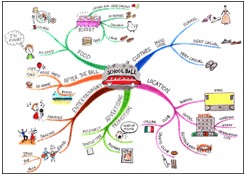
Fifty years later, Buzan has become the world’s leading speaker on the brain and learning. In the late 1960s, he invented the mind map, a visual representation of thought processes.
This kind of thinking has become a popular tool for planning, organizing, problem solving, and communicating across the world. He has since authored and co-authored over 100 books that have appeared in more than 30 languages.
“I think in most cases, people use less than 1 percent of their brains,” he says.
But how do you expand this 1 percent? How do you become the best student you can be?
According to Buzan, the answer is simple. You take a section of whatever it is that you are trying to learn, he says, and you read it for its essence (精髓、要素). Then you make a mind map of all the important details. For a truly effective mind map, you start with a colored image in the center of your page. Draw the first image that comes to mind on the topic you are mind mapping. Branch off from your central image and create one of your main ideas. From your main branches draw some sub-branches and from those sub-branches you can draw even more branches. He emphasizes that you should use plenty of images and colors as these help with memory recall and encourage creativity.
By using this visual format (形式), according to Buzan, your mind will begin to make associations that will help you remember more information for longer periods of time.
Buzan believes that traditional note-taking methods, such as lists and summaries, do not stimulate the brain’s recall capacity or ability in the same way. Because of this, students will often find themselves locked away in their rooms for hours, trying hard to memorize separate details. Buzan believes that for a more effective and lasting way of studying, you must first understand how your brain works.
“Everyone is born smart,” he says. “You just have to learn how to learn.”
1.What is the main purpose of the first two paragraphs?
A.To show that Tony Buzan was worried about his study.
B.To invite us to think about the importance of manuals.
C.To prove that the mind map is a useful tool for the brain.
D.To show why Tony Buzan studies the brain and learning.
2.What does the word “stimulate” mean in the passage?
A.Excite. B.Improve. C.Encourage. D.Affect.
3.What can we infer from the passage?
A.If we learn the mind map, we will become the best student.
B.The mind map will help your brain connect separate details.
C.The mind map will be more effective if we put more details in it.
D.We will solve the problem if we make connections between ideas.
4.What is the best title for the passage?
A.How to make the mind map?
B.Is the mind map widely used?
C.Can your memory be mapped?
D.Is the mind map helpful in thinking?
Mobile phone (手机)has become a problem for middle schools. Some middle schools in Australia have banned (禁止) students from carrying mobile phones during school hours.
Mobile phone use among children has become a problem for the schools this year. Several children have got mobile phones as Christmas presents, and more students want them.
Mary Bluett, an official(官员), said mobile phone use is a distraction(分心) to students during school hours and it also gives teachers so much trouble in their classrooms. Teachers were also saying that sometimes students might use phone messages to cheat during exams.
She said some schools had tried to ban mobile phones. Some parents felt unhappy, because they couldn’t get in touch with their children.
Many teachers said students should not have mobile phones at school, but if there was a good reason, they could leave their phones at school office. They also said there were many reasons why the students should not have mobile phones at school; they were easy to lose and were a distraction from studies.
Many people say that they understand why parents would like their children to have phones, but they think schools should let the students know when they can use their mobile phones.
1.Some middle schools in Australia have banned students from carrying mobile phones ____.
|
A.because they are students |
B.when they are free |
|
C.when they are at school |
D.because they are children |
2.We know from the passage that some children get mobile phones from _______.
|
A.the makers and sellers |
|
B.the passers-by and strangers |
|
C.their parents and friends |
|
D.some mobile phone users |
3.What does the word “cheat” mean in the passage in Chinese?
|
A.聊天 |
B.核对 |
C.查询 |
D.作弊 |
4. Some parents felt unhappy because they couldn’t________ during school hours.
|
A.use their mobile phones |
|
B.leave their mobile phones at school office |
|
C.help the teachers with their work |
|
D.get in touch with their children |
5.The passage tells us that_______.
|
A.students shouldn’t have mobile phones at school except for some special reasons |
|
B.it is impossible to ban students from using mobile phone at school |
|
C.some parents felt unhappy because they couldn’t Use their phones at school |
|
D.parents should teach their children how to use mobile phones during school hours |
湖北省互联网违法和不良信息举报平台 | 网上有害信息举报专区 | 电信诈骗举报专区 | 涉历史虚无主义有害信息举报专区 | 涉企侵权举报专区
违法和不良信息举报电话:027-86699610 举报邮箱:58377363@163.com