
题目列表(包括答案和解析)
听力
A.听句子,从所给三幅图中选出你所听到的句子情景相同(相近)的图画。(每小题读两遍)(5分)
1.

2.

3.

4.

5.

B.情景反应:根据你所听到的句子,选择恰当的答语。(每小题读两遍)(8分)
6.A.She is clever. B.No, you don't have to. C.Hold on, please.
7.A.You're welcome. B.It doesn't matter. C.Go ahead.
8.A.That sounds interesting. B.Well done! C.It's very kind of you.
9.A.Nice to meet you. B.How are you? C.Thank you.
10.A.Good idea. B.Enjoy yourselves! C.By bike.
11.A.Thank you all the same. B.Sorry, I am new here. C.Here you are.
12.A.Just a little. B.One kilo. C.Fifty yuan.
13.A.It's a knife. B.It's made of paper. C.It's round.
C.对话理解:根据你所听到的对话内容,选择最佳选项回答问题。(每段对话读两遍)(12分)
第一节 听第
14至19段对话,回答第14至19小题。14.How was the film according to the man?
A.Boring. B.Interesting. C.Exciting.
15.What does the man's mother do?
A.A teacher. B.A worker. C.A nurse.
16.How long has Michael been in Zhangzhou?
A.For Five days. B.For three days. C.For two days.
17.Where did the dialog probably happen?
A.In a shop. B.In a school. C.In a restaurant.
18.What did Peter do last night?
A.He watched the soccer game.
B.He did his homework.
C.He went shopping.
19.What will the weather be like tomorrow?
A.Sunny. B.Snowy. C.Rainy.
第二节 听下面两段对话,每段对话后各有三个问题,选择最佳选项回答问题。
听第20段对话,回答第20至22小题。
20.When does Mr.Li drink tea?
A.In the evening. B.In the daytime. C.At any time.
21.Why can't we grow tea in the north?
A.It's too cold. B.It's too windy. C.It's too wet.
22.What does the woman like to drink?
A.Coffee. B.Water. C.Tea.
听第21段对话,回答第23至25小题。
23.Where is Jane from?
A.America. B.Australia. C.Canada.
24.What are Jane's family going to do in the summer holidays?
A.To visit Dalian.
B.To see Jane's grandparents.
C.To visit some cities in the north.
25.Who will travel with Li Ming?
A.His father.
B.His parents.
C.His grandparents.
D.短文理解:根据你所听到的短文内容,填写出下面表格中的空缺部分。(短文读三遍)(5分)

听力
A.听对话,从A、B、C三幅图中找出与你所听内容相符的选项。听两遍。
1.How's the weather now?

2.How do the man's parents go to work?

3.Where is John from?

4.What is she going to buy?
A.

B.

C.

B.听对话,从题中所给的A、B、C三个选项中选出最佳答案。听两遍。
5.What does the woman advise the man to do?
A.To stay at home.
B.To take some medicine.
C.To see a doctor.
6.Why does the woman hate traveling by air?
A.Because she thinks the journey is too tiring.
B.Because she likes traveling very much.
C.Because she doesn't like plane.
7.Where did the dialogue happen?
A.In a school.
B.At a factory.
C.In a shop.
8.What's the telephone number?
A.87659413.
B.87759314.
C.87669413.
9.What did Mary do just now?
A.She did shopping.
B.She bought a book in the bookstore.
C.She went to the library to borrow a book.
10.What does the woman think the boy should do?
A.Listen to music every day.
B.Listen to and read English every day.
C.Listen to and read Chinese every day.
C.听下面两段材料,从题中所给的A、B、C三个选项中选出最佳答案。听两遍。
听第一段材料,回答第11-12题。
11.Where is the man going?
A.The railway station.
B.The clock tower.
C.The park.
12.Why can't the man find the place?
A.This is his first time to visit the place.
B.The railway station is still next to the clock tower.
C.Things have changed a lot over the years.
听第二段材料,回答第13-14题。
13.How long did Li Fang live in Shanghai?
A.For 5 years.
B.For 6 years.
C.For 7 years.
14.What does Li Fang's father sell?
A.Apples.
B.Football.
C.Computers.
D.听下面两篇短文,回答15-20题。请根据所听内容,从A、B、C三个选项中选出最佳答案,完成信息记录表。听两遍。
听第一段材料,回答第15-17题。
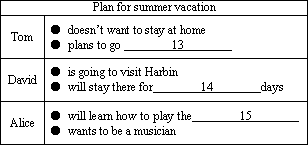
15.A.fishing
B.camping
C.swimming
16.A.5
B.6
C.7
17.A.guitar
B.violin
C.piano
听第二段材料,回答第18-20题。

18.A.weekdays
B.weekends
C.every night
19.A.popular
B.more
C.new
20.A.meals
B.lessons
C.sports
E.听短文,从题中所给的A、B、C三个选项中选出最佳答案。听两遍。
21.Where may the tourists be now?
A.In Nanjing.
B.On the bus.
C.In the park.
22.Where does Nanjing lie(位于)?
A.In the southeast of China.
B.In the northeast of China.
C.In the south of China.
23.What does the guide think of the people in Nanjing?
A.Hard-working and humorous.
B.Polite and generous.
C.Helpful and friendly.
24.What can people do in Xuanwu Lake according to the passage?
A.Boating and flying kites.
B.Boating and fishing.
C.Swimming and flying kites.
25.Where can the tourists enjoy the beauty of the whole city?
A.Nanjing Museum.
B.On the top of Zijin Mountain.
C.On the Great Changjiang Bridge.
阅读下面短文,根据其内容完成后面各项任务。
I and many other people in Britain love charity (慈善) shops because we can find them on every street. The charity shops sell all kinds of things and they are very cheap.
The first charity shop was opened by Oxfam in 1947. Now there are over 7,000 charity shops in the UK. My favourite charity shop in my hometown is the Red Cross Shop. There I always find children's books, all 10 to 20 pence each. They are really cheap.
Most of the shop workers in charity shops are volunteers (志愿者), ________ each shop has a manager and he gets some money. Every morning you see bags of things outside the shops. Some people bring and put them there without waiting for thanks. In fact, over 90% of the things in charity shops are from kind people.
All the money the shops get goes to charity work. Charity shops raise more than 110 million pounds every year. The money is for sick and poor children, homeless and disabled people, and many others. In a charity shop you can get cheap but nice things. You might even feel special while shopping.
If possible, let's do something for charity together.
1.What do the charity shops sell?
2.从短文中找出可以替换下面所给句子的一句话。
Oxfam opened the first charity shop in 1947.
3.在短文第三段的空白处填人一个适当的连词,使句意完整通顺。
4.How much do charity shops raise every year?
5.将短文划线部分(第五段)的英语句子译成汉语。
阅读下面短文,根据其内容完成后面各项任务。
I and many other people in Britain love charity (慈善) shops because we can find them on every street. The charity shops sell all kinds of things and they are very cheap.
The first charity shop was opened by Oxfam in 1947. Now there are over 7,000 charity shops in the UK. My favourite charity shop in my hometown is the Red Cross Shop. There I always find children's books, all 10 to 20 pence each. They are really cheap.
Most of the shop workers in charity shops are volunteers (志愿者), ________ each shop has a manager and he gets some money. Every morning you see bags of things outside the shops. Some people bring and put them there without waiting for thanks. In fact, over 90% of the things in charity shops are from kind people.
All the money the shops get goes to charity work. Charity shops raise more than 110 million pounds every year. The money is for sick and poor children, homeless and disabled people, and many others. In a charity shop you can get cheap but nice things. You might even feel special while shopping.
If possible, let's do something for charity together.
【小题1】What do the charity shops sell?
【小题2】从短文中找出可以替换下面所给句子的一句话。
Oxfam opened the first charity shop in 1947.
【小题3】在短文第三段的空白处填人一个适当的连词,使句意完整通顺。
【小题4】How much do charity shops raise every year?
【小题5】将短文划线部分(第五段)的英语句子译成汉语。
湖北省互联网违法和不良信息举报平台 | 网上有害信息举报专区 | 电信诈骗举报专区 | 涉历史虚无主义有害信息举报专区 | 涉企侵权举报专区
违法和不良信息举报电话:027-86699610 举报邮箱:58377363@163.com