
题目列表(包括答案和解析)
Venice is an attractive city in Italy. Tourists throughout the world love traveling to Venice. But sometimes you’ll have such strange experiences. One moment you walk across the Rialto Bridge, and there’s nothing special. Unfortunately, when you come back to the bridge an hour later, it’s underwater and everyone’s wearing rain boots.
That’s just the way it has always been, which may be considered seriously by Italian government. Before the sea comes to Venice, the government has decided to build the MOSE gates. Actually(实际上), there were many kinds of gates that were built to stop the floods, but all the gates were just built on the ground. Besides, the flooding was becoming worse. Industrial(工业的)factories built nearby on the mainland also made the condition get worse, causing the city to sink about 0.75 feet in the 20th century.
So the Italian government asked some of Italy’s biggest construction and engineering companies to build the MOST project, which was planned to be built under the sea water to stop floods. Now the government are using 3 000 people and expect to spend nearly five billion euros(欧元) on it. The MOSE gates are being built at the inlets(海湾).Each MOST gate is 197 feet long ,28.5 to 37 feel tall, and weight up to 22 tons. It’s nearly the size of a 20-story building. Before the gates are in use, under the sea full of water. When the flood comes, the water in the gates will be poured out, and then the gates will be filled with air. So the gates can go up with the sea water. Once they’re in the right place, they will stop the sea water pouring into Venice. These gates will be able to deal with floods up to 10feet,and as long as the sea level(平面)rises no more than two feet in the next 100 years, the MOSE will work as expected.
The MOSE project is now two-thirds done. The head engineer, Giovanni Cecconi, said, “This is a war. During the war, it’s not important that you win. It’s important that you’re alive. We’ve alive.” Anyway, this project is saving Venice from falling.
根据短文内容选择最佳答案。
1.The underlined word “construction” in the passage means “_______”in Chinese.
A.建筑 B. 农业 C. 交通
2.Before building the MOSE gates, the Italian government _______ to stop the floods.
A. never built gates on the ground
B. built many kinds of gates on the ground
C. built some gates which were under the ground
3.When the flood comes, _______ can describe the working steps of the MOSE gates.
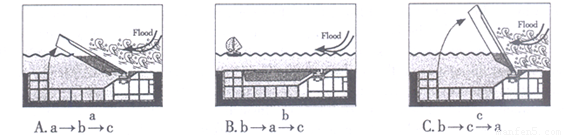
4.Which of the following is TRUE according to the passage?
A. The Italian government ate using 3000 people and expect to spend nearly five billion dollars on the MOSE.
B. The MOSE project is half done now.
C. Each MOSE gate is 197 feet long, 28.5 to 37 feet tall, and weighs up to 22 tons.
5.The best title for this passage should be _______.
A. The Journey to Venice
B. The MOSE Project in Venice
C. Several Kinds of Floods in Venice
You either have it, or you don’t—a sense of direction, that is. But why is that some people would find their way across the Sahara without a map, while others can lose themselves in the next street?
Scientists say we’re all born with a sense of direction, but it is not properly understood how it works. One theory(理论) is that people with a good sense of direction have simply worked harder at developing it. Research being carried out at Liverpool University supports this idea and suggests that if we don’t have it, we lose it.
“Children as young as seven have the ability to find their way around,” says Jim Martland, Research Director of this project. “However, if they are not allowed out alone or are taken everywhere by car, they never develop the skills.”
Jim Martland also emphasized(强调) that young people should be taught certain skills to improve their sense of direction. He makes the following suggestions:
If you are using a map, turn it to the way you are facing.
If you leave your bike in a strange place, put it near something like a big stone or a tree. Note landmarks on the route as you go away from your bike. When you return, go back along the same route.
The simple way of finding your direction is by using lines such as streets in a town, streams, or walls in the countryside to guide you. Count your steps so that you know how far you have gone and note any landmarks such as tower blocks or hills which can help you find out where you are.
Now you will never get lost again!
1.Scientists believe that .
A. only some babies are born with a sense of direction
B. people never lose their sense of direction
C. people learn a sense of direction as they grow older
D. everybody has a sense of direction from birth
2.What is true of seven-year-old children according to the passage?
A. They never have a sense of direction without a map.
B. They have a sense of direction and can find their way around.
C. They should never be allowed out alone if they lack a sense of direction.
D. They can develop a good sense of direction if they are driven around in a car.
3.If you leave your bike in a strange place, you should .
A. tie it to the tree in order to prevent it from being stolen
B. draw a map of the route to help remember where it is
C. take the different routes when you come back to it
D. remember something easily recognizable(可辨认的) on the route
Bruno was a boy of eight His father worked in a cinema and his mother worked in a shop.He lived not far from his school.He always walked there and walked home.On his way to school, he had to pass a playground.It was very wet after it rained.One day, when he got home, his clothes were all wet.His mother became angry and said,” Don’t play in the water on your way home from school!"
On the next day Bruno came home with wet and dirty(脏的)clothes.His mother became even angrier."I'll tell your father if you come back wet again," said his mother."He'll punish(惩罚)You, you know."
The third day the little boy was dry when he came home.
"You're a good boy today", his mother said happily."You didn't play in the water.”
"No," the boy said unhappily."There were too many older boys in the water when I got there this afternoon.There wasn't any room(空地方)for me at all!"
【小题1】Bruno went to school ________ every day.
| A.by bike | B.by bus | C.by car | D.on foot |
| A.two classrooms | B.the cinema and shop |
| C.Bruno's house and school | D.the shop and Bruno's school |
| A.when it snowed |
| B.when there was some water there |
| C.when the children played football there |
| D.when his father was busy with his work |
| A.his father | B.his mother | C.his teacher | D.the older boys |
| A.There wasn't any room (空地方) for him to play. |
| B.He didn't go to school that day |
| C.he played in the water carefully |
| D.There were too many older girls in the water |
A teenage girl couldn’t stand(忍受)her family rules, so she left home.
She wanted to be a star and became famous. But she had a little education and 41 years later, she had to ask for food on the street for a living. Now her father has died. Her mother is an old woman. But she is still ___42___ her daughter. She has been to every corner of the city. Everywhere she goes, she 43 a big photo of her daughter on the wall. At the lower part of the photo she writes, “I still love you …Come back home!”
One day, the daughter saw one of the photos. She was so surprised that she couldn’t believe her 44 . “Is that me?” She moved 45 and read the words, “I still love you…” She cried. She couldn’t wait ___46 back home. When she got home, it was early morning. She pushed the door. The door opened itself. She rushed to the bedroom at once. Her mother was sleeping there. She 47 her mother up, “It’s me! Your daughter is back home!” The mother and daughter looked at each other with excitement, full of happy tears. The daughter asked, “ 48 is the door unlocked? A thief could get in.” The mother answered softly, “The door has never locked 49 you left. We miss you all the time. We believe that you’ll come back some day.”
As everyone knows, parents love their children forever. Children should also understand their parents and share their happiness, sadness, even everything with their parents. 50 this way, both parents and children can be happy.
| 【小题1】 |
|
| 【小题2】 |
|
| 【小题3】 |
|
| 【小题4】 |
|
| 【小题5】 |
|
| 【小题6】 |
|
| 【小题7】 |
|
| 【小题8】 |
|
| 【小题9】 |
|
| 【小题10】 |
|
Bruno was a boy of eight His father worked in a cinema and his mother worked in a shop.He lived not far from his school.He always walked there and walked home.On his way to school, he had to pass a playground.It was very wet after it rained.One day, when he got home, his clothes were all wet.His mother became angry and said,” Don’t play in the water on your way home from school!"
On the next day Bruno came home with wet and dirty(脏的)clothes.His mother became even angrier."I'll tell your father if you come back wet again," said his mother."He'll punish(惩罚)You, you know."
The third day the little boy was dry when he came home.
"You're a good boy today", his mother said happily."You didn't play in the water.”
"No," the boy said unhappily."There were too many older boys in the water when I got there this afternoon.There wasn't any room(空地方)for me at all!"
1.Bruno went to school ________ every day.
|
A.by bike |
B.by bus |
C.by car |
D.on foot |
2.The playground was between(在……之间)_______
|
A.two classrooms |
B.the cinema and shop |
|
C.Bruno's house and school |
D.the shop and Bruno's school |
3.The little boy liked to play on the playground __________.
|
A.when it snowed |
|
B.when there was some water there |
|
C.when the children played football there |
|
D.when his father was busy with his work |
4.Bruno was afraid of (害怕) _________the most.
|
A.his father |
B.his mother |
C.his teacher |
D.the older boys |
5.That afternoon, the boy's clothes were dry because _______.
|
A.There wasn't any room (空地方) for him to play. |
|
B.He didn't go to school that day |
|
C.he played in the water carefully |
|
D.There were too many older girls in the water |
湖北省互联网违法和不良信息举报平台 | 网上有害信息举报专区 | 电信诈骗举报专区 | 涉历史虚无主义有害信息举报专区 | 涉企侵权举报专区
违法和不良信息举报电话:027-86699610 举报邮箱:58377363@163.com