
题目列表(包括答案和解析)
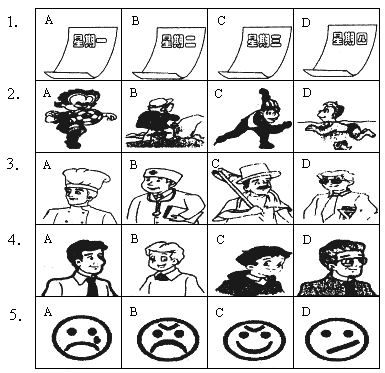
一、每小题你将听到一段对话,然后从A、B、C、D四幅图中找出与你所听内容相符的选项。(每题听一遍)
二、根据所听对话及问题,选择正确答案。(每题听两遍)
6.
[ ]
|
A.16. |
B.15. |
|
C.60. |
D.61. |
7.
[ ]
|
A.Beethoven. |
B.Mark Twain. |
|
C.Thomas Edison. |
D.Jacques Cousteau. |
8.
[ ]
|
A.By train. |
B.By boat. |
|
C.By plane. |
D.By bus. |
9.
[ ]
|
A.4:20. |
B.4:00. |
|
C.4:40. |
D.4:30. |
10.
[ ]
A.She didn't want to lend her eraser.
B.She hasn't got an eraser.
C.She didn't hear him clearly.
D.She felt sorry for the man.
三、根据所听句子,从A、B、C、D四个选项中选出一个意思与其相同或相近的句子。(每题听两遍)
11.
[ ]
A.Tom and Jack have already seen the film.
B.Tom hasn't seen the film, but Jack has seen it.
C.Jack hasn't seen the film, but Tom has seen it.
D.Neither Tom nor Jack has seen the film.
12.
[ ]
A.There is nothing in the box.
B.There are a few books in the box.
C.There is a box in the house.
D.There is little water in the bottle.
13.
[ ]
A.The girl isn't ill and she can go to school.
B.The girl will go to work in a week.
C.The girl is too weak to go to school.
D.The girl is strong enough to go to school.
14.
[ ]
A.Jim could eat up all the fruits.
B.Jim could eat only some of the fruits.
C.Jim didn't like the fruits at all.
D.Jim didn't feel like eating the fruits.
15.
[ ]
A.It took him thirty minutes to buy this pair of shoes.
B.He paid thirty yuan for the trousers.
C.This pair of shoes cost him thirty yuan.
D.He wanted to buy this pair of shoes, but he had only thirty yuan.
四、根据所听到的短文,判断句子是否与短文内容相符。(短文听两遍)
16.A guide is talking to the tourists.
( )
17.The tourists are on the way to London.
( )
18.People in London don't like to help foreign tourists.
( )
19.People working there often have a lot of time visiting the museum.
( )
20.There are many parks and gardens in the city.
( )
听力部分
A)找出你所听到的字词。(5分)
1.
A.Uu
B.Qq
C.Ww
D.Vv
2.
A.cap
B.eraser
C.Dale
D.name
3.
A.evening
B.Ben
C.desk
D.Peter
4.
A.book
B.Dale
C.good
D.Ben
5.
A.desk
B.map
C.pencil
D.case
B)情景反映,根据所听到的句子选择正确答语补全对话。(15分)
6.
A.Good morning, Ben
B.Good afternoon, Alice
C.Good evening, Dale
D.Good night, Gina.
7.
A.Hello
B.Nice to meet you
C.Good morning
D.Who are you?
8.
A.I am James
B.That's a ball
C.It's an egg.
D.This is an egg.
9.
A.It's my father
B.It's a bike
C.It's John.
D.It's his bike.
10.
A.It's black
B.It's a black
C.They are black
D.They are black chairs.
11.
A.5123456
B.5553456
C.5523456
D.5223456
12.
A.Yes, it is.
B.No, it isn't.
C.It's a notebook
D.It's my notebook.
13.
A.Yes, he does
B.No, he doesn't.
C.He doesn't like basketball
D.He likes basketball.
14.
A.She has 13 volleyballs
B.She has 12 basketballs.
C.She has 25 balls
D.She has 14 basketballs.
15.
A.$4
B.$5
C.$10
D.$9
D)听写,听短文,填入所缺单词。(5分)
1.Good morning, Miss Wang! Good morning.Nice to 16 you.
2.UVWXYZ, happy, happy we shall be when we 17 to our ABC.
3.Kangkang is from 18 .
4.Please give this 19 to Maria in Class 2, Grade 1.I'm sorry.I don't know her.What does she look 20 ?
根据汉语提示,完成下面的英语短文
早晨我通常六点钟起床,六点半吃早饭,七点半乘十七路车去上学。我在学校里吃午饭,下午六点回家。七点做作业,九点左右我洗个澡就上床睡觉了。?
I usually 1 2 at six in the morning. I 3 4 at six thirty. At 5 6 seven I take the No.17 bus to 7 8 9 .I eat lunch 10 11 .At six 12 13 ? 14 I go home. At about seven, I 15 16 17 .At about nine o'clock I take a shower, then 18 19 20 quickly.
听力部分(共20分)
Ⅰ.听句子,从题中所给的三个选项中选择最恰当的答语。每个句子读两遍.(1×5=5分)
1.
A.It was great.
B.I'm very happy.
C.That is OK.
2.
A.No, he isn't.
B.No, he didn't.
C.Yes, he does.
3.
A.Yes, I did.
B.Yes, I do.
C.Yes, it is.
4.
A.Do homework.
B.On Sunday.
C.Playing tennis.
8.
A.I'm watching cartoons.
B.I did some shopping.
C.It was a lovely day.
Ⅱ.听对话,每段对话后有一个小题,从题中所给的图片中选择与对话内容相符的图片.每段对话读两遍。(1×5=5分)
6.
A.
B.
C.
7.
A.
B.
C.
8.
A.
B.
C.
9.
A.
B.
C.
10.
A.
B.
C.
Ⅲ.听对话,从题中所给的ABC三个选项中选择最佳选项。每段对话读两遍。(1×5=5分)
听下面一段对话,回答第11小题。
11.What did Jane do in London?
A.She visited the Big Ben.
B.She visited Mr.Smith.
C.She visited Mrs.Smith.
听下面一段对话,回答第12小题。
12.What did the girl's father buy on her last birthday?
A.Some CDs.
B.Some boots.
C.Some books.
听下面一段对话,回答第13小题。
13.What are they talking about?
A.Geography.
B.Math.
C.Activity
听下面一段对话,回答第14~15小题。
14.What is the weather like today?
A.It's windy.
B.It's rainy.
C.It's nice.
15.Who did Gina go to the beach with?
A.Her uncle.
B.Her cousin.
C.Her friends.
Ⅳ.听独白,根据所听内容补全段落, 所填入的可以是单词或短语..独白读两遍。(1×5=5分)
My name is Rose.Last Sunday was my 16 .I had a great party at home.Many of my friends came to say “Happy birthday”.I was so happy.My mother made some 17 for us.My friends and I made some soup.After lunch, we 18 together.Mike 19 .In the afternoon, I cleaned the house.I 20 had a busy but happy day.
湖北省互联网违法和不良信息举报平台 | 网上有害信息举报专区 | 电信诈骗举报专区 | 涉历史虚无主义有害信息举报专区 | 涉企侵权举报专区
违法和不良信息举报电话:027-86699610 举报邮箱:58377363@163.com