
题目列表(包括答案和解析)
A greeting is a way of saying "Hello" to someone. People in different countries greet each other in different ways. Here are some.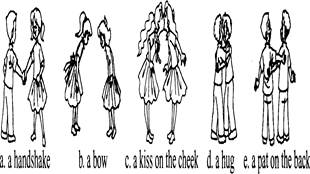
World Greetings
| Philippine | The everyday greeting for friends is a handshake for both men and women. Men sometimes pat each other on the back. |
| Japan | When people meet for the first time, they usually bow. In business, people also shake hands. In formal situations, people often exchange business cards. When you give a business card, give it with two hands. This is polite. Special note: In Japan, a smile can have different meanings. It usually means that the person is happy, or that the person thinks something is funny. But it can also mean that the person is embarrassed. |
| New Zealand | Usually, both men and women shake hands when they meet someone for the first time. Fun fact: If you see two people pressing their noses together, they are probably Maori. The Maori are the native people of New Zealand. This is their traditional greeting. |
| Brazil | Men often shake hands when they meet for the first time. When women meet, they kiss each other on the cheek. Women also kiss male friends to say hello. When you shake hands, look at the person in the eyes. This shows interest and friendliness. |
| A.Kisses. | B.Hugs. | C.Bows. | D.Handshakes. |
| A.a | B.b | C.c | D.d |
| A.Both men and women shake hands in Brazil when they meet. |
| B.Japanese won't smile until they feel very happy. |
| C.The Maori often press their noses together to greet each other. |
| D.In Philippine, people shake hands only when they meet for the first time. |
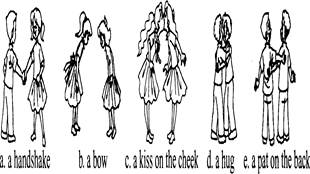
A greeting is a way of saying "Hello" to someone. People in different countries greet each other in different ways. Here are some.
World Greetings
|
Philippine |
The everyday greeting for friends is a handshake for both men and women. Men sometimes pat each other on the back. |
|
Japan |
When people meet for the first time, they usually bow. In business, people also shake hands. In formal situations, people often exchange business cards. When you give a business card, give it with two hands. This is polite. Special note: In Japan, a smile can have different meanings. It usually means that the person is happy, or that the person thinks something is funny. But it can also mean that the person is embarrassed. |
|
New Zealand |
Usually, both men and women shake hands when they meet someone for the first time. Fun fact: If you see two people pressing their noses together, they are probably Maori. The Maori are the native people of New Zealand. This is their traditional greeting. |
|
Brazil |
Men often shake hands when they meet for the first time. When women meet, they kiss each other on the cheek. Women also kiss male friends to say hello. When you shake hands, look at the person in the eyes. This shows interest and friendliness. |
1.In this passage, which of the following is NOT mentioned?
A.Kisses. B.Hugs. C.Bows. D.Handshakes.
2.Of the five pictures above (a, b, c, d and e), which is the same way to greet each other in the four countries?
A.a B.b C.c D.d
3.Which of the following is TRUE according to the passage?
A.Both men and women shake hands in Brazil when they meet.
B.Japanese won't smile until they feel very happy.
C.The Maori often press their noses together to greet each other.
D.In Philippine, people shake hands only when they meet for the first time.
A little boy invited his mother to attend his school’s first teacher-parent meeting. To the little boy’s dismay (沮丧), his mother said she would go. This would be the first time that his classmates and teachers met his mother and he was embarrassed by her appearance(出现). There was a severe (严重的) scar (伤疤) that covered nearly the whole right side of her face. The boy never wanted to talk about why or how she got the scar.
At the meeting, the people were impressed by the kindness of his mother with the scar, but the little boy was still embarrassed and hid himself from everyone. However, he could hear clearly the conversation between his mother and the teacher.
“How did you get the scar on your face?” the teacher asked.
The mother replied, “When my son was a baby, he was in a room that caught on fire. Everyone was too afraid to go in because the fire was out of control, but I went in. As I was running towards his bed, I saw a burning wood falling down and I placed myself over him trying to protect him. I was knocked to be unconscious (无知觉的), but luckily, a fireman came in and saved both of us.” She touched the burned side of her face. “This scar will be forever, but until today, I have never regretted doing what I did.”
When the little boy heard this, he couldn’t help running towards his mother with tears in his eyes. He hugged her and felt his mother was greater than anyone. He held her hand tightly for the rest of the day.
【小题1】The underline world “embarrassed” means ______ in Chinese.
| A.焦虑的 | B.尴尬的 |
| C.悲伤的 | D.悔恨的 |
| A.beautiful | B.ugly |
| C.kind | D.ugly but kind |
| A.wasn’t moved by what her mother said |
| B.didn’t ask his mother to attend the meeting |
| C.wanted his mother to attend the meeting at first |
| D.didn’t really want his mother to attend the meeting at first |
| A.moved | B.unhappy |
| C.worried | D.dismay |
| A.The boy’s mother was brave but foolish |
| B.The boy hated what his mother had done |
| C.We should love our parents whatever they are like |
| D.The people at the meeting didn’t like the boy’s mother |
| A.To prevent the students’ road accidents |
| B.To relieve the traffic pressure |
| C.To save time for the parents and students |
| D.To help the parents save money |
| A.By letting the bus run in the morning only. |
| B.By limiting the number of the students |
| C.By getting the support from the headmaster |
| D.By linking the new bus service with the existing one |
| A.The bus company will make much more money |
| B.The children can choose whatever school they like |
| C.The parents can get rid of their worries |
| D.The students in Impington School can have free bus rides |
| A.a personal letter. | B.an advertisemen |
| C.headmaster’s report. | D.a newspaper article |
| A.焦虑的 | B.尴尬的 |
| C.悲伤的 | D.悔恨的 |
| A.beautiful | B.ugly |
| C.kind | D.ugly but kind |
| A.wasn’t moved by what her mother said |
| B.didn’t ask his mother to attend the meeting |
| C.wanted his mother to attend the meeting at first |
| D.didn’t really want his mother to attend the meeting at first |
| A.moved | B.unhappy |
| C.worried | D.dismay |
| A.The boy’s mother was brave but foolish |
| B.The boy hated what his mother had done |
| C.We should love our parents whatever they are like |
| D.The people at the meeting didn’t like the boy’s mother |
湖北省互联网违法和不良信息举报平台 | 网上有害信息举报专区 | 电信诈骗举报专区 | 涉历史虚无主义有害信息举报专区 | 涉企侵权举报专区
违法和不良信息举报电话:027-86699610 举报邮箱:58377363@163.com