
题目列表(包括答案和解析)
| |||||||||||||||||||||||||||||||||||||||||||||||||||||||||||||||||||||||||
A sign is another kind of language. Here are some of them that you see on the roads.
Number One is a sign with the number thirty on it. Whendrivers see this sign, they must not go at more than thirty kilometres one hour. We see this sign when we are getting near a town.Number Two is a sign that we're near a crossing. We must drive carefully. Number Three is a sign that there is a bend on the road. Again, we must drive slowly and carefully. It is not safe to go round a bend very fast. Number Four is a sign that there is another road coming in from the right. There is a junction (交叉点) at this place. Number Five is a sign that there is a hill and Number Six is a sign that the road gets narrow. Drivers must go slowly and carefully. Number Seven has the word “SCHOOL” on it. This is a sign that there is a school at the side of the street or the road. Perhaps there are children going to or leaving school. So drivers must look carefully and go slowly. Number Eight is a sign with the letter “P” on it. The letter “P” means “Parking”. At some places, there are the signs “NO PARKING” or “NO WAITING”. If a driver leaves his car near one of these signs, a policeman may come and write down the number of his car.
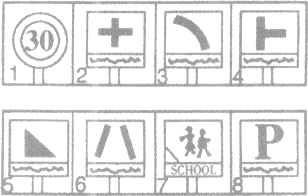
(1) At the places where you see Sign 1, ________.
[ ]
A.you are already out of the town
B.you still have thirty kilometres to go
C.there must be a town thirty kilometres away
D.there must be many houses and buildings not far away
(2) There stands Sign 2 near a place where ________.
[ ]
A.two roads cross
B.people can cross the road
C.the road gets narrow
D.there are no traffic lights
(3) You have to drive not only slowly but also carefully when you find ________.
[ ]
A.each of the eight signs
B.either of signs 2 and 3
C.all of signs 3, 6 and 7
D.any of signs 3, 6, 7 and 8
(4) A driver can leave his car ________.
[ ]
A.near Sign 8 at any time
B.near a sign with “NO PARKING” on it
C.near a sign with “NO WAITING” if there're no police there
D.near a sign with “P” on it in the daytime
(5) People put these signs on the roads to ________.
[ ]
A.show drivers the way
B.stop cars going too fast
C.make driving even safer
D.learn another kind of language
When I was a child, my mother often told me, “Don’t run around, or bad uncles will grad(抓住) you. And you know what? You will never see Mum and Dad again.”
“Why, Mama? Why would these uncles grab me?” I would ask. “The city is a dangerous place and we don’t trust any strangers, ”she would reply.
Well, that might answer the question of why my second brother never picks up calls from an unknown person either on his mobile or his home phone. It seems that he doesn’t care if he misses an important call. because he thinks that all unknown calls are from bad persons.
So, have we given too much protection to our young kids? Perhaps it is so. But the adults’ thoughts are indeed easy to understand. The kids meet swindlers sometimes as we adults tell them. Also they get some news about cheating(欺骗) in newspapers or on TV every day. That makes the kids believe that they just cannot trust strangers.
Let’s look at an example from everyday life. Say, if someone carrying a wooden stick(棍子) comes nearer to you, will you try to run away at once even before he or she starts talking to you? Will you guess this person’s intentions(意图) and think that he or she wants to rob(抢劫) you of something? Think of the answer for yourself.
Of course, the kids should look after themselves, but overprotection can sometimes stop them from making new friends. Sometimes it’s not good for their new friendships.
Trust is like a mirror. When we offer trust to people, they might just show you trust in return.
1 What do “swindlers” probably do?
A. They cheat other people.
B. They often call other people.
C. They rob people of something.
D. They teach children to protect themselves.
2 Which of the following is NOT the reason why children don’t trust strangers?
A. Their parents tell them not to trust strangers.
B. They get to know some news about cheating in newspapers or on TV every day.
C. Strangers always have bad intentions.
D. They sometimes have experiences of being cheated.
3 What does the writer want to tell us?
A. Children should always follow their parents’ advice.
B. We should never talk to strangers.
C. Parents should learn to protect their children.
D. People should try to  trust each other.
?I'm very glad to see you again.
?________ !
A. I, also
B. I, too
C. Me, either
D. Me, too
完形填空
Mike was a small boy. He didn't like water. When(当…时) his mother asked him 1 his hand, he never washed them 2. He only put his hands in the water for 3 seconds (秒) and took them 4 again. Mike's aunt and uncle lived in another city. 5 day they came to stay with Mike's parents and they brought (bring过去式) their small son, Ted, 6 them. Ted was a year 7 than Mike, and didn't like water, 8. The two boys went out to play. After an hour, Mike looked at Ted's hands and then said proudly (骄傲地). "My hands are dirtier (脏) than yours!" "9 course, they are." Ted answered angrily' (生气地), "You are one year older than I 10."
1.[ ]
A. washing B. to wash C. washed D. wash2.
[ ]
A. good B. white C. nice D. clean3.
[ ]
A. few B. little C. bit D. one4.
[ ]
A. up B. away C. out D. off5.
[ ]
A. One B. On one C. A D. On a6.
[ ]
A. with B. on C. for D. without7.
[ ]
A. elder B. younger C. smaller D. bigger8.
[ ]
A. also B. too C. same D. either9.
[ ]
A. Off B. TO C. In D. Of10.
[ ]
A. am B. a are C. be D. do湖北省互联网违法和不良信息举报平台 | 网上有害信息举报专区 | 电信诈骗举报专区 | 涉历史虚无主义有害信息举报专区 | 涉企侵权举报专区
违法和不良信息举报电话:027-86699610 举报邮箱:58377363@163.com