
题目列表(包括答案和解析)
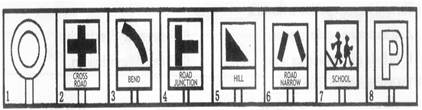
A sign is another kind of language. Here are some of them that you see on the roads.
Number One is a sign with the number thirty on it. When drivers see this sign, they must not go at more than thirty kilometers an hour. We see this sign when we are getting near a town. Number Two is a sign that we’re near a crossing. We must drive carefully. Number Three is a sign that there is a bend (拐弯) in the road. Again, we must drive slowly and carefully. It is not safe to go around a bend very fast. Number Four is a sign that there is another road coming in from the right. There is a junction (交叉) at this place. Number Five is a sign that there is a hill and Number Six is a sign that the road gets narrow. Drivers must go slowly and carefully. Number Seven has the word “SCHOOL” on it. This is a sign that there is a school at the side of the street or the road. Perhaps there are children going to or leaving school. So drivers must look carefully and go slowly. Number Eight is a sign with the letter “P” on it. The letter “P” means “Parking”. At some places, there are the signs “No parking” or “No waiting”. If a driver leaves his car near one of these signs, a policeman may come and write down the number of his car.
1.At the places where you see Sign 1, ____________. .
A.you are already out of a town
B.you still have thirty kilometers to go
C.there must be many houses and building not far away
D.there must be a town thirty kilometers away
2.A driver can leave his car ___________.
A.near a sign with “P” on it in the daytime
B.near a sign with “No parking” on it
C.near a sign with “No waiting” if there’re no policemen there
D.near Sign 8 at any time
3.People put these signs on the roads to ____________.
A.make driving even safer B.show drivers the way
C.stop cars going too fast D.learn another kind of language
— I think the man over there must be Bob.
— It _______ be him. He has gone to England.
A. can’t B. mustn’t C. couldn’t D. shouldn’t
Have you ever been ill? When you are ill, you must be unhappy because your body becomes hot, and there are pains all over your body. You don’t want to work, and you stay in bed, feeling very sad.What makes us ill? It is germs(细菌) .
Germs are everywhere. They are very small and you can’t find them with your eyes, but you can see them with a microscope. They are very very small and there could be hundreds of them on a very small thing. Germs are always found in dirty water. When we look at dirty water under the microscope, we shall see them in it. So your parents will not let you drink dirty water. Germs aren’t found only in water. They are found in air and dust.If you cut your finger, if some of the dust from the floor goes into the cut. some of the germs
would go into your finger. Your finger would become big and red, and you will have much pain in it. Sometimes the germs would go into all of your body, and you would have pain everywhere.
1.Which of the following is true?
A. If things are very very small, they are germs.
B. If things can‟ t be seen, they must be germs.
C. Germs are only in dirty water.
D. Germs are everywhere around us.
2.What is a microscope used for?
A. Making very very small things look much bigger.
B. Making very big things look much smaller.
C. Helping you read some newspapers.
D. Helping you if you can‟t see things clearly.
3.Why don’t your parents let you drink dirty water?
A. You haven’t looked at it carefully. B. Water can’t be drunk in this way.
C. There must be lots of germs in it. D. Water will make you ill.
4.Which of the following is not true?
A Germs can be found both in water and in the air.
B. Germs can go into your finger if it is cut.
C. If your temperature is not OK, there must be germs in your body.
D. If your finger isn’t cut, there aren’t any germs on it.
5.What’s the main idea of the passage?
A .Germs may make us ill. B, Germs are in dirty water.
C. Don’t drink dirty water. D. Take care of your fingers.
Many people say that they are working too many hours. They don’t have enough time to relax or to stay with their family.
Work hours are different from one country to another. In France, people spend about 1,646 hours a year at work. In Japan, however, people work about 2,159 hours a year. That means a Japanese worker works 513 more hours a year than a French worker.
Why do people work so many hours? Some people work extra hours because they want to make more money. However, many companies don’t pay overtime. Their workers don’t get more pay for more work. Some people think it’s their duty to work more hours. Some are afraid of losing their jobs if they don’t work more hours.
Many people say that their vacations are too short. In France, people get five weeks of paid vacation a year. In Germany, they get four to six weeks, and in the United States, two weeks. One study shows fewer than half of workers used all their vacation days. In Great Britain, there is a saying, “All work and no play makes Jack a dull boy.” If that is true, there must be a lot of dull people in the world.
1.A Japanese worker works __________ more hours a year than a French one.
A. 513 B. 1,646 C. 2,159 D. 3,805
2.The word “overtime” in Paragraph 3 means _____________.
A. 税费 B. 加班费 C. 学费 D. 冷饮费
3.People in ________ get only two weeks of paid vacation a year.
A. France B. Germany C. the United States D. Great Britain
4.Which of the following is true according to the passage?
A. No companies offer vacations to their workers.
B. Many people say they have enough time to relax.
C. Not all companies pay their workers for more work.
D. More than half of workers use all their vacation days.
5.What can we infer(推断) from the passage?
A. Many workers have to work long hours.
B. Many people have vacations long enough.
C. Work hours are the same around the world.
D. There are a lot of dull people in the world
It was very late at night. An old man came to a small town. He found an inn (小旅馆) and Wanted to slay there for the night. After he went to his room, the owner said to his 41 ."Look at his bag. There must be much money in it. Let's take it away when he's 42 , shall we? '
"Oh, no," said the woman. "He must 43 his bag when he wakes up tomorrow morning. If he can't find it, he'll telephone the police."
They thought for a few minutes. Then the woman had an 44 . "We have forgetful grass. Why not put some forgetful grass into his food? If he 45 the food, he will forget lo take his bag away."
The old man ate the food 46 the forgetful grass and went to bed. The next morning when the owner got up, he found the door 47 and the old man had gone away with his bag. He woke his wife up and said to her angrily, "How foolish you are! Your forgetful grass isn't 48 at all."
"No, I don't think so. He must forget_49__," his wife said.
"Oh! I remember now! He forgot to 50 for the night," cried out the man suddenly. Then they looked at each other without saying a word.
1.A. sister B. friend C. aunt D. wife
2. A. asleep B. awake C. alive D. alone
3.A. set off B. give up C. look for D. take off
4.A. idea B. advice C. instruction D. excuse
5. A. eats B. receives C. likes D. refuses
6.A. onto B. for C. with D. into
7. A. open B. opens C. opening D. lo open
8.A. interesting B. important C. delicious D. useful
9.A. anything B. nothing C. something D. everything
10.A. spend B. cost C. take D. pay
湖北省互联网违法和不良信息举报平台 | 网上有害信息举报专区 | 电信诈骗举报专区 | 涉历史虚无主义有害信息举报专区 | 涉企侵权举报专区
违法和不良信息举报电话:027-86699610 举报邮箱:58377363@163.com