
题目列表(包括答案和解析)
| 阅读理解。 |
| Foreign visitors are often puzzled in Japan because most streets there don't havenames. In Japan, people use landmarks instead of street names. For example, the Japanese will say to travelers," Go straight down to the corner. Turn left at the big hotel and go past a fruit market. The post office is just across the bus stop. " In the Midwest of America, usually there are not many landmarks. There are no mountains. So the land is very flat. In many places there are no towns or buildings within miles. Instead of landmarks, people will tell you directions and distance. In Kansas (堪萨斯州) , for example, people will say, "Go north two miles. Turn east, and then go another mile. " People in Los Angeles, California, have no idea of distance on the map. They measure (测量) distance by telling time. "How far away is the post office?" you ask. "60h," they answer, "it's about five minutes from here, "You say, "Yes, but how many miles away is it?" They don't know. People in Greece sometimes do not even try to give directions because few visitors understand the Greek language. Instead of giving you the direction, a Greek will often say, "Follow me."Then he'll lead you through the streets of the city to the post office. Sometimes a person doesn't know the answer to your question. A New Yorker might say, "Sorry, I have no idea." But in Yucatan, Mexico (墨西哥), no one answers "I don't know. " People in Yucatan think "I don't know" is not polite. They usually give an answer, often a wrong one. A visitor can get very, very lost in Yucatan! One thing will help you everywhere. You might not understand a person's words, but maybe you can understand his body language. He or she will usually turn and then point in the correct direction. Go on in that direction and you may find the post office! |
| 1. What does the word "landmarks" mean? |
| A. Street names. B. Building names. C. Hotels,markets and bus stops. D. Buildings or places which are easily seen. |
| 2. 根据短文内容和句意,填入一个适当的单词。 |
| People in _____ prefer to tell you directions and distance if you ask for the way. |
| 3. 把下面的句子译成汉语。 |
| People in Greece (希腊)sometimes do not even try to give directions because few visitors understand the Greek language. _____________________________________________________________________________ |
| 4. 通过短文内容回答问题。 |
| Why don't people in Yucatan say,"I don't know" to a person who asks for the way? _____________________________________________________________________________ |
| 5. 通过短文内容回答问题。 |
| What does the passage mainly tell us? _____________________________________________________________________________ |
| 根据短文内容,从下面方框中选择适当的单词或词组填空。 | |
the most suitable for the post. We had a class meeting yesterday afternoon. We all consider that David is 2. the post. He is very confident and he thinks he can do anything if he does his best. He is never afraid of 3. in front of the whole school. He is a helpful student and he often helps people in need. He never minds 4. other students. Besides, he has a good memory and he is 5. . He won't forget to do things he needs to do. We all think that David has all the qualities to be a good chairperson. |
听力
一、听对话,选择与对话内容相符的图片。每段对话读两遍。(共4分,每小题1分)
请听第一段对话,完成第1小题。
1.

请听第二段对话,完成第2小题。
2.

请听第三段对话,完成第3小题。
3.

请听第四段对话,完成第4小题。
4.

二、听对话,根据其内容,从下列各题所给的A、B、C三个选项中,选择最佳选项。每段对话读两遍。(共14分,每小题1分)
请听第一段对话,回答第5小题。
5.What does the man want?
A.Some flowers.
B.Some bananas.
C.Some books.
请听第二段对话,回答第6小题。
6.Where does the woman want to go?
A.The school.
B.The post office.
C.The library.
请听第三段对话,回答第7小题。
7.How is the weather?
A.Fine.
B.Hot.
C.Cold.
请听第四段对话,回答第8小题。
8.Who is answering the telephone call?
A.Bill.
B.Mike.
C.Kate.
请听第五段对话,回答第9~10小题。
9.Why does the man just ask for a piece of apple pie?
A.He’s in a hurry.
B.He doesn’t eat much.
C.He doesn’t have enough money.
10.How much will he pay?
A.$4.99.
B.$5.99.
C.$3.98.
请听第六段对话,回答第11~12小题。
11.What is the woman doing on the 13th?
A.Having a meeting.
B.Seeing her doctor.
C.Visiting her friend Ruth.
12.When are they going to meet?
A.On the fourteenth.
B.On the fifteenth.
C.On the sixteenth.
请听第七段对话,回答第13~15小题。
13.What does the man think of Kathy’s room?
A.Large.
B.Simple.
C.Pleasant.
14.What does Peter want for a drink?
A.Apple juice.
B.Orange juice.
C.Ice water.
15.Where were the photos taken?
A.In the CD shop.
B.In China.
C.In Kathy’s room.
请听第八段对话,回答第16~18小题。
16.Which is true about Robert and Betty?
A.They are classmates.
B.They work together.
C.They first met.
17.Why are they here?
A.To find a teacher.
B.To learn art.
C.To find a room.
18.What can you learn about the man from the conversation?
A.He is humorous and popular.
B.He is friendly and helpful.
C.He is polite and happy.
三、听独白、记录信息。(共8分,每小题2分)

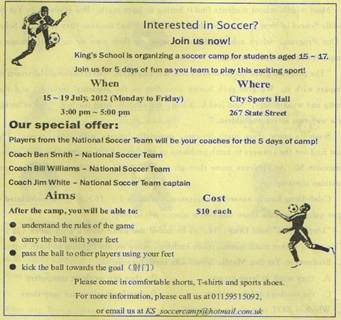
【小题1】The camp is for the children who________.
| A.are good at soccer | B.are 15~17 years old |
| C.come form King's School | D.want to relax in camp |
| A.July 15 | B.July 19 | C.Sunday | D.Friday |
| A.$ 5 | B.$6 | C.$7 | D.$ 10 |
| A.carrying the football | B.kicking a goal |
| C.passing the football | D.making game rules |
| A.The camp lasts for 5 days. |
| B.The camp doesn't cost much. |
| C.The camp is organized by King's School. |
| D.The coaches will be national soccer players. |
Mr Bean, who is silly, awkward (笨拙的) 1 always funny and enjoyable, is a world-famous comedy character on TV and in movies. He makes people 2 through a series of simple and funny acts 3 body languages. Rowan Atkinson is the 4 who plays Mr Bean. Mr Atkinson is quite 5 for playing Mr Bean.
Rowan was born on January 6, 1955, and 6 his early years on the family farm with his mother, three older brothers and his strict father, who did not believe 7 the value of television. For a time, he attended the same school as Tony Blair, who was two years older than him. At the age of 13, he 8 at Newcastle University where he had the highest marks in his year. At Oxford he got his Master’s degree (硕士学位) in electrical engineering. He was particularly 9 fast cars, of which he has a large collection.
Rowan’s career change from an electrical engineer to a famous comedian was partly 10 some speaking problems he had in his childhood.
While he was still at primary school, Rowan had already shown great talent in 11 . Although his teachers predicted (预言) a career in acting, Rowan was not confident 12 he met a group of talented people at university, and he realized this could be a career for him. Another important event 13 . One day in 1976, he was playing around and making faces 14 . He realized something. “I discovered my face,” he said later. John Lloyd, who worked for the BBC, says, “When I watched Mr Atkinson act for the first time, I was 15 that he would be more famous than Chaplin.”
| 【小题1】 |
|
| 【小题2】 |
|
| 【小题3】 |
|
| 【小题4】 |
|
| 【小题5】 |
|
| 【小题6】 |
|
| 【小题7】 |
|
| 【小题8】 |
|
| 【小题9】 |
|
| 【小题10】 |
|
| 【小题11】 |
|
| 【小题12】 |
|
| 【小题13】 |
|
| 【小题14】 |
|
| 【小题15】 |
|
湖北省互联网违法和不良信息举报平台 | 网上有害信息举报专区 | 电信诈骗举报专区 | 涉历史虚无主义有害信息举报专区 | 涉企侵权举报专区
违法和不良信息举报电话:027-86699610 举报邮箱:58377363@163.com